

150
A. Cruzado et al.
all the slip systems β in the crystal according to Eq. 14. The self-hardening rule
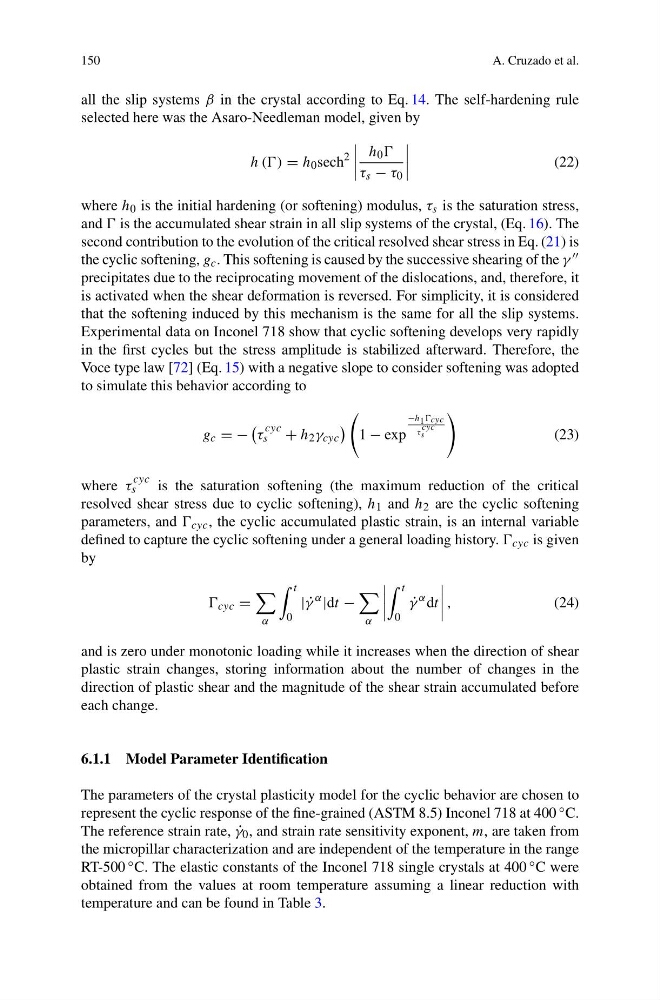
selected here was the Asaro-Needleman model, given by
h () = h 0 sech
2
h 0
τ s − τ 0
(22)
where h 0 is the initial hardening (or softening) modulus, τ s is the saturation stress,
and is the accumulated shear strain in all slip systems of the crystal, (Eq. 16). The
second contribution to the evolution of the critical resolved shear stress in Eq. (21) is
the cyclic softening, g c . This softening is caused by the successive shearing of the γ
precipitates due to the reciprocating movement of the dislocations, and, therefore, it
is activated when the shear deformation is reversed. For simplicity, it is considered
that the softening induced by this mechanism is the same for all the slip systems.
Experimental data on Inconel 718 show that cyclic softening develops very rapidly
in the first cycles but the stress amplitude is stabilized afterward. Therefore, the
Voce type law [72] (Eq. 15) with a negative slope to consider softening was adopted
to simulate this behavior according to
g c = −
τ
cyc
s
+ h 2 γ cyc
1 − exp
−h 1 cyc
τ
cyc
s
(23)
where τ
cyc
s
is the saturation softening (the maximum reduction of the critical
resolved shear stress due to cyclic softening), h 1 and h 2 are the cyclic softening
parameters, and cyc , the cyclic accumulated plastic strain, is an internal variable
defined to capture the cyclic softening under a general loading history. cyc is given
by
cyc =
α
t
0
| ˙
γ
α
|dt −
α
t
0
˙
γ
α dt
,
(24)
and is zero under monotonic loading while it increases when the direction of shear
plastic strain changes, storing information about the number of changes in the
direction of plastic shear and the magnitude of the shear strain accumulated before
each change.
6.1.1 Model Parameter Identification
The parameters of the crystal plasticity model for the cyclic behavior are chosen to
represent the cyclic response of the fine-grained (ASTM 8.5) Inconel 718 at 400 ◦ C.
The reference strain rate, ˙
γ 0 , and strain rate sensitivity exponent, m, are taken from
the micropillar characterization and are independent of the temperature in the range
RT-500 ◦ C. The elastic constants of the Inconel 718 single crystals at 400 ◦ C were
obtained from the values at room temperature assuming a linear reduction with
temperature and can be found in Table 3.
A. Cruzado et al.
all the slip systems β in the crystal according to Eq. 14. The self-hardening rule
selected here was the Asaro-Needleman model, given by
h () = h 0 sech
2
h 0
τ s − τ 0
(22)
where h 0 is the initial hardening (or softening) modulus, τ s is the saturation stress,
and is the accumulated shear strain in all slip systems of the crystal, (Eq. 16). The
second contribution to the evolution of the critical resolved shear stress in Eq. (21) is
the cyclic softening, g c . This softening is caused by the successive shearing of the γ
precipitates due to the reciprocating movement of the dislocations, and, therefore, it
is activated when the shear deformation is reversed. For simplicity, it is considered
that the softening induced by this mechanism is the same for all the slip systems.
Experimental data on Inconel 718 show that cyclic softening develops very rapidly
in the first cycles but the stress amplitude is stabilized afterward. Therefore, the
Voce type law [72] (Eq. 15) with a negative slope to consider softening was adopted
to simulate this behavior according to
g c = −
τ
cyc
s
+ h 2 γ cyc
1 − exp
−h 1 cyc
τ
cyc
s
(23)
where τ
cyc
s
is the saturation softening (the maximum reduction of the critical
resolved shear stress due to cyclic softening), h 1 and h 2 are the cyclic softening
parameters, and cyc , the cyclic accumulated plastic strain, is an internal variable
defined to capture the cyclic softening under a general loading history. cyc is given
by
cyc =
α
t
0
| ˙
γ
α
|dt −
α
t
0
˙
γ
α dt
,
(24)
and is zero under monotonic loading while it increases when the direction of shear
plastic strain changes, storing information about the number of changes in the
direction of plastic shear and the magnitude of the shear strain accumulated before
each change.
6.1.1 Model Parameter Identification
The parameters of the crystal plasticity model for the cyclic behavior are chosen to
represent the cyclic response of the fine-grained (ASTM 8.5) Inconel 718 at 400 ◦ C.
The reference strain rate, ˙
γ 0 , and strain rate sensitivity exponent, m, are taken from
the micropillar characterization and are independent of the temperature in the range
RT-500 ◦ C. The elastic constants of the Inconel 718 single crystals at 400 ◦ C were
obtained from the values at room temperature assuming a linear reduction with
temperature and can be found in Table 3.