

148
A. Cruzado et al.
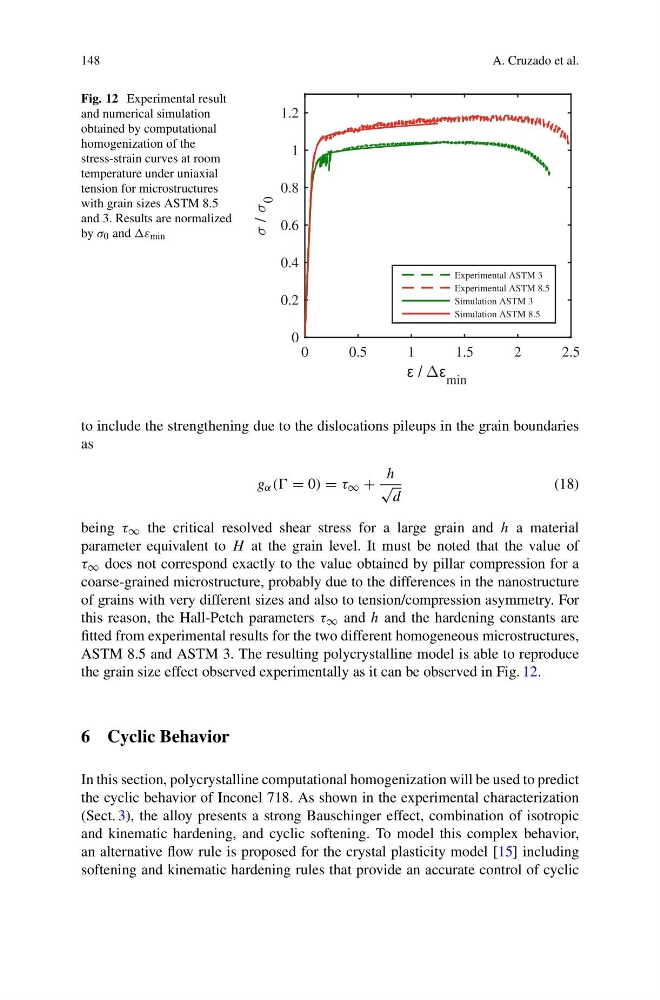
Fig. 12 Experimental result
and numerical simulation
obtained by computational
homogenization of the
stress-strain curves at room
temperature under uniaxial
tension for microstructures
with grain sizes ASTM 8.5
and 3. Results are normalized
by σ 0 and ε min
to include the strengthening due to the dislocations pileups in the grain boundaries
as
g α (( = 0) = τ ∞ +
h
√
d
(18)
being τ ∞ the critical resolved shear stress for a large grain and h a material
parameter equivalent to H at the grain level. It must be noted that the value of
τ ∞ does not correspond exactly to the value obtained by pillar compression for a
coarse-grained microstructure, probably due to the differences in the nanostructure
of grains with very different sizes and also to tension/compression asymmetry. For
this reason, the Hall-Petch parameters τ ∞ and h and the hardening constants are
fitted from experimental results for the two different homogeneous microstructures,
ASTM 8.5 and ASTM 3. The resulting polycrystalline model is able to reproduce
the grain size effect observed experimentally as it can be observed in Fig. 12.
6 Cyclic Behavior
In this section, polycrystalline computational homogenization will be used to predict
the cyclic behavior of Inconel 718. As shown in the experimental characterization
(Sect. 3), the alloy presents a strong Bauschinger effect, combination of isotropic
and kinematic hardening, and cyclic softening. To model this complex behavior,
an alternative flow rule is proposed for the crystal plasticity model [15] including
softening and kinematic hardening rules that provide an accurate control of cyclic
A. Cruzado et al.
Fig. 12 Experimental result
and numerical simulation
obtained by computational
homogenization of the
stress-strain curves at room
temperature under uniaxial
tension for microstructures
with grain sizes ASTM 8.5
and 3. Results are normalized
by σ 0 and ε min
to include the strengthening due to the dislocations pileups in the grain boundaries
as
g α (( = 0) = τ ∞ +
h
√
d
(18)
being τ ∞ the critical resolved shear stress for a large grain and h a material
parameter equivalent to H at the grain level. It must be noted that the value of
τ ∞ does not correspond exactly to the value obtained by pillar compression for a
coarse-grained microstructure, probably due to the differences in the nanostructure
of grains with very different sizes and also to tension/compression asymmetry. For
this reason, the Hall-Petch parameters τ ∞ and h and the hardening constants are
fitted from experimental results for the two different homogeneous microstructures,
ASTM 8.5 and ASTM 3. The resulting polycrystalline model is able to reproduce
the grain size effect observed experimentally as it can be observed in Fig. 12.
6 Cyclic Behavior
In this section, polycrystalline computational homogenization will be used to predict
the cyclic behavior of Inconel 718. As shown in the experimental characterization
(Sect. 3), the alloy presents a strong Bauschinger effect, combination of isotropic
and kinematic hardening, and cyclic softening. To model this complex behavior,
an alternative flow rule is proposed for the crystal plasticity model [15] including
softening and kinematic hardening rules that provide an accurate control of cyclic