

Computational Micromechanics Modeling of Polycrystalline Superalloys. . .
147
The differences in the mechanical response between the four different models
were below 1.3%, that is, an estimation of the error in the prediction of the macroscopic response for a given crystal behavior. The agreement between experimental
behavior and simulation results (Fig. 11) was fairly good: the maximum difference
in the compressive flow stress was below 4%, and the strain hardening rate predicted
was identical to the experimental value. This accurate prediction is remarkable
because no fitting parameters have been used being all the crystal parameters
obtained from tests at lower length scales (with scatter near 5%). An interesting
consequence of this good agreement is that the contribution of the grain boundaries
to the strengthening of the alloy is minimal for this coarse-grained microstructure.
If dislocation pilling up in front of grain boundaries would play a role, the stressstrain curve of the polycrystal predicted using parameters from micropillar (without
grain boundaries) would underestimate the experimental response. The reason of
this negligible effect of grain boundaries is probably the small distance between
precipitates (tens of nanometers) that controls the dislocation arrangement within
the microstructure, minimizing the effect of grain boundaries for this grain size.
The computational homogenization approach presented, based on obtaining all
the crystal properties by microtesting, is interesting from the academic viewpoint. However, this strategy implies a very demanding microscopic experimental
campaign limiting its technological application since the resulting macroscopic
models are only valid for the particular temperature in which the material has
been tested and neglect grain boundary effects that might not be negligible for
smaller grain sizes. For this reason, the model is extended using a crystal plasticity
phenomenological formulation that includes the effect of grain size to provide more
general macroscopic predictions.
5.3 Grain Size-Dependent Model
The mechanical behavior of Inconel 718 is mainly controlled by its precipitate sizes
and distances, but grain boundaries also play a role for fine-grained microstructures,
and in this range, Inconel 718 shows a typical grain size effect of the type the smaller
the stronger (Fig. 5). This effect has been classically parameterized using Hall-Petch
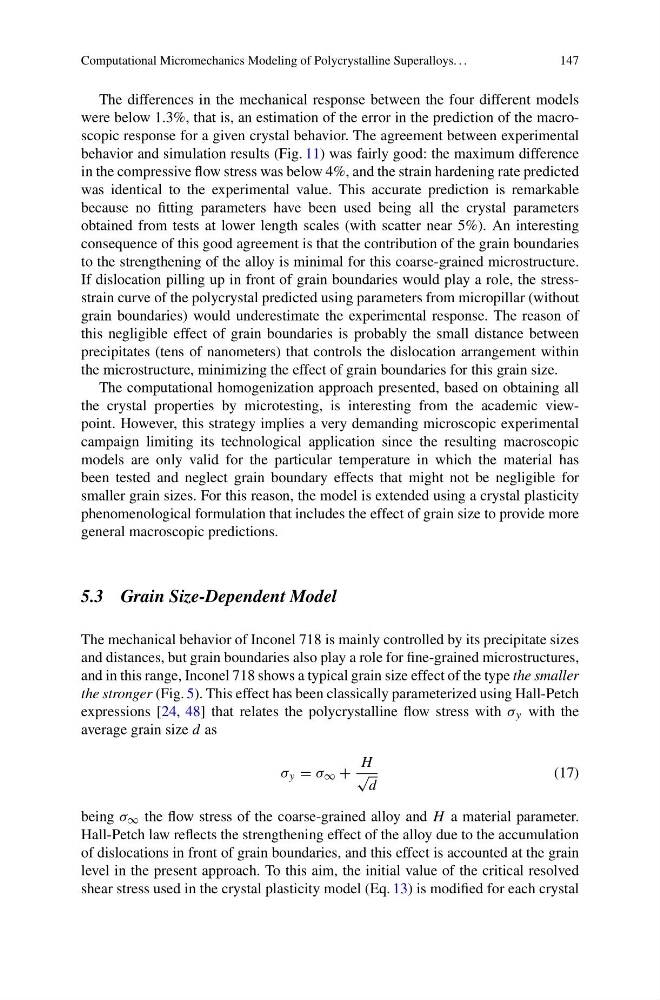
expressions [24, 48] that relates the polycrystalline flow stress with σ y with the
average grain size d as
σ y = σ ∞ +
H
√
d
(17)
being σ ∞ the flow stress of the coarse-grained alloy and H a material parameter.
Hall-Petch law reflects the strengthening effect of the alloy due to the accumulation
of dislocations in front of grain boundaries, and this effect is accounted at the grain
level in the present approach. To this aim, the initial value of the critical resolved
shear stress used in the crystal plasticity model (Eq. 13) is modified for each crystal
147
The differences in the mechanical response between the four different models
were below 1.3%, that is, an estimation of the error in the prediction of the macroscopic response for a given crystal behavior. The agreement between experimental
behavior and simulation results (Fig. 11) was fairly good: the maximum difference
in the compressive flow stress was below 4%, and the strain hardening rate predicted
was identical to the experimental value. This accurate prediction is remarkable
because no fitting parameters have been used being all the crystal parameters
obtained from tests at lower length scales (with scatter near 5%). An interesting
consequence of this good agreement is that the contribution of the grain boundaries
to the strengthening of the alloy is minimal for this coarse-grained microstructure.
If dislocation pilling up in front of grain boundaries would play a role, the stressstrain curve of the polycrystal predicted using parameters from micropillar (without
grain boundaries) would underestimate the experimental response. The reason of
this negligible effect of grain boundaries is probably the small distance between
precipitates (tens of nanometers) that controls the dislocation arrangement within
the microstructure, minimizing the effect of grain boundaries for this grain size.
The computational homogenization approach presented, based on obtaining all
the crystal properties by microtesting, is interesting from the academic viewpoint. However, this strategy implies a very demanding microscopic experimental
campaign limiting its technological application since the resulting macroscopic
models are only valid for the particular temperature in which the material has
been tested and neglect grain boundary effects that might not be negligible for
smaller grain sizes. For this reason, the model is extended using a crystal plasticity
phenomenological formulation that includes the effect of grain size to provide more
general macroscopic predictions.
5.3 Grain Size-Dependent Model
The mechanical behavior of Inconel 718 is mainly controlled by its precipitate sizes
and distances, but grain boundaries also play a role for fine-grained microstructures,
and in this range, Inconel 718 shows a typical grain size effect of the type the smaller
the stronger (Fig. 5). This effect has been classically parameterized using Hall-Petch
expressions [24, 48] that relates the polycrystalline flow stress with σ y with the
average grain size d as
σ y = σ ∞ +
H
√
d
(17)
being σ ∞ the flow stress of the coarse-grained alloy and H a material parameter.
Hall-Petch law reflects the strengthening effect of the alloy due to the accumulation
of dislocations in front of grain boundaries, and this effect is accounted at the grain
level in the present approach. To this aim, the initial value of the critical resolved
shear stress used in the crystal plasticity model (Eq. 13) is modified for each crystal