

6.3. Applying directed typed embeddings
73
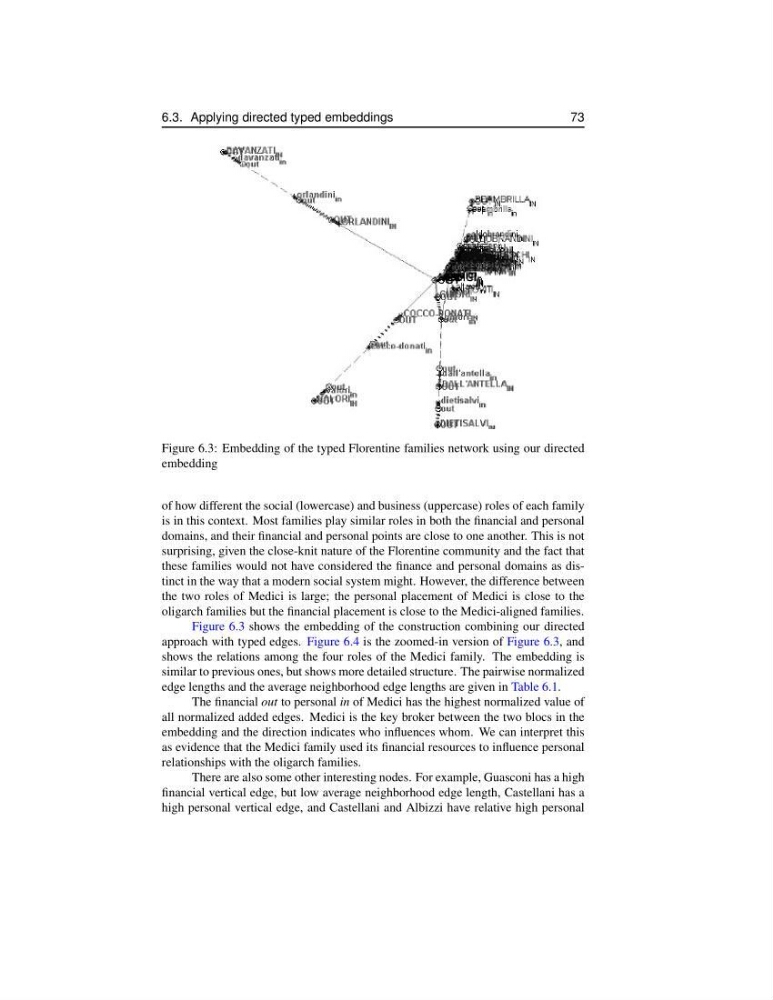
Figure 6.3: Embedding of the typed Florentine families network using our directed
embedding
of how different the social (lowercase) and business (uppercase) roles of each family
is in this context. Most families play similar roles in both the financial and personal
domains, and their financial and personal points are close to one another. This is not
surprising, given the close-knit nature of the Florentine community and the fact that
these families would not have considered the finance and personal domains as distinct in the way that a modern social system might. However, the difference between
the two roles of Medici is large; the personal placement of Medici is close to the
oligarch families but the financial placement is close to the Medici-aligned families.
Figure 6.3 shows the embedding of the construction combining our directed
approach with typed edges. Figure 6.4 is the zoomed-in version of Figure 6.3, and
shows the relations among the four roles of the Medici family. The embedding is
similar to previous ones, but shows more detailed structure. The pairwise normalized
edge lengths and the average neighborhood edge lengths are given in Table 6.1.
The financial out to personal in of Medici has the highest normalized value of
all normalized added edges. Medici is the key broker between the two blocs in the
embedding and the direction indicates who influences whom. We can interpret this
as evidence that the Medici family used its financial resources to influence personal
relationships with the oligarch families.
There are also some other interesting nodes. For example, Guasconi has a high
financial vertical edge, but low average neighborhood edge length, Castellani has a
high personal vertical edge, and Castellani and Albizzi have relative high personal
73
Figure 6.3: Embedding of the typed Florentine families network using our directed
embedding
of how different the social (lowercase) and business (uppercase) roles of each family
is in this context. Most families play similar roles in both the financial and personal
domains, and their financial and personal points are close to one another. This is not
surprising, given the close-knit nature of the Florentine community and the fact that
these families would not have considered the finance and personal domains as distinct in the way that a modern social system might. However, the difference between
the two roles of Medici is large; the personal placement of Medici is close to the
oligarch families but the financial placement is close to the Medici-aligned families.
Figure 6.3 shows the embedding of the construction combining our directed
approach with typed edges. Figure 6.4 is the zoomed-in version of Figure 6.3, and
shows the relations among the four roles of the Medici family. The embedding is
similar to previous ones, but shows more detailed structure. The pairwise normalized
edge lengths and the average neighborhood edge lengths are given in Table 6.1.
The financial out to personal in of Medici has the highest normalized value of
all normalized added edges. Medici is the key broker between the two blocs in the
embedding and the direction indicates who influences whom. We can interpret this
as evidence that the Medici family used its financial resources to influence personal
relationships with the oligarch families.
There are also some other interesting nodes. For example, Guasconi has a high
financial vertical edge, but low average neighborhood edge length, Castellani has a
high personal vertical edge, and Castellani and Albizzi have relative high personal