

74
Chapter 6. Modelling asymmetric relationships with multiple types
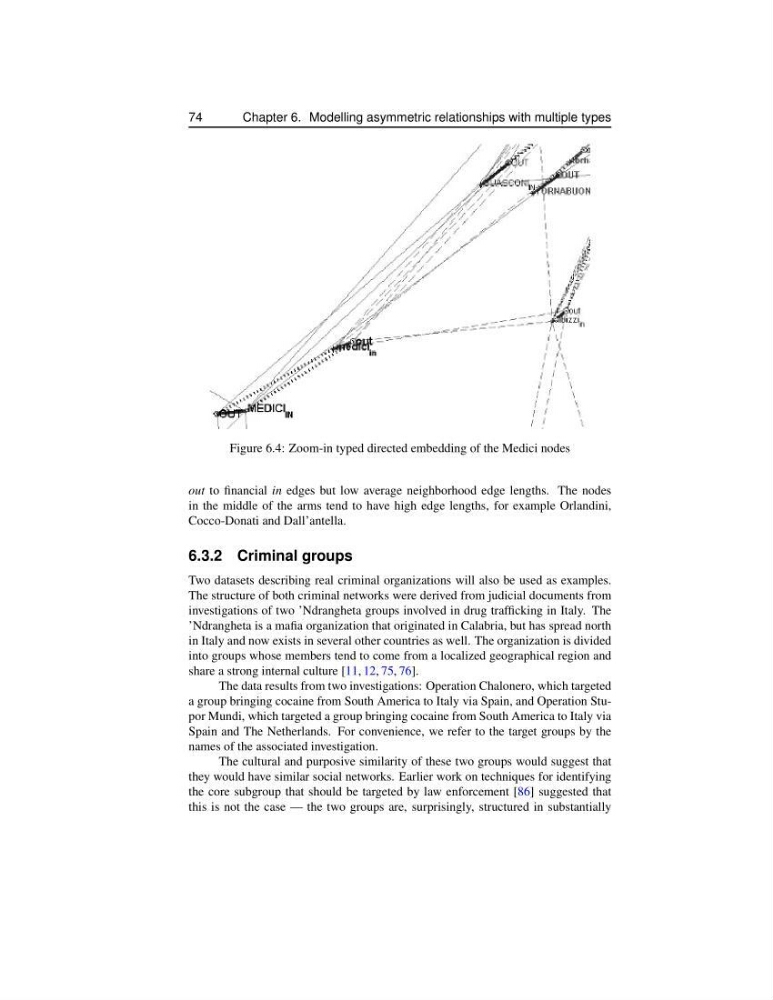
Figure 6.4: Zoom-in typed directed embedding of the Medici nodes
out to financial in edges but low average neighborhood edge lengths. The nodes
in the middle of the arms tend to have high edge lengths, for example Orlandini,
Cocco-Donati and Dall’antella.
6.3.2 Criminal groups
Two datasets describing real criminal organizations will also be used as examples.
The structure of both criminal networks were derived from judicial documents from
investigations of two ’Ndrangheta groups involved in drug trafficking in Italy. The
’Ndrangheta is a mafia organization that originated in Calabria, but has spread north
in Italy and now exists in several other countries as well. The organization is divided
into groups whose members tend to come from a localized geographical region and
share a strong internal culture [11, 12, 75, 76].
The data results from two investigations: Operation Chalonero, which targeted
a group bringing cocaine from South America to Italy via Spain, and Operation Stupor Mundi, which targeted a group bringing cocaine from South America to Italy via
Spain and The Netherlands. For convenience, we refer to the target groups by the
names of the associated investigation.
The cultural and purposive similarity of these two groups would suggest that
they would have similar social networks. Earlier work on techniques for identifying
the core subgroup that should be targeted by law enforcement [86] suggested that
this is not the case — the two groups are, surprisingly, structured in substantially
Chapter 6. Modelling asymmetric relationships with multiple types
Figure 6.4: Zoom-in typed directed embedding of the Medici nodes
out to financial in edges but low average neighborhood edge lengths. The nodes
in the middle of the arms tend to have high edge lengths, for example Orlandini,
Cocco-Donati and Dall’antella.
6.3.2 Criminal groups
Two datasets describing real criminal organizations will also be used as examples.
The structure of both criminal networks were derived from judicial documents from
investigations of two ’Ndrangheta groups involved in drug trafficking in Italy. The
’Ndrangheta is a mafia organization that originated in Calabria, but has spread north
in Italy and now exists in several other countries as well. The organization is divided
into groups whose members tend to come from a localized geographical region and
share a strong internal culture [11, 12, 75, 76].
The data results from two investigations: Operation Chalonero, which targeted
a group bringing cocaine from South America to Italy via Spain, and Operation Stupor Mundi, which targeted a group bringing cocaine from South America to Italy via
Spain and The Netherlands. For convenience, we refer to the target groups by the
names of the associated investigation.
The cultural and purposive similarity of these two groups would suggest that
they would have similar social networks. Earlier work on techniques for identifying
the core subgroup that should be targeted by law enforcement [86] suggested that
this is not the case — the two groups are, surprisingly, structured in substantially