

8.4. Applications of signed networks
115
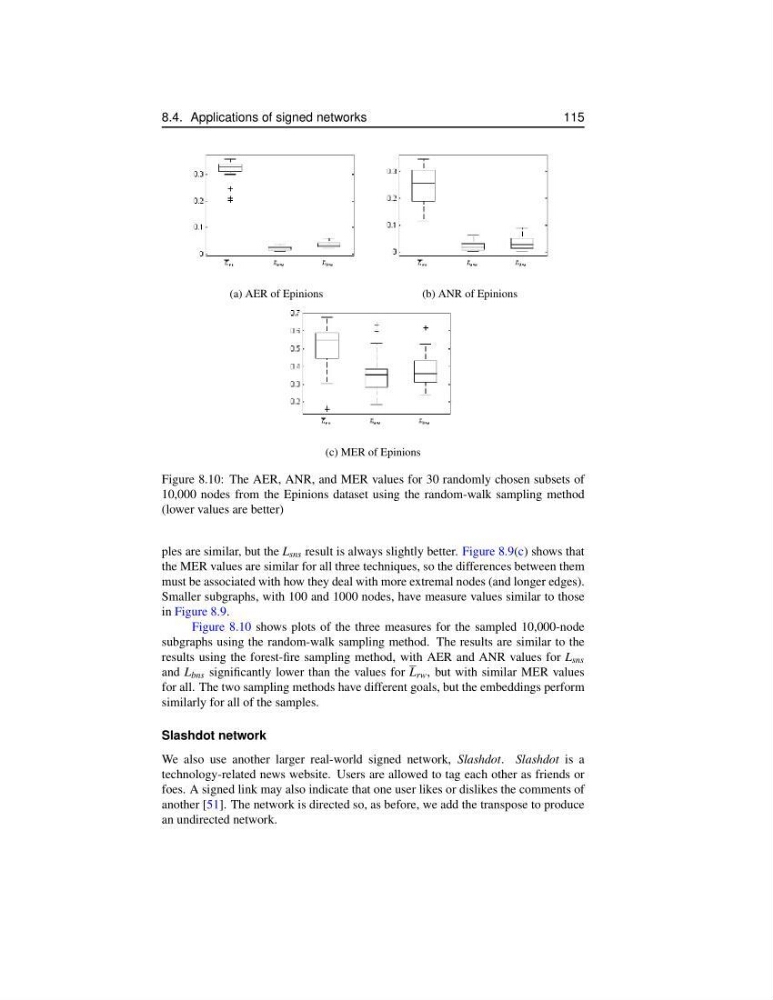
(a) AER of Epinions
(b) ANR of Epinions
(c) MER of Epinions
Figure 8.10: The AER, ANR, and MER values for 30 randomly chosen subsets of
10,000 nodes from the Epinions dataset using the random-walk sampling method
(lower values are better)
ples are similar, but the L sns result is always slightly better. Figure 8.9(c) shows that
the MER values are similar for all three techniques, so the differences between them
must be associated with how they deal with more extremal nodes (and longer edges).
Smaller subgraphs, with 100 and 1000 nodes, have measure values similar to those
in Figure 8.9.
Figure 8.10 shows plots of the three measures for the sampled 10,000-node
subgraphs using the random-walk sampling method. The results are similar to the
results using the forest-fire sampling method, with AER and ANR values for L sns
and L bns significantly lower than the values for L rw , but with similar MER values
for all. The two sampling methods have different goals, but the embeddings perform
similarly for all of the samples.
Slashdot network
We also use another larger real-world signed network, Slashdot. Slashdot is a
technology-related news website. Users are allowed to tag each other as friends or
foes. A signed link may also indicate that one user likes or dislikes the comments of
another [51]. The network is directed so, as before, we add the transpose to produce
an undirected network.
115
(a) AER of Epinions
(b) ANR of Epinions
(c) MER of Epinions
Figure 8.10: The AER, ANR, and MER values for 30 randomly chosen subsets of
10,000 nodes from the Epinions dataset using the random-walk sampling method
(lower values are better)
ples are similar, but the L sns result is always slightly better. Figure 8.9(c) shows that
the MER values are similar for all three techniques, so the differences between them
must be associated with how they deal with more extremal nodes (and longer edges).
Smaller subgraphs, with 100 and 1000 nodes, have measure values similar to those
in Figure 8.9.
Figure 8.10 shows plots of the three measures for the sampled 10,000-node
subgraphs using the random-walk sampling method. The results are similar to the
results using the forest-fire sampling method, with AER and ANR values for L sns
and L bns significantly lower than the values for L rw , but with similar MER values
for all. The two sampling methods have different goals, but the embeddings perform
similarly for all of the samples.
Slashdot network
We also use another larger real-world signed network, Slashdot. Slashdot is a
technology-related news website. Users are allowed to tag each other as friends or
foes. A signed link may also indicate that one user likes or dislikes the comments of
another [51]. The network is directed so, as before, we add the transpose to produce
an undirected network.