

55
Review of Basic Device Physics
2.3.3.1 Junction Potential and Electric Field
The analysis of an abrupt junction becomes even simpler in the depletion
approximation in which the pn-junction is approximated by three regions
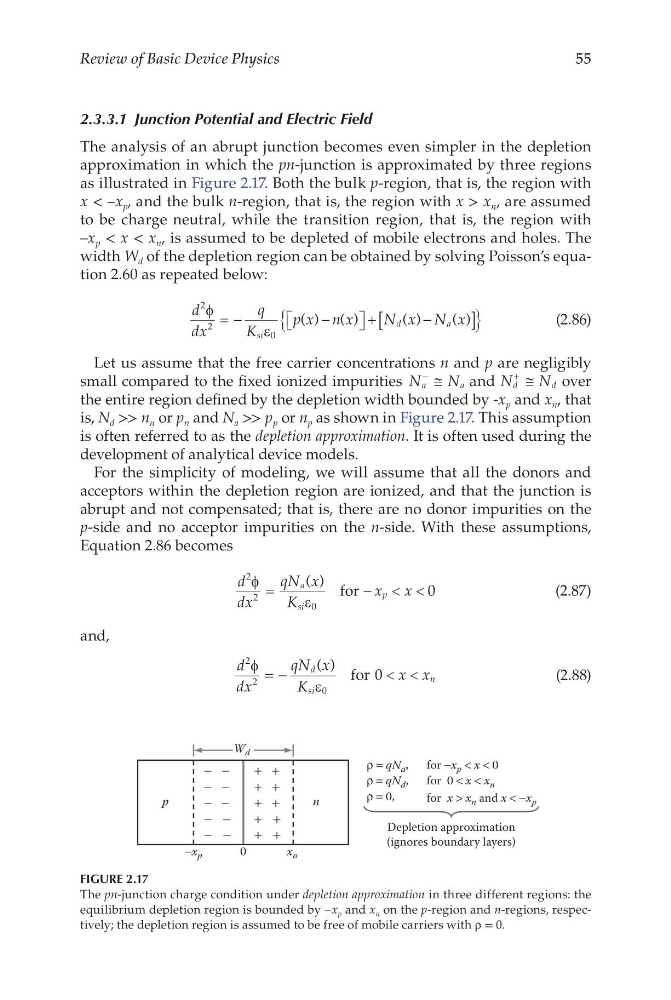
as illustrated in Figure 2.17. Both the bulk p-region, that is, the region with
x < –x p , and the bulk n-region, that is, the region with x > x n , are assumed
to be charge neutral, while the transition region, that is, the region with
–x p < x < x n , is assumed to be depleted of mobile electrons and holes. The
width W d of the depletion region can be obtained by solving Poisson’s equation 2.60 as repeated below:
d
dx
q
K
p x n x
N x N x
si
d
a
2
2
0
φ
ε
= −
−
+
−
[
]
{
}
( ) ( )
( )
( )
(2.86)
Let us assume that the free carrier concentrations n and p are negligibly
small compared to the fixed ionized impurities N
N
a
a
−
≅
and N
N
d
d
+
≅
over
the entire region defined by the depletion width bounded by -x p and x n , that
is, N d >> n n or p n and N a >> p p or n p as shown in Figure 2.17. This assumption
is often referred to as the depletion approximation. It is often used during the
development of analytical device models.
For the simplicity of modeling, we will assume that all the donors and
acceptors within the depletion region are ionized, and that the junction is
abrupt and not compensated; that is, there are no donor impurities on the
p-side and no acceptor impurities on the n-side. With these assumptions,
Equation 2.86 becomes
d
dx
qN x
K
x x
a
si
p
2
2
0
0
φ
ε
=
< <
( ) for −
(2.87)
and,
d
dx
qN x
K
x x
d
si
n
2
2
0
0
φ
ε
= −
< <
( ) for
(2.88)
W d
ρ = qN a ,
Depletion approximation
(ignores boundary layers)
for −x p < x < 0
for 0 < x < x n
for x > x n and x < −x p
ρ = qN d ,
ρ = 0,
p
−x p
x n
0
n
FIGURE 2.17
The pn-junction charge condition under depletion approximation in three different regions: the
equilibrium depletion region is bounded by −x p and x n on the p-region and n-regions, respectively; the depletion region is assumed to be free of mobile carriers with ρ = 0.
Review of Basic Device Physics
2.3.3.1 Junction Potential and Electric Field
The analysis of an abrupt junction becomes even simpler in the depletion
approximation in which the pn-junction is approximated by three regions
as illustrated in Figure 2.17. Both the bulk p-region, that is, the region with
x < –x p , and the bulk n-region, that is, the region with x > x n , are assumed
to be charge neutral, while the transition region, that is, the region with
–x p < x < x n , is assumed to be depleted of mobile electrons and holes. The
width W d of the depletion region can be obtained by solving Poisson’s equation 2.60 as repeated below:
d
dx
q
K
p x n x
N x N x
si
d
a
2
2
0
φ
ε
= −
−
+
−
[
]
{
}
( ) ( )
( )
( )
(2.86)
Let us assume that the free carrier concentrations n and p are negligibly
small compared to the fixed ionized impurities N
N
a
a
−
≅
and N
N
d
d
+
≅
over
the entire region defined by the depletion width bounded by -x p and x n , that
is, N d >> n n or p n and N a >> p p or n p as shown in Figure 2.17. This assumption
is often referred to as the depletion approximation. It is often used during the
development of analytical device models.
For the simplicity of modeling, we will assume that all the donors and
acceptors within the depletion region are ionized, and that the junction is
abrupt and not compensated; that is, there are no donor impurities on the
p-side and no acceptor impurities on the n-side. With these assumptions,
Equation 2.86 becomes
d
dx
qN x
K
x x
a
si
p
2
2
0
0
φ
ε
=
< <
( ) for −
(2.87)
and,
d
dx
qN x
K
x x
d
si
n
2
2
0
0
φ
ε
= −
< <
( ) for
(2.88)
W d
ρ = qN a ,
Depletion approximation
(ignores boundary layers)
for −x p < x < 0
for 0 < x < x n
for x > x n and x < −x p
ρ = qN d ,
ρ = 0,
p
−x p
x n
0
n
FIGURE 2.17
The pn-junction charge condition under depletion approximation in three different regions: the
equilibrium depletion region is bounded by −x p and x n on the p-region and n-regions, respectively; the depletion region is assumed to be free of mobile carriers with ρ = 0.