

47
Review of Basic Device Physics
Since n p << p, electrons are minority carriers in a p-type semiconductor.
Consequently, we often use the terminology of majority and minority carriers.
From Equation 2.62, we can write for an n-type semiconductor
φ φ
φ
i
f
d
i
kT
d
i
B
kT
q
N
n
v
N
n
− =
=
≡ −
ln
ln
(2.68)
where:
ϕ B ≡ (ϕ f – ϕ i ) is called the bulk potential and is negative for n-type
semiconductors
Similarly, from Equation 2.63, for p-type semiconductor, we can show
φ φ
φ
f
i
kT
a
i
B
v
N
n
− =
≡
ln
(2.69)
Thus, we can write a generalized expression for bulk potential in semiconductors as
φ
φ φ
B
i
f
k T
b
i
v
N
n
=
−
(
) = ±
ln
(2.70)
where:
the “+” sign is for p-type semiconductors with N b = N a
the “–” sign is for n-type semiconductors with N b = N d
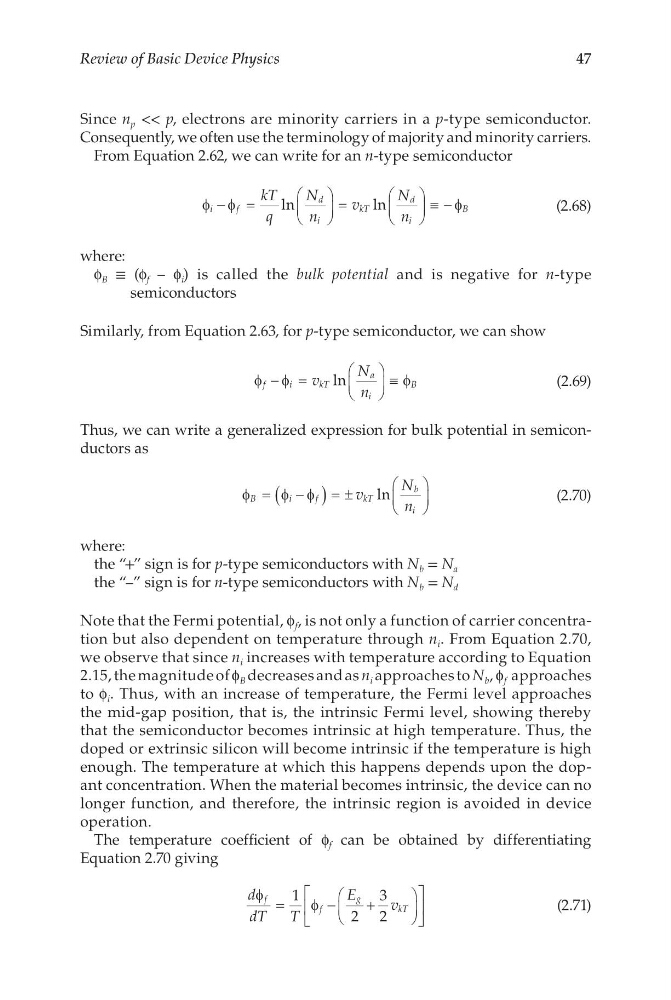
Note that the Fermi potential, ϕ f , is not only a function of carrier concentration but also dependent on temperature through n i . From Equation 2.70,
we observe that since n i increases with temperature according to Equation
2.15, the magnitude of ϕ B decreases and as n i approaches to N b , ϕ f approaches
to ϕ i . Thus, with an increase of temperature, the Fermi level approaches
the mid-gap position, that is, the intrinsic Fermi level, showing thereby
that the semiconductor becomes intrinsic at high temperature. Thus, the
doped or extrinsic silicon will become intrinsic if the temperature is high
enough. The temperature at which this happens depends upon the dopant concentration. When the material becomes intrinsic, the device can no
longer function, and therefore, the intrinsic region is avoided in device
operation.
The temperature coefficient of ϕ f can be obtained by differentiating
Equation 2.70 giving
d
dT
T
E
v
f
f
g
kT
φ
φ
=
−
+
1
2
3
2
(2.71)
Review of Basic Device Physics
Since n p << p, electrons are minority carriers in a p-type semiconductor.
Consequently, we often use the terminology of majority and minority carriers.
From Equation 2.62, we can write for an n-type semiconductor
φ φ
φ
i
f
d
i
kT
d
i
B
kT
q
N
n
v
N
n
− =
=
≡ −
ln
ln
(2.68)
where:
ϕ B ≡ (ϕ f – ϕ i ) is called the bulk potential and is negative for n-type
semiconductors
Similarly, from Equation 2.63, for p-type semiconductor, we can show
φ φ
φ
f
i
kT
a
i
B
v
N
n
− =
≡
ln
(2.69)
Thus, we can write a generalized expression for bulk potential in semiconductors as
φ
φ φ
B
i
f
k T
b
i
v
N
n
=
−
(
) = ±
ln
(2.70)
where:
the “+” sign is for p-type semiconductors with N b = N a
the “–” sign is for n-type semiconductors with N b = N d
Note that the Fermi potential, ϕ f , is not only a function of carrier concentration but also dependent on temperature through n i . From Equation 2.70,
we observe that since n i increases with temperature according to Equation
2.15, the magnitude of ϕ B decreases and as n i approaches to N b , ϕ f approaches
to ϕ i . Thus, with an increase of temperature, the Fermi level approaches
the mid-gap position, that is, the intrinsic Fermi level, showing thereby
that the semiconductor becomes intrinsic at high temperature. Thus, the
doped or extrinsic silicon will become intrinsic if the temperature is high
enough. The temperature at which this happens depends upon the dopant concentration. When the material becomes intrinsic, the device can no
longer function, and therefore, the intrinsic region is avoided in device
operation.
The temperature coefficient of ϕ f can be obtained by differentiating
Equation 2.70 giving
d
dT
T
E
v
f
f
g
kT
φ
φ
=
−
+
1
2
3
2
(2.71)