

46
Compact Models for Integrated Circuit Design
2.2.7.2 Carrier Concentration in Terms of Electrostatic Potential
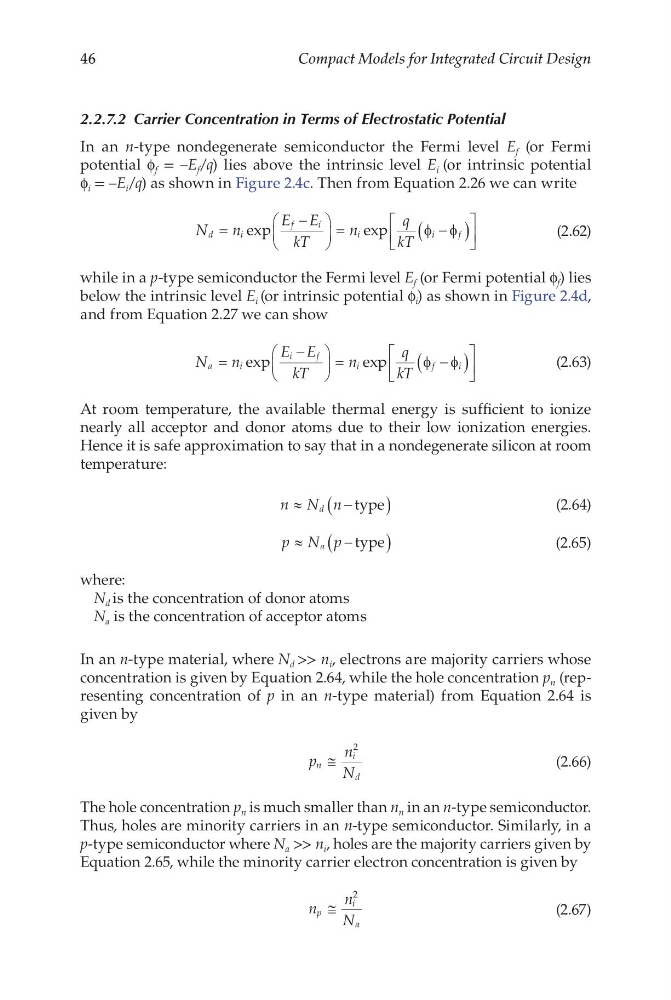
In an n-type nondegenerate semiconductor the Fermi level E f (or Fermi
potential f f = –E f /q) lies above the intrinsic level E i (or intrinsic potential
f i = –E i /q) as shown in Figure 2.4c. Then from Equation 2.26 we can write
N
n
E E
kT
n
q
kT
d
i
f
i
i
i
f
=
−
=
−
(
)
exp
e xp
φ φ
(2.62)
while in a p-type semiconductor the Fermi level E f (or Fermi potential f f ) lies
below the intrinsic level E i (or intrinsic potential f i ) as shown in Figure 2.4d,
and from Equation 2.27 we can show
N
n
E E
kT
n
q
kT
a
i
i
f
i
f
i
=
−
=
−
(
)
exp
e xp
φ φ
(2.63)
At room temperature, the available thermal energy is sufficient to ionize
nearly all acceptor and donor atoms due to their low ionization energies.
Hence it is safe approximation to say that in a nondegenerate silicon at room
temperature:
n N n
d
≈
(
)
− type
(2.64)
p N p
a
≈
(
)
− type
(2.65)
where:
N d is the concentration of donor atoms
N a is the concentration of acceptor atoms
In an n-type material, where N d >> n i , electrons are majority carriers whose
concentration is given by Equation 2.64, while the hole concentration p n (representing concentration of p in an n-type material) from Equation 2.64 is
given by
p
n
N
n
i
d
≅
2
(2.66)
The hole concentration p n is much smaller than n n in an n-type semiconductor.
Thus, holes are minority carriers in an n-type semiconductor. Similarly, in a
p-type semiconductor where N a >> n i , holes are the majority carriers given by
Equation 2.65, while the minority carrier electron concentration is given by
n
n
N
p
i
a
≅
2
(2.67)
Compact Models for Integrated Circuit Design
2.2.7.2 Carrier Concentration in Terms of Electrostatic Potential
In an n-type nondegenerate semiconductor the Fermi level E f (or Fermi
potential f f = –E f /q) lies above the intrinsic level E i (or intrinsic potential
f i = –E i /q) as shown in Figure 2.4c. Then from Equation 2.26 we can write
N
n
E E
kT
n
q
kT
d
i
f
i
i
i
f
=
−
=
−
(
)
exp
e xp
φ φ
(2.62)
while in a p-type semiconductor the Fermi level E f (or Fermi potential f f ) lies
below the intrinsic level E i (or intrinsic potential f i ) as shown in Figure 2.4d,
and from Equation 2.27 we can show
N
n
E E
kT
n
q
kT
a
i
i
f
i
f
i
=
−
=
−
(
)
exp
e xp
φ φ
(2.63)
At room temperature, the available thermal energy is sufficient to ionize
nearly all acceptor and donor atoms due to their low ionization energies.
Hence it is safe approximation to say that in a nondegenerate silicon at room
temperature:
n N n
d
≈
(
)
− type
(2.64)
p N p
a
≈
(
)
− type
(2.65)
where:
N d is the concentration of donor atoms
N a is the concentration of acceptor atoms
In an n-type material, where N d >> n i , electrons are majority carriers whose
concentration is given by Equation 2.64, while the hole concentration p n (representing concentration of p in an n-type material) from Equation 2.64 is
given by
p
n
N
n
i
d
≅
2
(2.66)
The hole concentration p n is much smaller than n n in an n-type semiconductor.
Thus, holes are minority carriers in an n-type semiconductor. Similarly, in a
p-type semiconductor where N a >> n i , holes are the majority carriers given by
Equation 2.65, while the minority carrier electron concentration is given by
n
n
N
p
i
a
≅
2
(2.67)