

45
Review of Basic Device Physics
E
d
dx
= −
φ
(2.56)
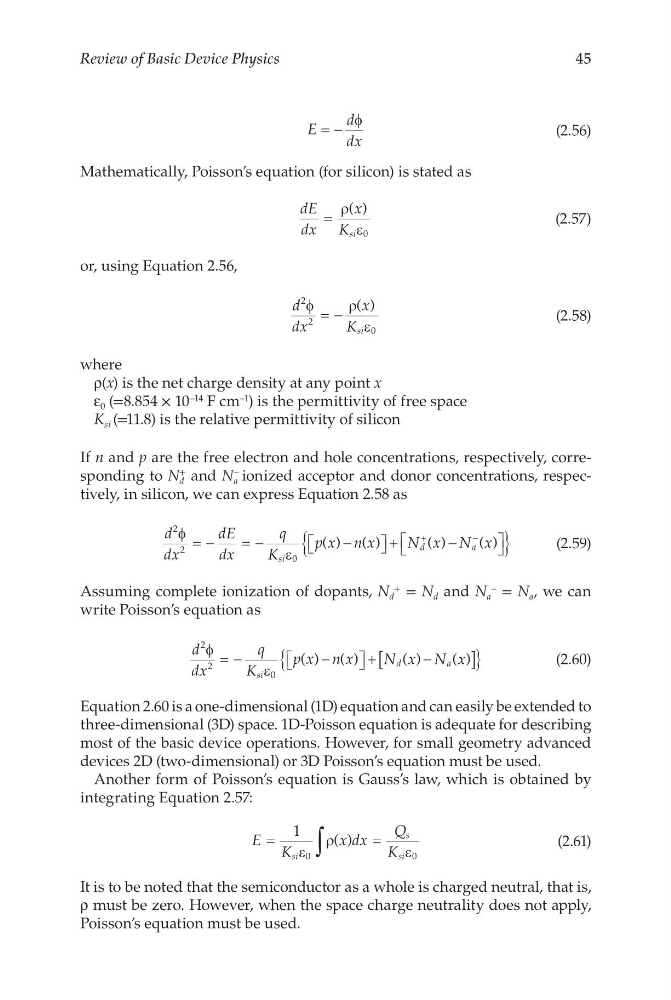
Mathematically, Poisson’s equation (for silicon) is stated as
dE
dx
x
K si
=
ρ
ε
( )
0
(2.57)
or, using Equation 2.56,
d
dx
x
K si
2
2
0
φ
ρ
ε
= −
( )
(2.58)
where
ρ(x) is the net charge density at any point x
ε 0 (=8.854 × 10 –14 F cm –1 ) is the permittivity of free space
K si (=11.8) is the relative permittivity of silicon
If n and p are the free electron and hole concentrations, respectively, corresponding to N d
+
and N a
–
ionized acceptor and donor concentrations, respectively, in silicon, we can express Equation 2.58 as
d
dx
dE
dx
q
K
p x n x
N x N x
si
d
a
2
2
0
φ
ε
= −
= −
−
+
−
{
}
+
−
( ) ( )
( )
( )
(2.59)
Assuming complete ionization of dopants, N d
+ = N d and N a
– = N a , we can
write Poisson’s equation as
d
dx
q
K
p x n x
x
x
N
N
si
d
a
2
2
0
φ
ε
= −
−
+
−
[
]
{
}
( ) ( )
( )
( )
(2.60)
Equation 2.60 is a one-dimensional (1D) equation and can easily be extended to
three-dimensional (3D) space. 1D-Poisson equation is adequate for describing
most of the basic device operations. However, for small geometry advanced
devices 2D (two-dimensional) or 3D Poisson’s equation must be used.
Another form of Poisson’s equation is Gauss’s law, which is obtained by
integrating Equation 2.57:
E K
x dx
Q
K
si
s
si
=
=
∫
1
0
0
ε
ρ
ε
( )
(2.61)
It is to be noted that the semiconductor as a whole is charged neutral, that is,
ρ must be zero. However, when the space charge neutrality does not apply,
Poisson’s equation must be used.
Review of Basic Device Physics
E
d
dx
= −
φ
(2.56)
Mathematically, Poisson’s equation (for silicon) is stated as
dE
dx
x
K si
=
ρ
ε
( )
0
(2.57)
or, using Equation 2.56,
d
dx
x
K si
2
2
0
φ
ρ
ε
= −
( )
(2.58)
where
ρ(x) is the net charge density at any point x
ε 0 (=8.854 × 10 –14 F cm –1 ) is the permittivity of free space
K si (=11.8) is the relative permittivity of silicon
If n and p are the free electron and hole concentrations, respectively, corresponding to N d
+
and N a
–
ionized acceptor and donor concentrations, respectively, in silicon, we can express Equation 2.58 as
d
dx
dE
dx
q
K
p x n x
N x N x
si
d
a
2
2
0
φ
ε
= −
= −
−
+
−
{
}
+
−
( ) ( )
( )
( )
(2.59)
Assuming complete ionization of dopants, N d
+ = N d and N a
– = N a , we can
write Poisson’s equation as
d
dx
q
K
p x n x
x
x
N
N
si
d
a
2
2
0
φ
ε
= −
−
+
−
[
]
{
}
( ) ( )
( )
( )
(2.60)
Equation 2.60 is a one-dimensional (1D) equation and can easily be extended to
three-dimensional (3D) space. 1D-Poisson equation is adequate for describing
most of the basic device operations. However, for small geometry advanced
devices 2D (two-dimensional) or 3D Poisson’s equation must be used.
Another form of Poisson’s equation is Gauss’s law, which is obtained by
integrating Equation 2.57:
E K
x dx
Q
K
si
s
si
=
=
∫
1
0
0
ε
ρ
ε
( )
(2.61)
It is to be noted that the semiconductor as a whole is charged neutral, that is,
ρ must be zero. However, when the space charge neutrality does not apply,
Poisson’s equation must be used.