

428
Compact Models for Integrated Circuit Design
12.2.3 Generation of Parameter Files
After the parameter optimization to fit the measured device characteristics with
the simulation data obtained by extracted model parameters, the parameters
for both NMOS and PMOS devices are saved into the respective parameter
files. A typical parameter file includes device information such as W, L, device
type, and the list of optimized model parameters of the compact model used.
The parameter files are verified to check the accuracy of fitting. This can
be achieved graphically using the parameter extraction tool by (1) comparing the simulated device characteristics obtained by the parameter file to the
measured device characteristics of a different set of device dimensions other
than that used for parameter extraction, (2) comparing the simulated device
characteristics with the measured device characteristics at temperatures
other than that used for parameter extraction, (3) comparing the simulated
device characteristics with the measured device characteristics at different
bias point other than that used for extraction, (4) checking for discontinuities
in the first- or second-order derivative of current (g m , R out , etc.), and (5) using
external circuit CAD tool (e.g., HSPICE) to check for convergence issues. The
verified parameter files are then used to generate the final model library.
Device 1 C−V data: Extract
capacitance model parameters
Model validation
No
Yes
Device 1 I−V data: Extract
core DC model parameters
Group 4 device I−V data: Extract
small-geometry dependent DC model parameters
Check C−V
Group 3 device I−V data: Extract
W-dependent DC model parameters
Extract temperature coefficients
of relevant model parameters
Is C−V
fit within
tolerance?
Group 2 device I−V data: Extract
L-dependent DC model parameters
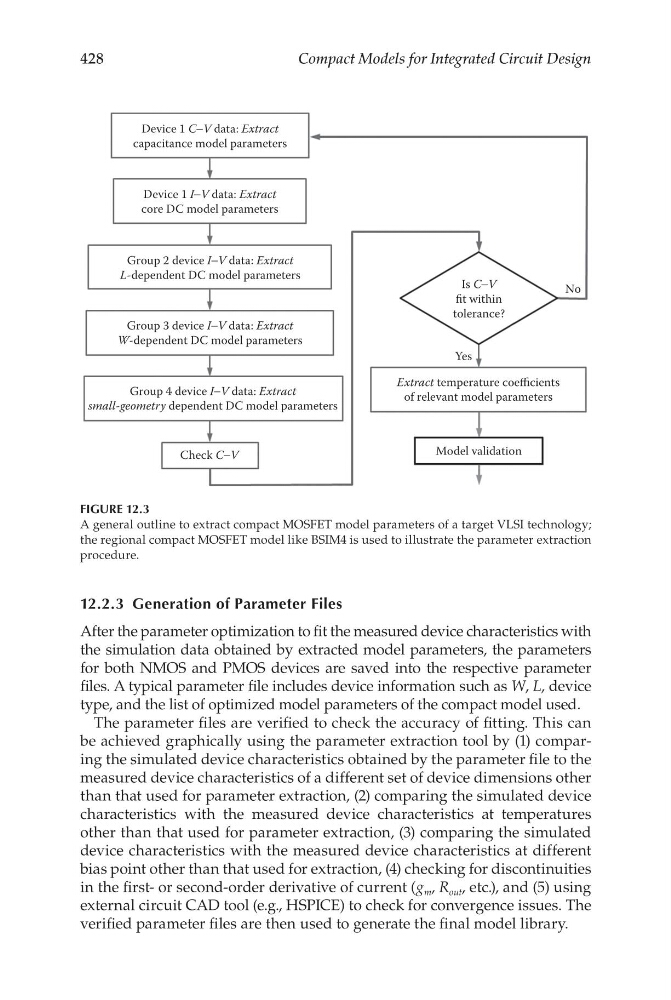
FIGURE 12.3
A general outline to extract compact MOSFET model parameters of a target VLSI technology;
the regional compact MOSFET model like BSIM4 is used to illustrate the parameter extraction
procedure.
Compact Models for Integrated Circuit Design
12.2.3 Generation of Parameter Files
After the parameter optimization to fit the measured device characteristics with
the simulation data obtained by extracted model parameters, the parameters
for both NMOS and PMOS devices are saved into the respective parameter
files. A typical parameter file includes device information such as W, L, device
type, and the list of optimized model parameters of the compact model used.
The parameter files are verified to check the accuracy of fitting. This can
be achieved graphically using the parameter extraction tool by (1) comparing the simulated device characteristics obtained by the parameter file to the
measured device characteristics of a different set of device dimensions other
than that used for parameter extraction, (2) comparing the simulated device
characteristics with the measured device characteristics at temperatures
other than that used for parameter extraction, (3) comparing the simulated
device characteristics with the measured device characteristics at different
bias point other than that used for extraction, (4) checking for discontinuities
in the first- or second-order derivative of current (g m , R out , etc.), and (5) using
external circuit CAD tool (e.g., HSPICE) to check for convergence issues. The
verified parameter files are then used to generate the final model library.
Device 1 C−V data: Extract
capacitance model parameters
Model validation
No
Yes
Device 1 I−V data: Extract
core DC model parameters
Group 4 device I−V data: Extract
small-geometry dependent DC model parameters
Check C−V
Group 3 device I−V data: Extract
W-dependent DC model parameters
Extract temperature coefficients
of relevant model parameters
Is C−V
fit within
tolerance?
Group 2 device I−V data: Extract
L-dependent DC model parameters
FIGURE 12.3
A general outline to extract compact MOSFET model parameters of a target VLSI technology;
the regional compact MOSFET model like BSIM4 is used to illustrate the parameter extraction
procedure.