

23
Review of Basic Device Physics
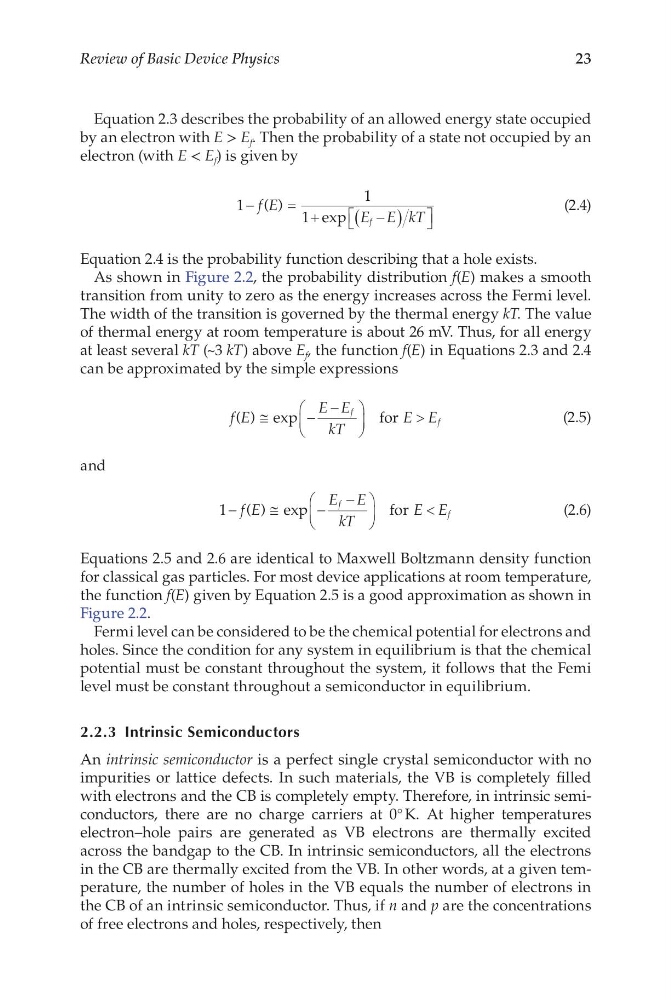
Equation 2.3 describes the probability of an allowed energy state occupied
by an electron with E > E f . Then the probability of a state not occupied by an
electron (with E < E f ) is given by
1
1
1
−
= +
−
(
)
f E
E E kT
f
( )
exp
(2.4)
Equation 2.4 is the probability function describing that a hole exists.
As shown in Figure 2.2, the probability distribution f(E) makes a smooth
transition from unity to zero as the energy increases across the Fermi level.
The width of the transition is governed by the thermal energy kT. The value
of thermal energy at room temperature is about 26 mV. Thus, for all energy
at least several kT (~3 kT) above E f , the function f(E) in Equations 2.3 and 2.4
can be approximated by the simple expressions
f E
E E
kT
E E
f
f
( ) exp
≅
−
−
>
for
(2.5)
and
1−
≅
−
−
<
f E
E E
kT
E E
f
f
( ) exp
f or
(2.6)
Equations 2.5 and 2.6 are identical to Maxwell Boltzmann density function
for classical gas particles. For most device applications at room temperature,
the function f(E) given by Equation 2.5 is a good approximation as shown in
Figure 2.2.
Fermi level can be considered to be the chemical potential for electrons and
holes. Since the condition for any system in equilibrium is that the chemical
potential must be constant throughout the system, it follows that the Femi
level must be constant throughout a semiconductor in equilibrium.
2.2.3 Intrinsic Semiconductors
An intrinsic semiconductor is a perfect single crystal semiconductor with no
impurities or lattice defects. In such materials, the VB is completely filled
with electrons and the CB is completely empty. Therefore, in intrinsic semiconductors, there are no charge carriers at 0° K. At higher temperatures
electron–hole pairs are generated as VB electrons are thermally excited
across the bandgap to the CB. In intrinsic semiconductors, all the electrons
in the CB are thermally excited from the VB. In other words, at a given temperature, the number of holes in the VB equals the number of electrons in
the CB of an intrinsic semiconductor. Thus, if n and p are the concentrations
of free electrons and holes, respectively, then
Review of Basic Device Physics
Equation 2.3 describes the probability of an allowed energy state occupied
by an electron with E > E f . Then the probability of a state not occupied by an
electron (with E < E f ) is given by
1
1
1
−
= +
−
(
)
f E
E E kT
f
( )
exp
(2.4)
Equation 2.4 is the probability function describing that a hole exists.
As shown in Figure 2.2, the probability distribution f(E) makes a smooth
transition from unity to zero as the energy increases across the Fermi level.
The width of the transition is governed by the thermal energy kT. The value
of thermal energy at room temperature is about 26 mV. Thus, for all energy
at least several kT (~3 kT) above E f , the function f(E) in Equations 2.3 and 2.4
can be approximated by the simple expressions
f E
E E
kT
E E
f
f
( ) exp
≅
−
−
>
for
(2.5)
and
1−
≅
−
−
<
f E
E E
kT
E E
f
f
( ) exp
f or
(2.6)
Equations 2.5 and 2.6 are identical to Maxwell Boltzmann density function
for classical gas particles. For most device applications at room temperature,
the function f(E) given by Equation 2.5 is a good approximation as shown in
Figure 2.2.
Fermi level can be considered to be the chemical potential for electrons and
holes. Since the condition for any system in equilibrium is that the chemical
potential must be constant throughout the system, it follows that the Femi
level must be constant throughout a semiconductor in equilibrium.
2.2.3 Intrinsic Semiconductors
An intrinsic semiconductor is a perfect single crystal semiconductor with no
impurities or lattice defects. In such materials, the VB is completely filled
with electrons and the CB is completely empty. Therefore, in intrinsic semiconductors, there are no charge carriers at 0° K. At higher temperatures
electron–hole pairs are generated as VB electrons are thermally excited
across the bandgap to the CB. In intrinsic semiconductors, all the electrons
in the CB are thermally excited from the VB. In other words, at a given temperature, the number of holes in the VB equals the number of electrons in
the CB of an intrinsic semiconductor. Thus, if n and p are the concentrations
of free electrons and holes, respectively, then