

399
Bipolar Junction Transistor Compact Models
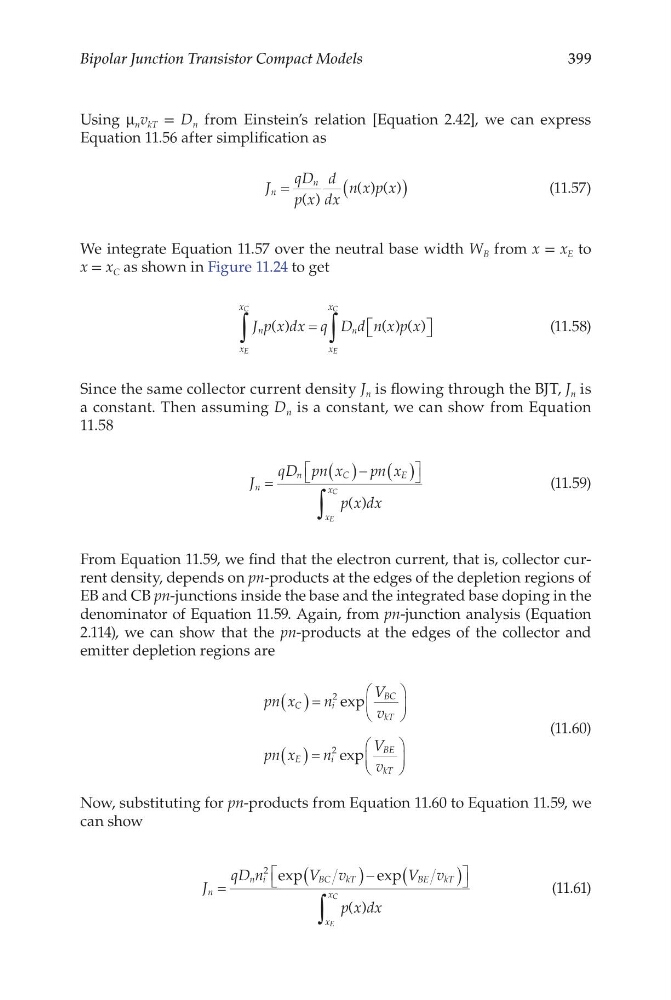
Using μ n v kT = D n from Einstein’s relation [Equation 2.42], we can express
Equation 11.56 after simplification as
J
qD
p x
d
dx
n x p x
n
n
=
(
)
( )
( ) ( )
(11.57)
We integrate Equation 11.57 over the neutral base width W B from x = x E to
x = x C as shown in Figure 11.24 to get
J p x dx q D d n x p x
n
x
x
n
x
x
E
C
E
C
( )
( ) ( )
∫
∫
=
(11.58)
Since the same collector current density J n is flowing through the BJT, J n is
a constant. Then assuming D n is a constant, we can show from Equation
11.58
J
qD pn x
pn x
p x dx
n
n
C
E
x
x
E
C
=
( )− ( )
∫
( )
(11.59)
From Equation 11.59, we find that the electron current, that is, collector current density, depends on pn-products at the edges of the depletion regions of
EB and CB pn-junctions inside the base and the integrated base doping in the
denominator of Equation 11.59. Again, from pn-junction analysis (Equation
2.114), we can show that the pn-products at the edges of the collector and
emitter depletion regions are
pn x
n
V
v
pn x
n
V
v
C
i
BC
kT
E
i
BE
kT
( )=
( )=
2
2
exp
exp
(11.60)
Now, substituting for pn-products from Equation 11.60 to Equation 11.59, we
can show
J
qD n
V v
V v
p x dx
n
n i
BC
kT
BE
kT
x
x
E
C
=
(
)− (
)
∫
2 exp
e xp
( )
(11.61)
Bipolar Junction Transistor Compact Models
Using μ n v kT = D n from Einstein’s relation [Equation 2.42], we can express
Equation 11.56 after simplification as
J
qD
p x
d
dx
n x p x
n
n
=
(
)
( )
( ) ( )
(11.57)
We integrate Equation 11.57 over the neutral base width W B from x = x E to
x = x C as shown in Figure 11.24 to get
J p x dx q D d n x p x
n
x
x
n
x
x
E
C
E
C
( )
( ) ( )
∫
∫
=
(11.58)
Since the same collector current density J n is flowing through the BJT, J n is
a constant. Then assuming D n is a constant, we can show from Equation
11.58
J
qD pn x
pn x
p x dx
n
n
C
E
x
x
E
C
=
( )− ( )
∫
( )
(11.59)
From Equation 11.59, we find that the electron current, that is, collector current density, depends on pn-products at the edges of the depletion regions of
EB and CB pn-junctions inside the base and the integrated base doping in the
denominator of Equation 11.59. Again, from pn-junction analysis (Equation
2.114), we can show that the pn-products at the edges of the collector and
emitter depletion regions are
pn x
n
V
v
pn x
n
V
v
C
i
BC
kT
E
i
BE
kT
( )=
( )=
2
2
exp
exp
(11.60)
Now, substituting for pn-products from Equation 11.60 to Equation 11.59, we
can show
J
qD n
V v
V v
p x dx
n
n i
BC
kT
BE
kT
x
x
E
C
=
(
)− (
)
∫
2 exp
e xp
( )
(11.61)