

383
Bipolar Junction Transistor Compact Models
i
I
v
v
C
S
BE
kT
≅ exp
(11.23)
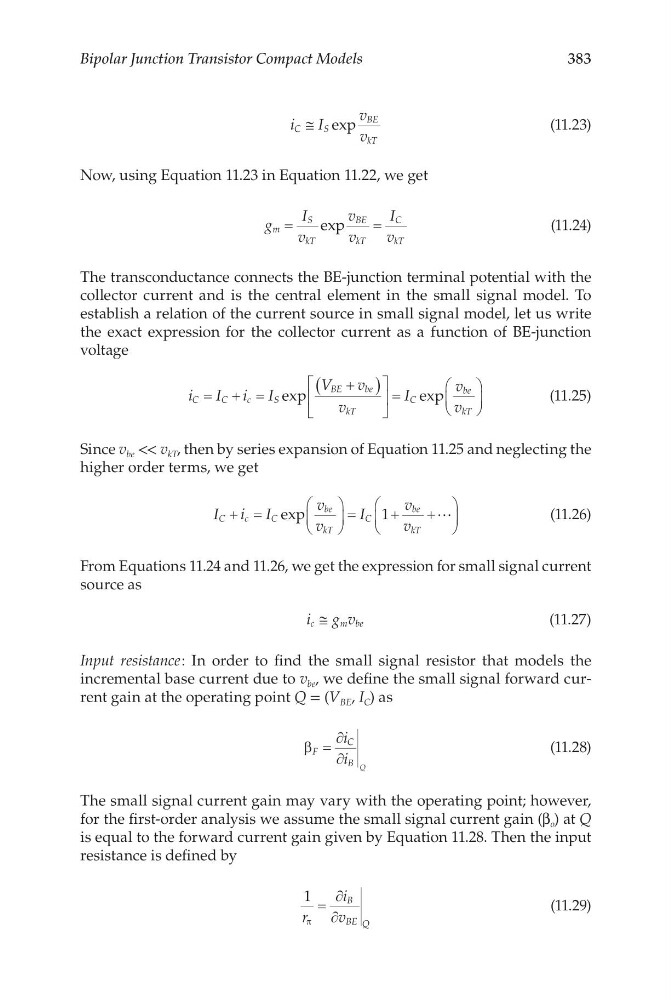
Now, using Equation 11.23 in Equation 11.22, we get
g
I
v
v
v
I
v
m
S
kT
BE
kT
C
kT
= = exp
(11.24)
The transconductance connects the BE-junction terminal potential with the
collector current and is the central element in the small signal model. To
establish a relation of the current source in small signal model, let us write
the exact expression for the collector current as a function of BE-junction
voltage
i
I i I
V
v
v
I
v
v
C
C
c
S
BE
be
kT
C
be
kT
= + =
+
(
)
=
exp
e xp
(11.25)
Since v be << v kT , then by series expansion of Equation 11.25 and neglecting the
higher order terms, we get
I i I
v
v
I
v
v
C
c
C
be
kT
C
be
kT
+ =
=
+
+
exp
1
(11.26)
From Equations 11.24 and 11.26, we get the expression for small signal current
source as
i g v
c
m be
≅
(11.27)
Input resistance: In order to find the small signal resistor that models the
incremental base current due to v be , we define the small signal forward current gain at the operating point Q = (V BE , I C ) as
β F
C
B
i
i Q
=
∂
∂
(11.28)
The small signal current gain may vary with the operating point; however,
for the first-order analysis we assume the small signal current gain (β o ) at Q
is equal to the forward current gain given by Equation 11.28. Then the input
resistance is defined by
1
r
i
v
B
BE Q
π
=
∂
∂
(11.29)
Bipolar Junction Transistor Compact Models
i
I
v
v
C
S
BE
kT
≅ exp
(11.23)
Now, using Equation 11.23 in Equation 11.22, we get
g
I
v
v
v
I
v
m
S
kT
BE
kT
C
kT
= = exp
(11.24)
The transconductance connects the BE-junction terminal potential with the
collector current and is the central element in the small signal model. To
establish a relation of the current source in small signal model, let us write
the exact expression for the collector current as a function of BE-junction
voltage
i
I i I
V
v
v
I
v
v
C
C
c
S
BE
be
kT
C
be
kT
= + =
+
(
)
=
exp
e xp
(11.25)
Since v be << v kT , then by series expansion of Equation 11.25 and neglecting the
higher order terms, we get
I i I
v
v
I
v
v
C
c
C
be
kT
C
be
kT
+ =
=
+
+
exp
1
(11.26)
From Equations 11.24 and 11.26, we get the expression for small signal current
source as
i g v
c
m be
≅
(11.27)
Input resistance: In order to find the small signal resistor that models the
incremental base current due to v be , we define the small signal forward current gain at the operating point Q = (V BE , I C ) as
β F
C
B
i
i Q
=
∂
∂
(11.28)
The small signal current gain may vary with the operating point; however,
for the first-order analysis we assume the small signal current gain (β o ) at Q
is equal to the forward current gain given by Equation 11.28. Then the input
resistance is defined by
1
r
i
v
B
BE Q
π
=
∂
∂
(11.29)