

367
Beyond-CMOS Transistor Models: Tunnel FETs
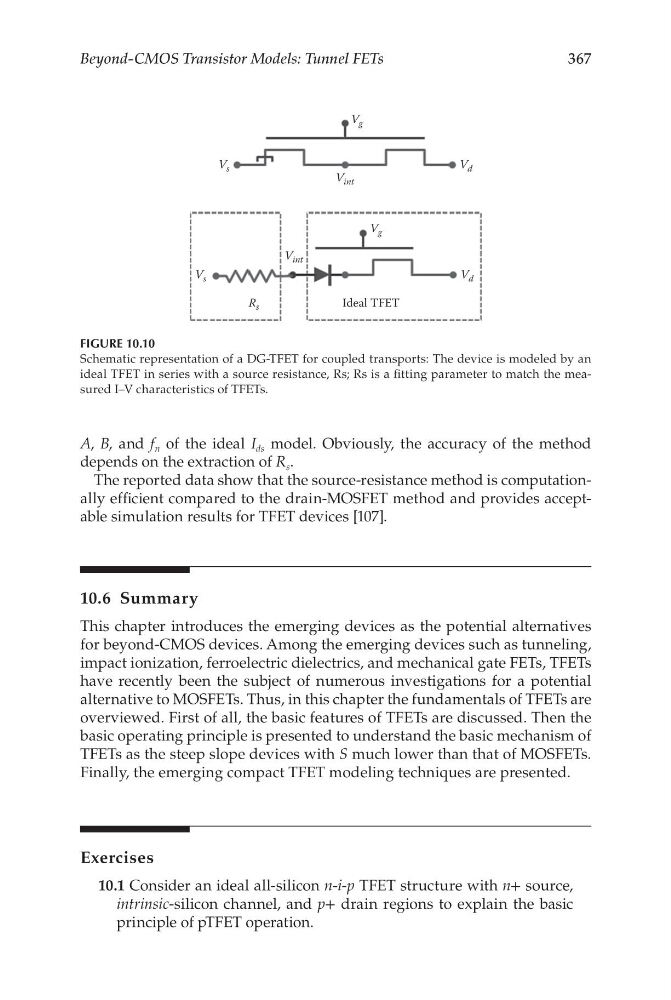
A, B, and f n of the ideal I ds model. Obviously, the accuracy of the method
depends on the extraction of R s .
The reported data show that the source-resistance method is computationally efficient compared to the drain-MOSFET method and provides acceptable simulation results for TFET devices [107].
10.6 Summary
This chapter introduces the emerging devices as the potential alternatives
for beyond-CMOS devices. Among the emerging devices such as tunneling,
impact ionization, ferroelectric dielectrics, and mechanical gate FETs, TFETs
have recently been the subject of numerous investigations for a potential
alternative to MOSFETs. Thus, in this chapter the fundamentals of TFETs are
overviewed. First of all, the basic features of TFETs are discussed. Then the
basic operating principle is presented to understand the basic mechanism of
TFETs as the steep slope devices with S much lower than that of MOSFETs.
Finally, the emerging compact TFET modeling techniques are presented.
Exercises
10.1 Consider an ideal all-silicon n-i-p TFET structure with n+ source,
intrinsic-silicon channel, and p+ drain regions to explain the basic
principle of pTFET operation.
V g
V d
V int
V s
V int
V g
V d
R s
V s
Ideal TFET
FIGURE 10.10
Schematic representation of a DG-TFET for coupled transports: The device is modeled by an
ideal TFET in series with a source resistance, Rs; Rs is a fitting parameter to match the measured I–V characteristics of TFETs.
Beyond-CMOS Transistor Models: Tunnel FETs
A, B, and f n of the ideal I ds model. Obviously, the accuracy of the method
depends on the extraction of R s .
The reported data show that the source-resistance method is computationally efficient compared to the drain-MOSFET method and provides acceptable simulation results for TFET devices [107].
10.6 Summary
This chapter introduces the emerging devices as the potential alternatives
for beyond-CMOS devices. Among the emerging devices such as tunneling,
impact ionization, ferroelectric dielectrics, and mechanical gate FETs, TFETs
have recently been the subject of numerous investigations for a potential
alternative to MOSFETs. Thus, in this chapter the fundamentals of TFETs are
overviewed. First of all, the basic features of TFETs are discussed. Then the
basic operating principle is presented to understand the basic mechanism of
TFETs as the steep slope devices with S much lower than that of MOSFETs.
Finally, the emerging compact TFET modeling techniques are presented.
Exercises
10.1 Consider an ideal all-silicon n-i-p TFET structure with n+ source,
intrinsic-silicon channel, and p+ drain regions to explain the basic
principle of pTFET operation.
V g
V d
V int
V s
V int
V g
V d
R s
V s
Ideal TFET
FIGURE 10.10
Schematic representation of a DG-TFET for coupled transports: The device is modeled by an
ideal TFET in series with a source resistance, Rs; Rs is a fitting parameter to match the measured I–V characteristics of TFETs.