

334
Compact Models for Integrated Circuit Design
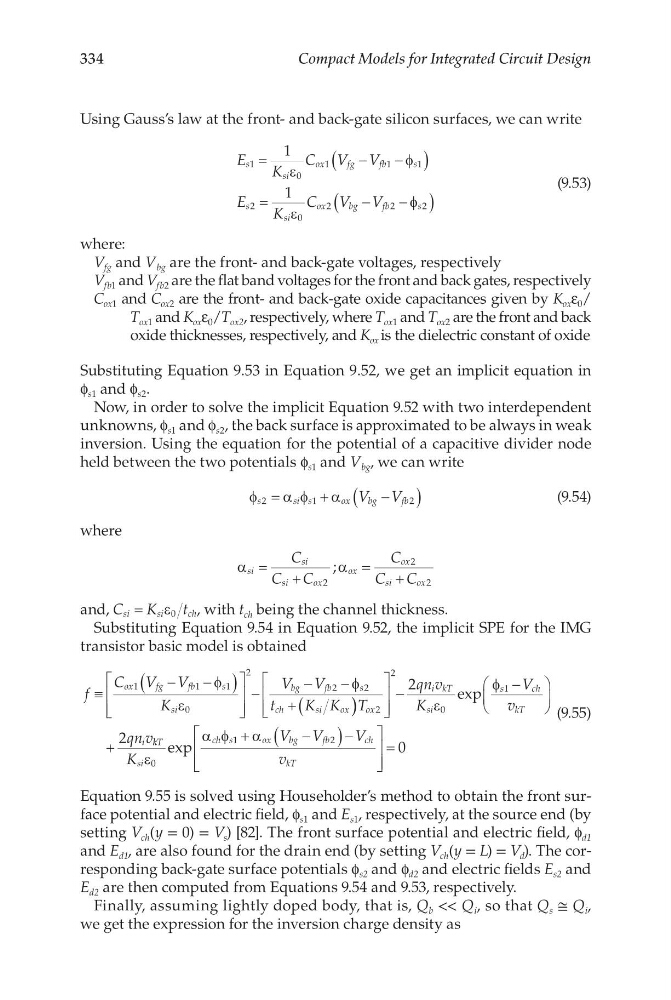
Using Gauss’s law at the front- and back-gate silicon surfaces, we can write
E
K
C V V
E
K
C V V
s
si
ox
fg
fb
s
s
si
ox
bg
fb
s
1
0
1
1
1
2
0
2
2
2
1
1
=
−
−
(
)
=
−
−
(
)
ε
φ
ε
φ
(9.53)
where:
V fg and V bg are the front- and back-gate voltages, respectively
V fb1 and V fb2 are the flat band voltages for the front and back gates, respectively
C ox1 and C ox2 are the front- and back-gate oxide capacitances given by K ox ε 0 /
T ox1 and K ox ε 0 /T ox2 , respectively, where T ox1 and T ox2 are the front and back
oxide thicknesses, respectively, and K ox is the dielectric constant of oxide
Substituting Equation 9.53 in Equation 9.52, we get an implicit equation in
f s1 and f s2 .
Now, in order to solve the implicit Equation 9.52 with two interdependent
unknowns, f s1 and f s2 , the back surface is approximated to be always in weak
inversion. Using the equation for the potential of a capacitive divider node
held between the two potentials f s1 and V bg , we can write
φ
α φ
α
s
s i s
ox
bg
fb
V V
2
1
2
=
+
−
(
)
(9.54)
where
α
α
si
si
si
ox
ox
ox
si
ox
C
C C
C
C C
=
+
=
+
2
2
2
;
and, C
K
t
si
si
ch
= ε 0 , with t ch being the channel thickness.
Substituting Equation 9.54 in Equation 9.52, the implicit SPE for the IMG
transistor basic model is obtained
f
C V V
K
V V
t
K K
ox
fg
fb
s
si
bg
fb
s
ch
si
ox
≡
−
−
(
)
−
−
−
+ (
1
1
1
0
2
2
2
φ
ε
φ
) )
−
−
+
T
qn v
K
V
v
qn v
ox
i kT
si
s
c h
kT
i
2
2
0
1
2
2
ε
φ
exp
k kT
si
ch s
o x
b g
f b
c h
kT
K
V V
V
v
ε
α φ
α
0
1
2
0
exp
+
−
(
) −
=
(9.55)
Equation 9.55 is solved using Householder’s method to obtain the front surface potential and electric field, f s1 and E s1 , respectively, at the source end (by
setting V ch (y = 0) = V s ) [82]. The front surface potential and electric field, f d1
and E d1 , are also found for the drain end (by setting V ch (y = L) = V d ). The corresponding back-gate surface potentials f s2 and f d2 and electric fields E s2 and
E d2 are then computed from Equations 9.54 and 9.53, respectively.
Finally, assuming lightly doped body, that is, Q b << Q i , so that Q s ≅ Q i ,
we get the expression for the inversion charge density as
Compact Models for Integrated Circuit Design
Using Gauss’s law at the front- and back-gate silicon surfaces, we can write
E
K
C V V
E
K
C V V
s
si
ox
fg
fb
s
s
si
ox
bg
fb
s
1
0
1
1
1
2
0
2
2
2
1
1
=
−
−
(
)
=
−
−
(
)
ε
φ
ε
φ
(9.53)
where:
V fg and V bg are the front- and back-gate voltages, respectively
V fb1 and V fb2 are the flat band voltages for the front and back gates, respectively
C ox1 and C ox2 are the front- and back-gate oxide capacitances given by K ox ε 0 /
T ox1 and K ox ε 0 /T ox2 , respectively, where T ox1 and T ox2 are the front and back
oxide thicknesses, respectively, and K ox is the dielectric constant of oxide
Substituting Equation 9.53 in Equation 9.52, we get an implicit equation in
f s1 and f s2 .
Now, in order to solve the implicit Equation 9.52 with two interdependent
unknowns, f s1 and f s2 , the back surface is approximated to be always in weak
inversion. Using the equation for the potential of a capacitive divider node
held between the two potentials f s1 and V bg , we can write
φ
α φ
α
s
s i s
ox
bg
fb
V V
2
1
2
=
+
−
(
)
(9.54)
where
α
α
si
si
si
ox
ox
ox
si
ox
C
C C
C
C C
=
+
=
+
2
2
2
;
and, C
K
t
si
si
ch
= ε 0 , with t ch being the channel thickness.
Substituting Equation 9.54 in Equation 9.52, the implicit SPE for the IMG
transistor basic model is obtained
f
C V V
K
V V
t
K K
ox
fg
fb
s
si
bg
fb
s
ch
si
ox
≡
−
−
(
)
−
−
−
+ (
1
1
1
0
2
2
2
φ
ε
φ
) )
−
−
+
T
qn v
K
V
v
qn v
ox
i kT
si
s
c h
kT
i
2
2
0
1
2
2
ε
φ
exp
k kT
si
ch s
o x
b g
f b
c h
kT
K
V V
V
v
ε
α φ
α
0
1
2
0
exp
+
−
(
) −
=
(9.55)
Equation 9.55 is solved using Householder’s method to obtain the front surface potential and electric field, f s1 and E s1 , respectively, at the source end (by
setting V ch (y = 0) = V s ) [82]. The front surface potential and electric field, f d1
and E d1 , are also found for the drain end (by setting V ch (y = L) = V d ). The corresponding back-gate surface potentials f s2 and f d2 and electric fields E s2 and
E d2 are then computed from Equations 9.54 and 9.53, respectively.
Finally, assuming lightly doped body, that is, Q b << Q i , so that Q s ≅ Q i ,
we get the expression for the inversion charge density as