

325
Compact Models for Ultrathin Body FETs
9.3.1.2 Drain Current Model
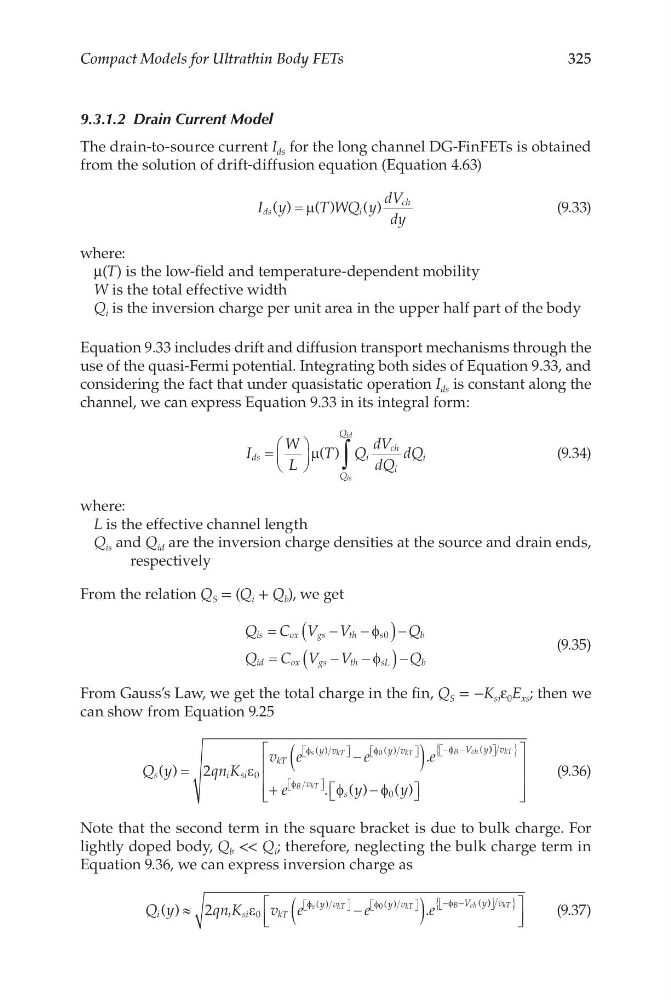
The drain-to-source current I ds for the long channel DG-FinFETs is obtained
from the solution of drift-diffusion equation (Equation 4.63)
I y
T WQ y
dV
dy
ds
i
ch
( )
( )
( )
= µ
(9.33)
where:
μ(T) is the low-field and temperature-dependent mobility
W is the total effective width
Q i is the inversion charge per unit area in the upper half part of the body
Equation 9.33 includes drift and diffusion transport mechanisms through the
use of the quasi-Fermi potential. Integrating both sides of Equation 9.33, and
considering the fact that under quasistatic operation I ds is constant along the
channel, we can express Equation 9.33 in its integral form:
I
W
L
T Q
dV
dQ
dQ
ds
i
Q
Q
ch
i
i
is
id
=
∫
µ( )
(9.34)
where:
L is the effective channel length
Q is and Q id are the inversion charge densities at the source and drain ends,
respectively
From the relation Q S = (Q i + Q b ), we get
Q C V V
Q
Q
C V V
Q
is
ox
gs
th
s
b
id
ox
gs
th
sL
b
=
−
−
(
) −
=
−
−
(
) −
φ
φ
0
(9.35)
From Gauss’s Law, we get the total charge in the fin, Q S = −K si ε 0 E xs ; then we
can show from Equation 9.25
Q y
qn K
v e
e
e
s
isi
kT
y v
y v
V y
s
k T
k T
B
c h
( )
.
( )
( )
(
=
−
(
)
− −
2
0
0
ε
φ
φ
φ
) )
. ( )
( )
{
}
+
−
v
v
s
kT
B kT
e
y
y
φ
φ
φ 0
(9.36)
Note that the second term in the square bracket is due to bulk charge. For
lightly doped body, Q b << Q i ; therefore, neglecting the bulk charge term in
Equation 9.36, we can express inversion charge as
Q y
qn K
v e
e
e
i
isi
kT
y v
y v
V y
s
k T
k T
B
c h
( )
.
( )
( )
(
≈
−
(
)
− −
2
0
0
ε
φ
φ
φ
) )
{
}
vkT
(9.37)
Compact Models for Ultrathin Body FETs
9.3.1.2 Drain Current Model
The drain-to-source current I ds for the long channel DG-FinFETs is obtained
from the solution of drift-diffusion equation (Equation 4.63)
I y
T WQ y
dV
dy
ds
i
ch
( )
( )
( )
= µ
(9.33)
where:
μ(T) is the low-field and temperature-dependent mobility
W is the total effective width
Q i is the inversion charge per unit area in the upper half part of the body
Equation 9.33 includes drift and diffusion transport mechanisms through the
use of the quasi-Fermi potential. Integrating both sides of Equation 9.33, and
considering the fact that under quasistatic operation I ds is constant along the
channel, we can express Equation 9.33 in its integral form:
I
W
L
T Q
dV
dQ
dQ
ds
i
Q
Q
ch
i
i
is
id
=
∫
µ( )
(9.34)
where:
L is the effective channel length
Q is and Q id are the inversion charge densities at the source and drain ends,
respectively
From the relation Q S = (Q i + Q b ), we get
Q C V V
Q
Q
C V V
Q
is
ox
gs
th
s
b
id
ox
gs
th
sL
b
=
−
−
(
) −
=
−
−
(
) −
φ
φ
0
(9.35)
From Gauss’s Law, we get the total charge in the fin, Q S = −K si ε 0 E xs ; then we
can show from Equation 9.25
Q y
qn K
v e
e
e
s
isi
kT
y v
y v
V y
s
k T
k T
B
c h
( )
.
( )
( )
(
=
−
(
)
− −
2
0
0
ε
φ
φ
φ
) )
. ( )
( )
{
}
+
−
v
v
s
kT
B kT
e
y
y
φ
φ
φ 0
(9.36)
Note that the second term in the square bracket is due to bulk charge. For
lightly doped body, Q b << Q i ; therefore, neglecting the bulk charge term in
Equation 9.36, we can express inversion charge as
Q y
qn K
v e
e
e
i
isi
kT
y v
y v
V y
s
k T
k T
B
c h
( )
.
( )
( )
(
≈
−
(
)
− −
2
0
0
ε
φ
φ
φ
) )
{
}
vkT
(9.37)