

308
Compact Models for Integrated Circuit Design
8.5.5 Simulation Results and Discussions
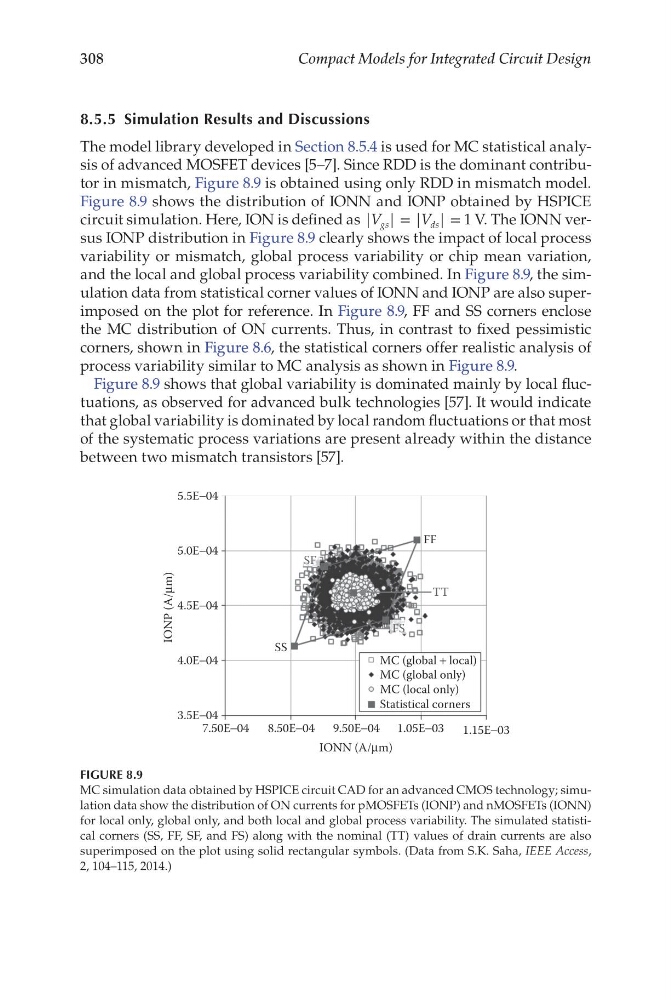
The model library developed in Section 8.5.4 is used for MC statistical analysis of advanced MOSFET devices [5–7]. Since RDD is the dominant contributor in mismatch, Figure 8.9 is obtained using only RDD in mismatch model.
Figure 8.9 shows the distribution of IONN and IONP obtained by HSPICE
circuit simulation. Here, ION is defined as |V gs | = |V ds | = 1 V. The IONN versus IONP distribution in Figure 8.9 clearly shows the impact of local process
variability or mismatch, global process variability or chip mean variation,
and the local and global process variability combined. In Figure 8.9, the simulation data from statistical corner values of IONN and IONP are also superimposed on the plot for reference. In Figure 8.9, FF and SS corners enclose
the MC distribution of ON currents. Thus, in contrast to fixed pessimistic
corners, shown in Figure 8.6, the statistical corners offer realistic analysis of
process variability similar to MC analysis as shown in Figure 8.9.
Figure 8.9 shows that global variability is dominated mainly by local fluctuations, as observed for advanced bulk technologies [57]. It would indicate
that global variability is dominated by local random fluctuations or that most
of the systematic process variations are present already within the distance
between two mismatch transistors [57].
7.50E−04
3.5E−04
4.0E−04
4.5E−04
5.0E−04
5.5E−04
8.50E−04
SS
MC (global + local)
MC (global only)
MC (local only)
Statistical corners
FF
SF
TT
FS
9.50E−04
IONN (A/μm)
IONP (A/μm)
1.05E−03
1.15E−03
FIGURE 8.9
MC simulation data obtained by HSPICE circuit CAD for an advanced CMOS technology; simulation data show the distribution of ON currents for pMOSFETs (IONP) and nMOSFETs (IONN)
for local only, global only, and both local and global process variability. The simulated statistical corners (SS, FF, SF, and FS) along with the nominal (TT) values of drain currents are also
superimposed on the plot using solid rectangular symbols. (Data from S.K. Saha, IEEE Access,
2, 104–115, 2014.)
Compact Models for Integrated Circuit Design
8.5.5 Simulation Results and Discussions
The model library developed in Section 8.5.4 is used for MC statistical analysis of advanced MOSFET devices [5–7]. Since RDD is the dominant contributor in mismatch, Figure 8.9 is obtained using only RDD in mismatch model.
Figure 8.9 shows the distribution of IONN and IONP obtained by HSPICE
circuit simulation. Here, ION is defined as |V gs | = |V ds | = 1 V. The IONN versus IONP distribution in Figure 8.9 clearly shows the impact of local process
variability or mismatch, global process variability or chip mean variation,
and the local and global process variability combined. In Figure 8.9, the simulation data from statistical corner values of IONN and IONP are also superimposed on the plot for reference. In Figure 8.9, FF and SS corners enclose
the MC distribution of ON currents. Thus, in contrast to fixed pessimistic
corners, shown in Figure 8.6, the statistical corners offer realistic analysis of
process variability similar to MC analysis as shown in Figure 8.9.
Figure 8.9 shows that global variability is dominated mainly by local fluctuations, as observed for advanced bulk technologies [57]. It would indicate
that global variability is dominated by local random fluctuations or that most
of the systematic process variations are present already within the distance
between two mismatch transistors [57].
7.50E−04
3.5E−04
4.0E−04
4.5E−04
5.0E−04
5.5E−04
8.50E−04
SS
MC (global + local)
MC (global only)
MC (local only)
Statistical corners
FF
SF
TT
FS
9.50E−04
IONN (A/μm)
IONP (A/μm)
1.05E−03
1.15E−03
FIGURE 8.9
MC simulation data obtained by HSPICE circuit CAD for an advanced CMOS technology; simulation data show the distribution of ON currents for pMOSFETs (IONP) and nMOSFETs (IONN)
for local only, global only, and both local and global process variability. The simulated statistical corners (SS, FF, SF, and FS) along with the nominal (TT) values of drain currents are also
superimposed on the plot using solid rectangular symbols. (Data from S.K. Saha, IEEE Access,
2, 104–115, 2014.)