

236
Compact Models for Integrated Circuit Design
6.2.3 Limitations of Meyer Model
The Meyer model is simple and predicts acceptable simulation results for
most circuit analysis since its implementation in SPICE [10]. However, it is
found to generate nonphysical simulation results when used to model circuits with charge storage nodes. The model incorrectly predicts the charge
built up on these nodes in circuit simulation. It is found that the Meyer
model is inadequate in predicting accurate capacitances in circuits such as
MOS (metal-oxide-semiconductor) charge pumps [11], silicon on sapphire [4],
dynamic random access memory, and switched-capacitor circuits [8]. This
inaccuracy in simulation results when using the Meyer model is due the (1)
charge nonconservation and (2) nonphysical reciprocity assumption.
The charge nonconservation problem has been extensively analyzed
[8,11,12]. The detailed investigation of the Meyer model reveals that the incorrect implementation of the model in circuit CAD causes charge nonconservation [11]. However, in order to ensure charge conservation in modeling
MOSFET capacitances, it is required to assign charges at each terminal of the
device. With quasistatic assumption, the charges at any time t only depend
on the values of the terminal voltages at the same time so that we can write
Q Q V V V
j G S D B
j
j
gs
gd
gb
= (
)
=
, ,
,
,, ,
where
(6.30)
Thus, the capacitance C ji with i = G (e.g., C GG , C DG , C SG , and C BG ) in a MOSFET
must satisfy the relation
C V V V
dQ
dV
j G S D B
i G
ji
gs
gd
gb
j
g
, ,
,
,, , ;
(
) ≡
=
=
where
and
(6.31)
Extrinsic region
Intrinsic
region
B
C JS
I bs
I ds
I bd
C GB
C JD
C GDO
C GSO
C GBO
S
D
G
C GD
C GS
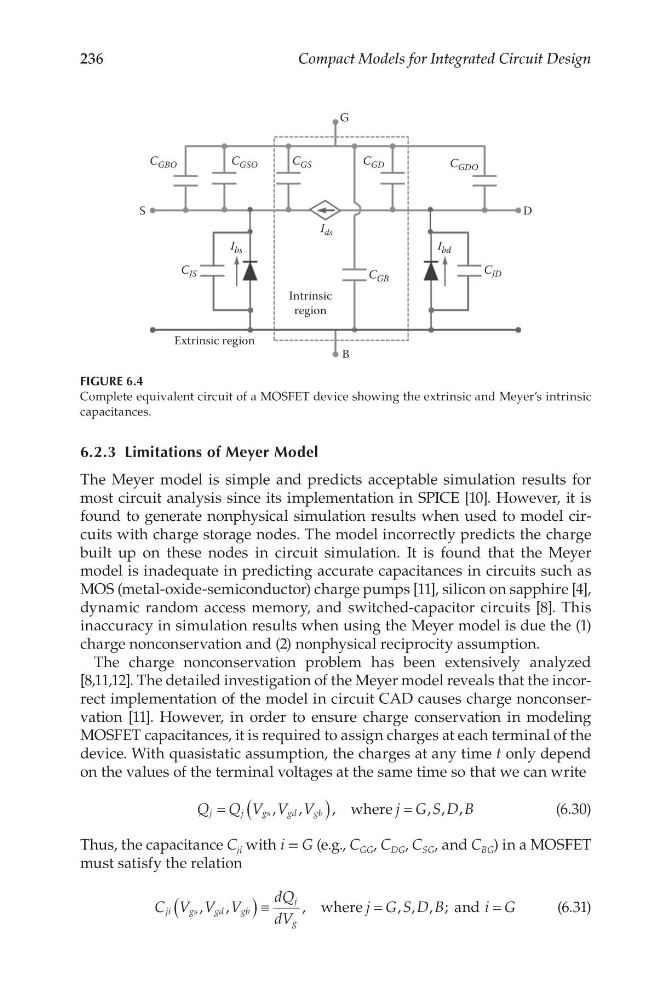
FIGURE 6.4
Complete equivalent circuit of a MOSFET device showing the extrinsic and Meyer’s intrinsic
capacitances.
Compact Models for Integrated Circuit Design
6.2.3 Limitations of Meyer Model
The Meyer model is simple and predicts acceptable simulation results for
most circuit analysis since its implementation in SPICE [10]. However, it is
found to generate nonphysical simulation results when used to model circuits with charge storage nodes. The model incorrectly predicts the charge
built up on these nodes in circuit simulation. It is found that the Meyer
model is inadequate in predicting accurate capacitances in circuits such as
MOS (metal-oxide-semiconductor) charge pumps [11], silicon on sapphire [4],
dynamic random access memory, and switched-capacitor circuits [8]. This
inaccuracy in simulation results when using the Meyer model is due the (1)
charge nonconservation and (2) nonphysical reciprocity assumption.
The charge nonconservation problem has been extensively analyzed
[8,11,12]. The detailed investigation of the Meyer model reveals that the incorrect implementation of the model in circuit CAD causes charge nonconservation [11]. However, in order to ensure charge conservation in modeling
MOSFET capacitances, it is required to assign charges at each terminal of the
device. With quasistatic assumption, the charges at any time t only depend
on the values of the terminal voltages at the same time so that we can write
Q Q V V V
j G S D B
j
j
gs
gd
gb
= (
)
=
, ,
,
,, ,
where
(6.30)
Thus, the capacitance C ji with i = G (e.g., C GG , C DG , C SG , and C BG ) in a MOSFET
must satisfy the relation
C V V V
dQ
dV
j G S D B
i G
ji
gs
gd
gb
j
g
, ,
,
,, , ;
(
) ≡
=
=
where
and
(6.31)
Extrinsic region
Intrinsic
region
B
C JS
I bs
I ds
I bd
C GB
C JD
C GDO
C GSO
C GBO
S
D
G
C GD
C GS
FIGURE 6.4
Complete equivalent circuit of a MOSFET device showing the extrinsic and Meyer’s intrinsic
capacitances.