

167
Large Geometry MOSFET Compact Models
I
W
L
C v e
e
ds
s
dkT
V V
nv
V v
gs
th
kT
ds kT
=
−
(
)
−
(
)
−(
)
µ
2
1
(4.118)
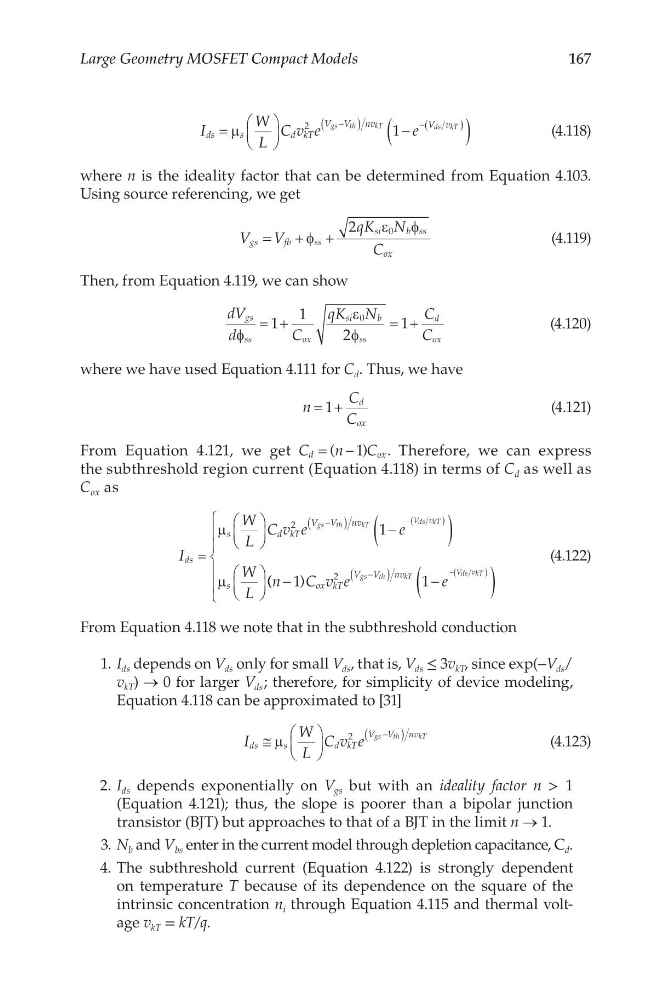
where n is the ideality factor that can be determined from Equation 4.103.
Using source referencing, we get
V
V
qK N
C
gs
fb
ss
si
b ss
ox
=
+ +
φ
ε
φ
2
0
(4.119)
Then, from Equation 4.119, we can show
dV
d
C
qK N
C
C
gs
ss
ox
si
b
ss
d
ox
φ
ε
φ
= +
= +
1
1
2
1
0
(4.120)
where we have used Equation 4.111 for C d . Thus, we have
n
C
C
d
ox
= +
1
(4.121)
From Equation 4.121, we get C
n
C
d
o x
= −
(
) .
1
Therefore, we can express
the subthreshold region current (Equation 4.118) in terms of C d as well as
C ox as
I
W
L
C v e
e
W
L
ds
s
dkT
V V
nv
s
gs
th
kT
Vds vkT
=
−
(
)
−
(
)
−(
)
µ
µ
2
1
( (
)
n
C v e
e
ox kT
V V
nv
gs
th
kT
Vds vkT
−
−
(
)
−
(
)
−(
)
1
1
2
(4.122)
From Equation 4.118 we note that in the subthreshold conduction
1. I ds depends on V ds only for small V ds , that is, V ds ≤ 3v kT , since exp(−V ds /
v kT ) → 0 for larger V ds ; therefore, for simplicity of device modeling,
Equation 4.118 can be approximated to [31]
I
W
L
C v e
ds
s
dkT
V V
nv
gs
th
kT
≅
−
(
)
µ
2
(4.123)
2. I ds depends exponentially on V gs but with an ideality factor n > 1
(Equation 4.121); thus, the slope is poorer than a bipolar junction
transistor (BJT) but approaches to that of a BJT in the limit n → 1.
3. N b and V bs enter in the current model through depletion capacitance, C d .
4. The subthreshold current (Equation 4.122) is strongly dependent
on temperature T because of its dependence on the square of the
intrinsic concentration n i through Equation 4.115 and thermal voltage v kT = kT/q.
Large Geometry MOSFET Compact Models
I
W
L
C v e
e
ds
s
dkT
V V
nv
V v
gs
th
kT
ds kT
=
−
(
)
−
(
)
−(
)
µ
2
1
(4.118)
where n is the ideality factor that can be determined from Equation 4.103.
Using source referencing, we get
V
V
qK N
C
gs
fb
ss
si
b ss
ox
=
+ +
φ
ε
φ
2
0
(4.119)
Then, from Equation 4.119, we can show
dV
d
C
qK N
C
C
gs
ss
ox
si
b
ss
d
ox
φ
ε
φ
= +
= +
1
1
2
1
0
(4.120)
where we have used Equation 4.111 for C d . Thus, we have
n
C
C
d
ox
= +
1
(4.121)
From Equation 4.121, we get C
n
C
d
o x
= −
(
) .
1
Therefore, we can express
the subthreshold region current (Equation 4.118) in terms of C d as well as
C ox as
I
W
L
C v e
e
W
L
ds
s
dkT
V V
nv
s
gs
th
kT
Vds vkT
=
−
(
)
−
(
)
−(
)
µ
µ
2
1
( (
)
n
C v e
e
ox kT
V V
nv
gs
th
kT
Vds vkT
−
−
(
)
−
(
)
−(
)
1
1
2
(4.122)
From Equation 4.118 we note that in the subthreshold conduction
1. I ds depends on V ds only for small V ds , that is, V ds ≤ 3v kT , since exp(−V ds /
v kT ) → 0 for larger V ds ; therefore, for simplicity of device modeling,
Equation 4.118 can be approximated to [31]
I
W
L
C v e
ds
s
dkT
V V
nv
gs
th
kT
≅
−
(
)
µ
2
(4.123)
2. I ds depends exponentially on V gs but with an ideality factor n > 1
(Equation 4.121); thus, the slope is poorer than a bipolar junction
transistor (BJT) but approaches to that of a BJT in the limit n → 1.
3. N b and V bs enter in the current model through depletion capacitance, C d .
4. The subthreshold current (Equation 4.122) is strongly dependent
on temperature T because of its dependence on the square of the
intrinsic concentration n i through Equation 4.115 and thermal voltage v kT = kT/q.