

147
Large Geometry MOSFET Compact Models
where n is the inversion layer electron concentration for nMOSFETs, q is the
electronic charge so that Q i = nq and v d = μ s E(y) = –μ s (df s /dy).
Again, if the electron transport is due to the concentration gradient (dn/dy)
along the channel, then from Fick’s first law of diffusion (Equation 2.39),
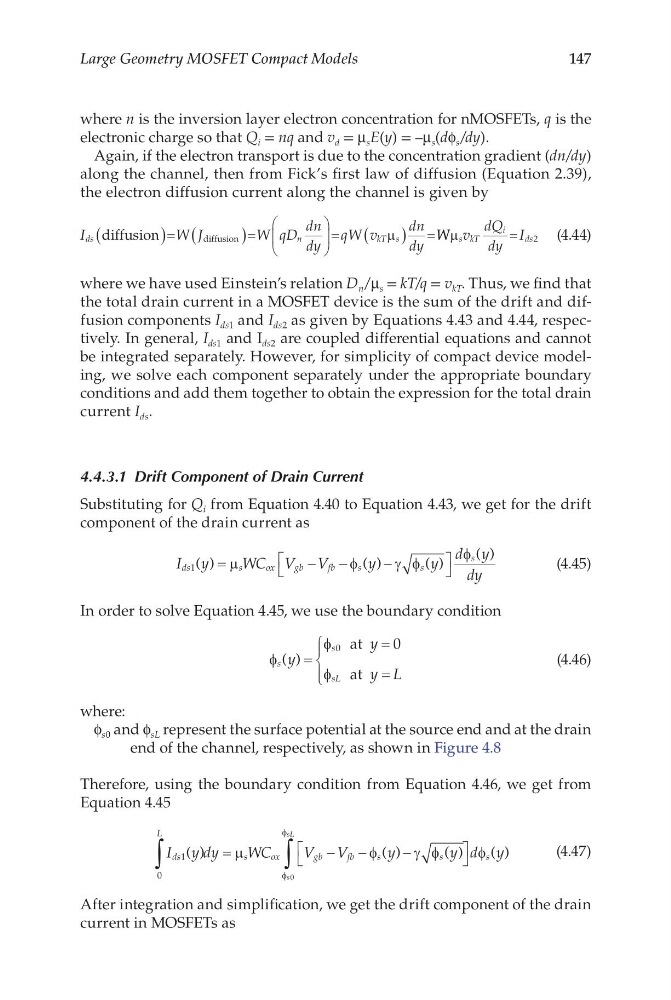
the electron diffusion current along the channel is given by
I
WJ
W qD
dn
dy
qW v
dn
dy
ds
n
k T s
diffusion
diffusion
(
)= (
)=
=
(
) =
µ
W W v
dQ
dy
I
s kT
i
ds
µ
= 2 (4.44)
where we have used Einstein’s relation D n /μ s = kT/q = v kT . Thus, we find that
the total drain current in a MOSFET device is the sum of the drift and diffusion components I ds1 and I ds2 as given by Equations 4.43 and 4.44, respectively. In general, I ds1 and I ds2 are coupled differential equations and cannot
be integrated separately. However, for simplicity of compact device modeling, we solve each component separately under the appropriate boundary
conditions and add them together to obtain the expression for the total drain
current I ds .
4.4.3.1 Drift Component of Drain Current
Substituting for Q i from Equation 4.40 to Equation 4.43, we get for the drift
component of the drain current as
I y
WC V V
y
y
d y
dy
ds
s
o x
g b
f b
s
s
s
1 ( )
( )
( )
( )
=
−
−
−
µ
φ
γ φ
φ
(4.45)
In order to solve Equation 4.45, we use the boundary condition
φ
φ
φ
s
s
sL
y
y
y L
( ) =
=
=
0
0
at
at
(4.46)
where:
f s0 and f sL represent the surface potential at the source end and at the drain
end of the channel, respectively, as shown in Figure 4.8
Therefore, using the boundary condition from Equation 4.46, we get from
Equation 4.45
I y dy
WC
V V
y
y d y
ds
L
s
o x
g b
f b
s
s
s
s
sL
1
0
0
( )
( )
( )
( )
∫
∫
=
−
−
−
µ
φ
γ φ
φ
φ
φ
(4.47)
After integration and simplification, we get the drift component of the drain
current in MOSFETs as
Large Geometry MOSFET Compact Models
where n is the inversion layer electron concentration for nMOSFETs, q is the
electronic charge so that Q i = nq and v d = μ s E(y) = –μ s (df s /dy).
Again, if the electron transport is due to the concentration gradient (dn/dy)
along the channel, then from Fick’s first law of diffusion (Equation 2.39),
the electron diffusion current along the channel is given by
I
WJ
W qD
dn
dy
qW v
dn
dy
ds
n
k T s
diffusion
diffusion
(
)= (
)=
=
(
) =
µ
W W v
dQ
dy
I
s kT
i
ds
µ
= 2 (4.44)
where we have used Einstein’s relation D n /μ s = kT/q = v kT . Thus, we find that
the total drain current in a MOSFET device is the sum of the drift and diffusion components I ds1 and I ds2 as given by Equations 4.43 and 4.44, respectively. In general, I ds1 and I ds2 are coupled differential equations and cannot
be integrated separately. However, for simplicity of compact device modeling, we solve each component separately under the appropriate boundary
conditions and add them together to obtain the expression for the total drain
current I ds .
4.4.3.1 Drift Component of Drain Current
Substituting for Q i from Equation 4.40 to Equation 4.43, we get for the drift
component of the drain current as
I y
WC V V
y
y
d y
dy
ds
s
o x
g b
f b
s
s
s
1 ( )
( )
( )
( )
=
−
−
−
µ
φ
γ φ
φ
(4.45)
In order to solve Equation 4.45, we use the boundary condition
φ
φ
φ
s
s
sL
y
y
y L
( ) =
=
=
0
0
at
at
(4.46)
where:
f s0 and f sL represent the surface potential at the source end and at the drain
end of the channel, respectively, as shown in Figure 4.8
Therefore, using the boundary condition from Equation 4.46, we get from
Equation 4.45
I y dy
WC
V V
y
y d y
ds
L
s
o x
g b
f b
s
s
s
s
sL
1
0
0
( )
( )
( )
( )
∫
∫
=
−
−
−
µ
φ
γ φ
φ
φ
φ
(4.47)
After integration and simplification, we get the drift component of the drain
current in MOSFETs as