

145
Large Geometry MOSFET Compact Models
Q
K E
K
d
dx
d
dx
Q
K
s
s i s
si
s
si
= −
=
∴
=
ε
ε
φ
φ
ε
0
0
0
(4.32)
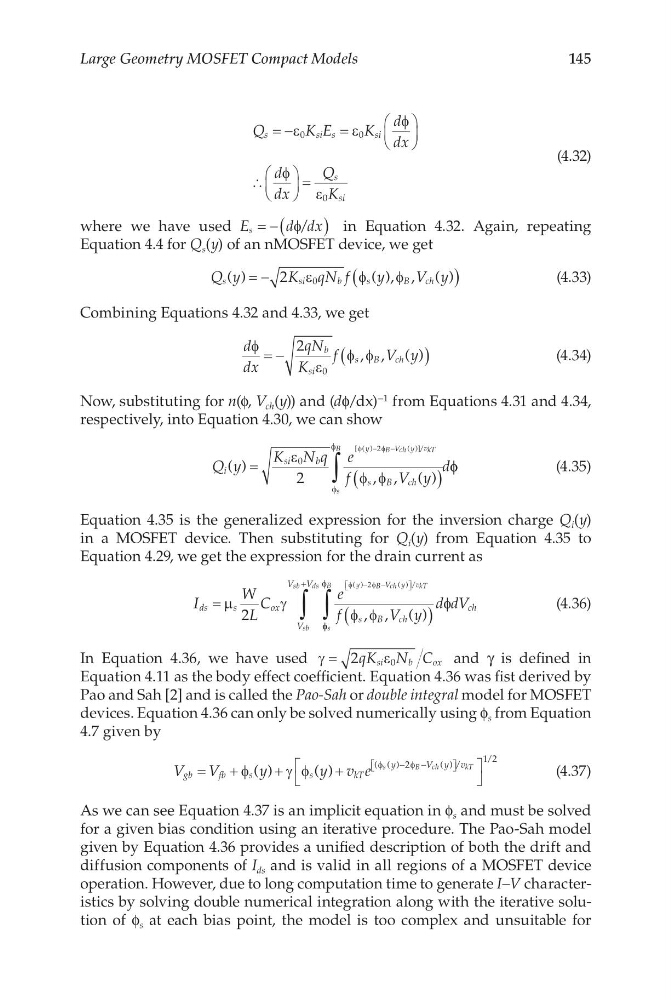
where we have used E
d dx
s = −(
)
φ/
in Equation 4.32. Again, repeating
Equation 4.4 for Q s (y) of an nMOSFET device, we get
Q y
K qN f
y
V y
s
s i
b
s
B
ch
( )
( ), , ( )
= −
(
)
2
0
ε
φ
φ
(4.33)
Combining Equations 4.32 and 4.33, we get
d
dx
qN
K
f
V y
b
si
s
B
ch
φ
ε
φ φ
= −
(
)
2
0
, , ( )
(4.34)
Now, substituting for n(f, V ch (y)) and (df/dx) −1 from Equations 4.31 and 4.34,
respectively, into Equation 4.30, we can show
Q y
K N q e
f
V y
d
i
si
b
s
B
ch
y
B Vch y vkT
s
B
( )
, , ( )
[ ( )
()]/
=
(
)
−
−
∫
ε
φ φ
φ
φ
φ
φ
0
2
2
φ φ
(4.35)
Equation 4.35 is the generalized expression for the inversion charge Q i (y)
in a MOSFET device. Then substituting for Q i (y) from Equation 4.35 to
Equation 4.29, we get the expression for the drain current as
I
W
L
C
e
f
V y
d dV
ds
s
o x
s
B
ch
ch
y
B Vch y vkT
=
(
)
−
−
µ
γ
φ φ
φ
φ
φ
2
2
( )
( ) /
, , ( )
φ φ
φ
s
B
sb
sb
ds
V
V V ∫
∫
+
(4.36)
In Equation 4.36, we have used γ
ε
= 2
0
qK N C
si
b
o x and γ is defined in
Equation 4.11 as the body effect coefficient. Equation 4.36 was fist derived by
Pao and Sah [2] and is called the Pao-Sah or double integral model for MOSFET
devices. Equation 4.36 can only be solved numerically using f s from Equation
4.7 given by
V
V
y
y v e
gb
fb
s
s
kT
y
V y v
s
B
ch
kT
=
+
+
+
−
−
φ
γ φ
φ
φ
( )
( )
( ( )
() /
/
2
1 2
(4.37)
As we can see Equation 4.37 is an implicit equation in f s and must be solved
for a given bias condition using an iterative procedure. The Pao-Sah model
given by Equation 4.36 provides a unified description of both the drift and
diffusion components of I ds and is valid in all regions of a MOSFET device
operation. However, due to long computation time to generate I–V characteristics by solving double numerical integration along with the iterative solution of f s at each bias point, the model is too complex and unsuitable for
Large Geometry MOSFET Compact Models
Q
K E
K
d
dx
d
dx
Q
K
s
s i s
si
s
si
= −
=
∴
=
ε
ε
φ
φ
ε
0
0
0
(4.32)
where we have used E
d dx
s = −(
)
φ/
in Equation 4.32. Again, repeating
Equation 4.4 for Q s (y) of an nMOSFET device, we get
Q y
K qN f
y
V y
s
s i
b
s
B
ch
( )
( ), , ( )
= −
(
)
2
0
ε
φ
φ
(4.33)
Combining Equations 4.32 and 4.33, we get
d
dx
qN
K
f
V y
b
si
s
B
ch
φ
ε
φ φ
= −
(
)
2
0
, , ( )
(4.34)
Now, substituting for n(f, V ch (y)) and (df/dx) −1 from Equations 4.31 and 4.34,
respectively, into Equation 4.30, we can show
Q y
K N q e
f
V y
d
i
si
b
s
B
ch
y
B Vch y vkT
s
B
( )
, , ( )
[ ( )
()]/
=
(
)
−
−
∫
ε
φ φ
φ
φ
φ
φ
0
2
2
φ φ
(4.35)
Equation 4.35 is the generalized expression for the inversion charge Q i (y)
in a MOSFET device. Then substituting for Q i (y) from Equation 4.35 to
Equation 4.29, we get the expression for the drain current as
I
W
L
C
e
f
V y
d dV
ds
s
o x
s
B
ch
ch
y
B Vch y vkT
=
(
)
−
−
µ
γ
φ φ
φ
φ
φ
2
2
( )
( ) /
, , ( )
φ φ
φ
s
B
sb
sb
ds
V
V V ∫
∫
+
(4.36)
In Equation 4.36, we have used γ
ε
= 2
0
qK N C
si
b
o x and γ is defined in
Equation 4.11 as the body effect coefficient. Equation 4.36 was fist derived by
Pao and Sah [2] and is called the Pao-Sah or double integral model for MOSFET
devices. Equation 4.36 can only be solved numerically using f s from Equation
4.7 given by
V
V
y
y v e
gb
fb
s
s
kT
y
V y v
s
B
ch
kT
=
+
+
+
−
−
φ
γ φ
φ
φ
( )
( )
( ( )
() /
/
2
1 2
(4.37)
As we can see Equation 4.37 is an implicit equation in f s and must be solved
for a given bias condition using an iterative procedure. The Pao-Sah model
given by Equation 4.36 provides a unified description of both the drift and
diffusion components of I ds and is valid in all regions of a MOSFET device
operation. However, due to long computation time to generate I–V characteristics by solving double numerical integration along with the iterative solution of f s at each bias point, the model is too complex and unsuitable for