

95
Metal-Oxide-Semiconductor System
nonideal insulator as discussed in Section 3.2.2, and (3) the induced charge
Q s in the silicon underneath the gate oxide. Then from the charge neutrality
condition we get
Q Q Q
g
o
s
+ + = 0
(3.18)
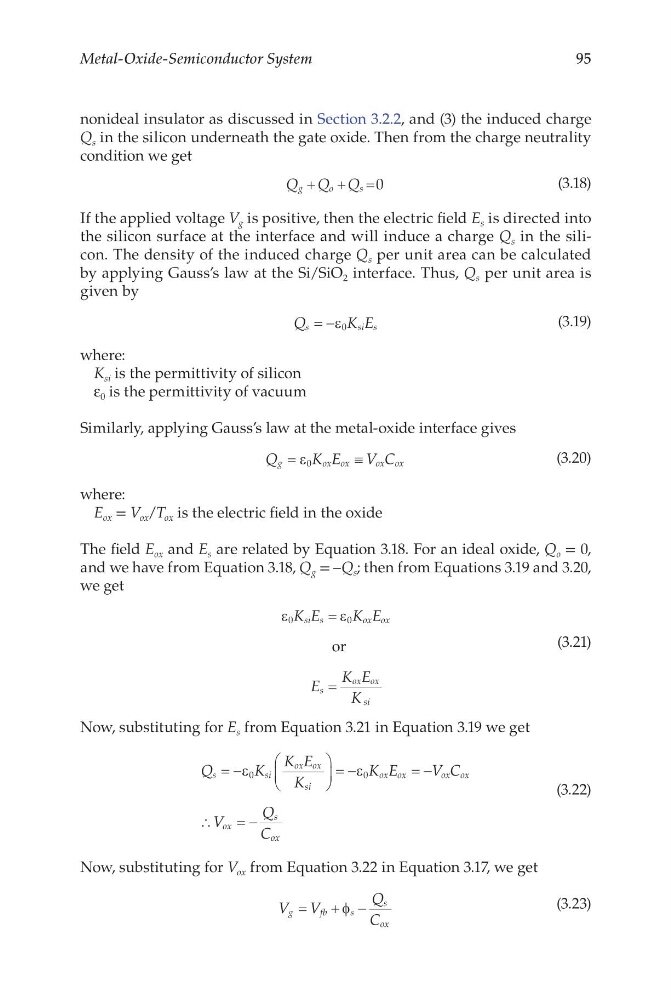
If the applied voltage V g is positive, then the electric field E s is directed into
the silicon surface at the interface and will induce a charge Q s in the silicon. The density of the induced charge Q s per unit area can be calculated
by applying Gauss’s law at the Si/SiO 2 interface. Thus, Q s per unit area is
given by
Q
K E
s
s i s
= −ε 0
(3.19)
where:
K si is the permittivity of silicon
ε 0 is the permittivity of vacuum
Similarly, applying Gauss’s law at the metal-oxide interface gives
Q
K E
V C
g
o x ox
o x ox
=
≡
ε 0
(3.20)
where:
E ox = V ox /T ox is the electric field in the oxide
The field E ox and E s are related by Equation 3.18. For an ideal oxide, Q o = 0,
and we have from Equation 3.18, Q g = –Q s ; then from Equations 3.19 and 3.20,
we get
ε
ε
0
0
K E
K E
E
K E
K
si s
o x ox
s
ox ox
si
=
=
or
(3.21)
Now, substituting for E s from Equation 3.21 in Equation 3.19 we get
Q
K
K E
K
K E
V C
V
Q
C
s
s i
ox ox
si
ox ox
ox ox
ox
s
ox
= −
= −
= −
∴
=−
ε
ε
0
0
(3.22)
Now, substituting for V ox from Equation 3.22 in Equation 3.17, we get
V V
Q
C
g
f b
s
s
ox
=
+ −
φ
(3.23)
Metal-Oxide-Semiconductor System
nonideal insulator as discussed in Section 3.2.2, and (3) the induced charge
Q s in the silicon underneath the gate oxide. Then from the charge neutrality
condition we get
Q Q Q
g
o
s
+ + = 0
(3.18)
If the applied voltage V g is positive, then the electric field E s is directed into
the silicon surface at the interface and will induce a charge Q s in the silicon. The density of the induced charge Q s per unit area can be calculated
by applying Gauss’s law at the Si/SiO 2 interface. Thus, Q s per unit area is
given by
Q
K E
s
s i s
= −ε 0
(3.19)
where:
K si is the permittivity of silicon
ε 0 is the permittivity of vacuum
Similarly, applying Gauss’s law at the metal-oxide interface gives
Q
K E
V C
g
o x ox
o x ox
=
≡
ε 0
(3.20)
where:
E ox = V ox /T ox is the electric field in the oxide
The field E ox and E s are related by Equation 3.18. For an ideal oxide, Q o = 0,
and we have from Equation 3.18, Q g = –Q s ; then from Equations 3.19 and 3.20,
we get
ε
ε
0
0
K E
K E
E
K E
K
si s
o x ox
s
ox ox
si
=
=
or
(3.21)
Now, substituting for E s from Equation 3.21 in Equation 3.19 we get
Q
K
K E
K
K E
V C
V
Q
C
s
s i
ox ox
si
ox ox
ox ox
ox
s
ox
= −
= −
= −
∴
=−
ε
ε
0
0
(3.22)
Now, substituting for V ox from Equation 3.22 in Equation 3.17, we get
V V
Q
C
g
f b
s
s
ox
=
+ −
φ
(3.23)