

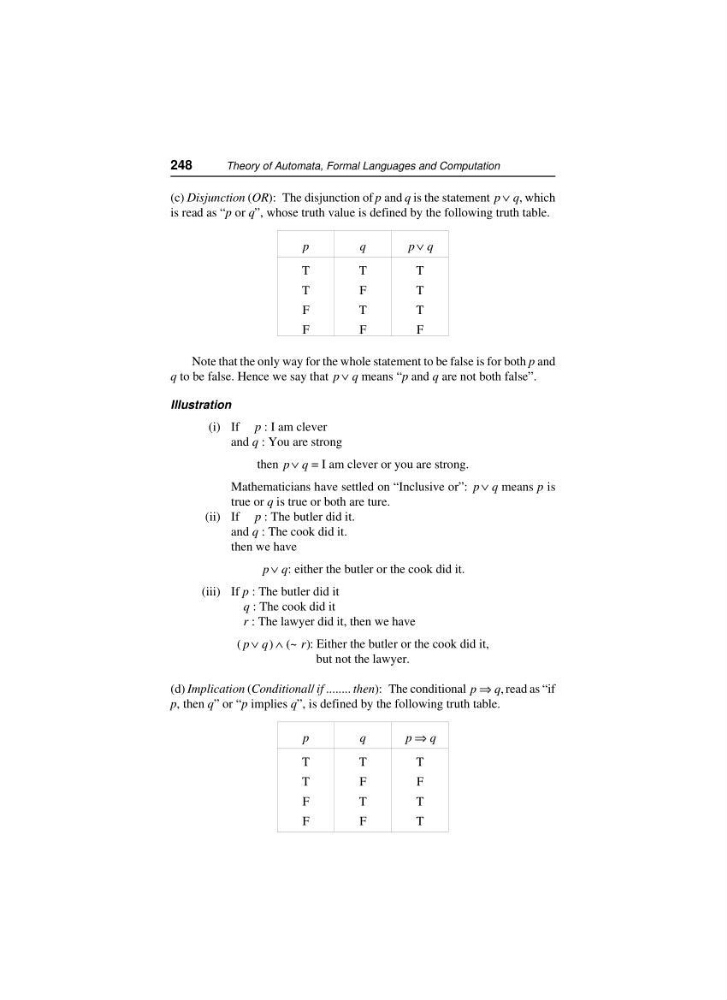
(c) Disjunction (OR): The disjunction of p and q is the statement p q
∨ , which
is read as “p or q”, whose truth value is defined by the following truth table.
p
q
p q
∨
T
T
T
T
F
T
F
T
T
F
F
F
Note that the only way for the whole statement to be false is for both p and
q to be false. Hence we say that p q
∨ means “p and q are not both false”.
Illus tra tion
(i) If p : I am clever
and q : You are strong
then p q
∨ = I am clever or you are strong.
Mathematicians have settled on “Inclusive or”: p q
∨ means p is
true or q is true or both are ture.
(ii) If p : The butler did it.
and q : The cook did it.
then we have
p q
∨ : either the but ler or the cook did it.
(iii) If p : The butler did it
q : The cook did it
r : The lawyer did it, then we have
(
) (~ )
p q
r
∨ ∧
: Either the but ler or the cook did it,
but not the law yer.
(d) Implication (Conditional/ if ........ then): The conditional p q
⇒ , read as “if
p, then q” or “p implies q”, is defined by the following truth table.
p
q
p q
⇒
T
T
T
T
F
F
F
T
T
F
F
T
248
Theory of Automata, Formal Languages and Computation
∨ , which
is read as “p or q”, whose truth value is defined by the following truth table.
p
q
p q
∨
T
T
T
T
F
T
F
T
T
F
F
F
Note that the only way for the whole statement to be false is for both p and
q to be false. Hence we say that p q
∨ means “p and q are not both false”.
Illus tra tion
(i) If p : I am clever
and q : You are strong
then p q
∨ = I am clever or you are strong.
Mathematicians have settled on “Inclusive or”: p q
∨ means p is
true or q is true or both are ture.
(ii) If p : The butler did it.
and q : The cook did it.
then we have
p q
∨ : either the but ler or the cook did it.
(iii) If p : The butler did it
q : The cook did it
r : The lawyer did it, then we have
(
) (~ )
p q
r
∨ ∧
: Either the but ler or the cook did it,
but not the law yer.
(d) Implication (Conditional/ if ........ then): The conditional p q
⇒ , read as “if
p, then q” or “p implies q”, is defined by the following truth table.
p
q
p q
⇒
T
T
T
T
F
F
F
T
T
F
F
T
248
Theory of Automata, Formal Languages and Computation