

The arrow ⇒ is the “conditional” operator, and in p q
⇒ the statement p is
called the “antecedent” or “hypothesis”, and q is called the “consequent”, or
“conclusion”.
Illus tra tion
(i) If p and q are both true, then p q
⇒ is true. For example, “if 2 + 2 = 4, then
the sun rises in the East”
Here: p : “2 + 2 = 4” and q : “the sun rises in the east”.
(ii) If p is true and q is false, then p q
⇒ is false. For example:
“When it rains, I carry an umbrella”. Here p : It is raining; q : I carry an
umbrella.
If it is raining then I carry an umbrella. Now there are lot of days when it
rains (p is true) and I forget to bring my umbrella (q is false). On any of those
days the statement p q
⇒ is clearly false.
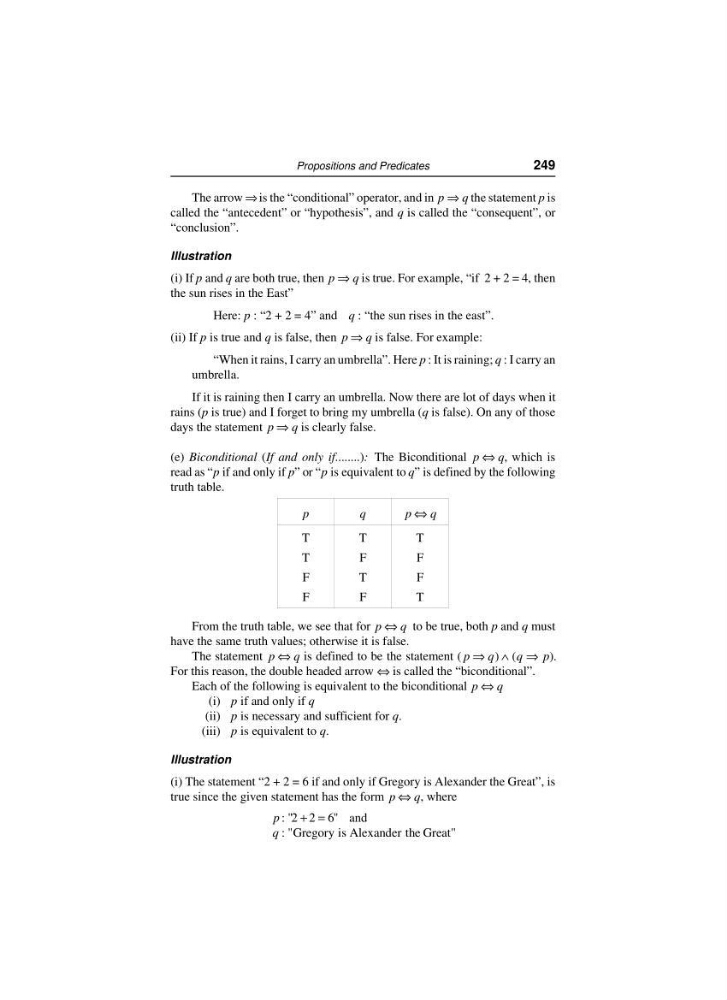
(e) Biconditional (If and only if........): The Biconditional p q
⇔ , which is
read as “p if and only if p” or “p is equivalent to q” is defined by the following
truth table.
p
q
p q
⇔
T
T
T
T
F
F
F
T
F
F
F
T
From the truth table, we see that for p q
⇔ to be true, both p and q must
have the same truth values; otherwise it is false.
The statement p q
⇔ is defined to be the statement (
) (
).
p q
q
p
⇒ ∧ ⇒
For this reason, the double headed arrow ⇔ is called the “biconditional”.
Each of the following is equivalent to the biconditional p q
⇔
(i) p if and only if q
(ii) p is necessary and sufficient for q.
(iii) p is equivalent to q.
Illus tra tion
(i) The statement “2 + 2 = 6 if and only if Gregory is Alexander the Great”, is
true since the given statement has the form p q
⇔ , where
p
q
: "
"
: "
2 2 6
+ =
and
Gregory is Alexander the Great"
Prop o si tions and Pred i cates
249
⇒ the statement p is
called the “antecedent” or “hypothesis”, and q is called the “consequent”, or
“conclusion”.
Illus tra tion
(i) If p and q are both true, then p q
⇒ is true. For example, “if 2 + 2 = 4, then
the sun rises in the East”
Here: p : “2 + 2 = 4” and q : “the sun rises in the east”.
(ii) If p is true and q is false, then p q
⇒ is false. For example:
“When it rains, I carry an umbrella”. Here p : It is raining; q : I carry an
umbrella.
If it is raining then I carry an umbrella. Now there are lot of days when it
rains (p is true) and I forget to bring my umbrella (q is false). On any of those
days the statement p q
⇒ is clearly false.
(e) Biconditional (If and only if........): The Biconditional p q
⇔ , which is
read as “p if and only if p” or “p is equivalent to q” is defined by the following
truth table.
p
q
p q
⇔
T
T
T
T
F
F
F
T
F
F
F
T
From the truth table, we see that for p q
⇔ to be true, both p and q must
have the same truth values; otherwise it is false.
The statement p q
⇔ is defined to be the statement (
) (
).
p q
q
p
⇒ ∧ ⇒
For this reason, the double headed arrow ⇔ is called the “biconditional”.
Each of the following is equivalent to the biconditional p q
⇔
(i) p if and only if q
(ii) p is necessary and sufficient for q.
(iii) p is equivalent to q.
Illus tra tion
(i) The statement “2 + 2 = 6 if and only if Gregory is Alexander the Great”, is
true since the given statement has the form p q
⇔ , where
p
q
: "
"
: "
2 2 6
+ =
and
Gregory is Alexander the Great"
Prop o si tions and Pred i cates
249