

It is very important to be careful while negating a statement involving the
words “All” or “Some”. The use of these “quantifiers” is the subject of
“Predicate calculus”. ~p is also written as ¬ p.
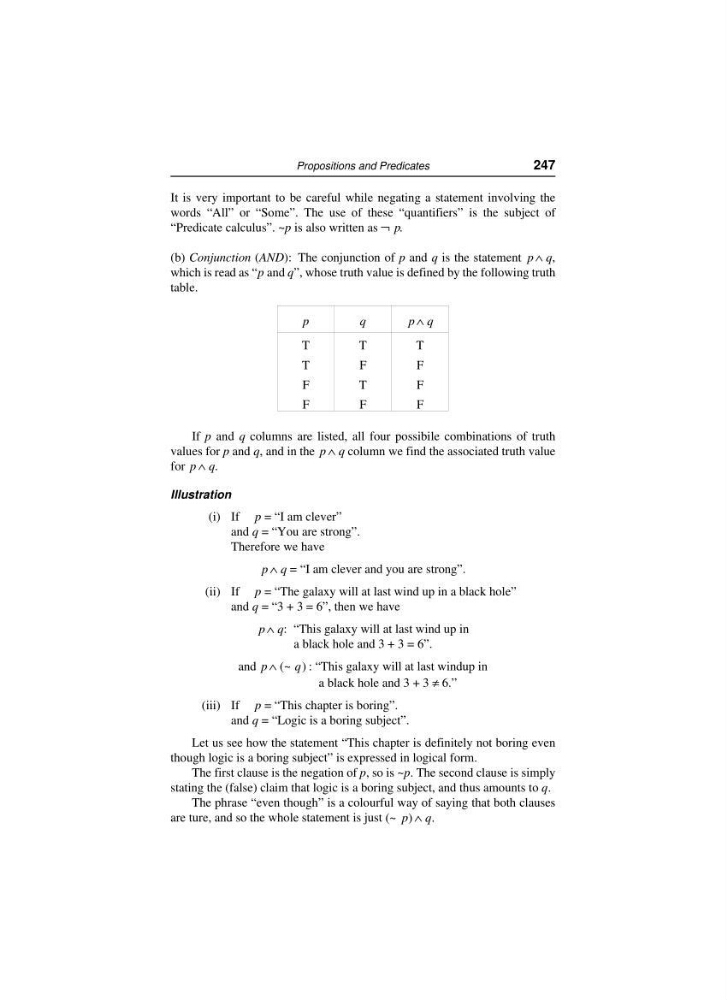
(b) Conjunction (AND): The conjunction of p and q is the statement p q
∧ ,
which is read as “p and q”, whose truth value is defined by the following truth
table.
p
q
p q
∧
T
T
T
T
F
F
F
T
F
F
F
F
If p and q columns are listed, all four possibile combinations of truth
values for p and q, and in the p q
∧ column we find the associated truth value
for p q
∧ .
Illus tra tion
(i) If p = “I am clever”
and q = “You are strong”.
Therefore we have
p q
∧ = “I am clever and you are strong”.
(ii) If p = “The galaxy will at last wind up in a black hole”
and q = “3 + 3 = 6”, then we have
p q
∧ : “This gal axy will at last wind up in
a black hole and 3 + 3 = 6”.
and p
q
∧ (~ ) : “This gal axy will at last windup in
a black hole and 3 + 3 ≠ 6.”
(iii) If p = “This chapter is boring”.
and q = “Logic is a boring subject”.
Let us see how the statement “This chapter is definitely not boring even
though logic is a boring subject” is expressed in logical form.
The first clause is the negation of p, so is ~p. The second clause is simply
stating the (false) claim that logic is a boring subject, and thus amounts to q.
The phrase “even though” is a colourful way of saying that both clauses
are ture, and so the whole statement is just (~ )
.
p q
∧
Prop o si tions and Pred i cates
247
words “All” or “Some”. The use of these “quantifiers” is the subject of
“Predicate calculus”. ~p is also written as ¬ p.
(b) Conjunction (AND): The conjunction of p and q is the statement p q
∧ ,
which is read as “p and q”, whose truth value is defined by the following truth
table.
p
q
p q
∧
T
T
T
T
F
F
F
T
F
F
F
F
If p and q columns are listed, all four possibile combinations of truth
values for p and q, and in the p q
∧ column we find the associated truth value
for p q
∧ .
Illus tra tion
(i) If p = “I am clever”
and q = “You are strong”.
Therefore we have
p q
∧ = “I am clever and you are strong”.
(ii) If p = “The galaxy will at last wind up in a black hole”
and q = “3 + 3 = 6”, then we have
p q
∧ : “This gal axy will at last wind up in
a black hole and 3 + 3 = 6”.
and p
q
∧ (~ ) : “This gal axy will at last windup in
a black hole and 3 + 3 ≠ 6.”
(iii) If p = “This chapter is boring”.
and q = “Logic is a boring subject”.
Let us see how the statement “This chapter is definitely not boring even
though logic is a boring subject” is expressed in logical form.
The first clause is the negation of p, so is ~p. The second clause is simply
stating the (false) claim that logic is a boring subject, and thus amounts to q.
The phrase “even though” is a colourful way of saying that both clauses
are ture, and so the whole statement is just (~ )
.
p q
∧
Prop o si tions and Pred i cates
247