

Microcontrollers
573
Microcontroller
Master (1)
SCL
Slave
(1)
SDA
Slave
(2)
Master-Slave
(1)
Slave
(n)
SCL-Line
SDA-Line
Master-Slave
(2)
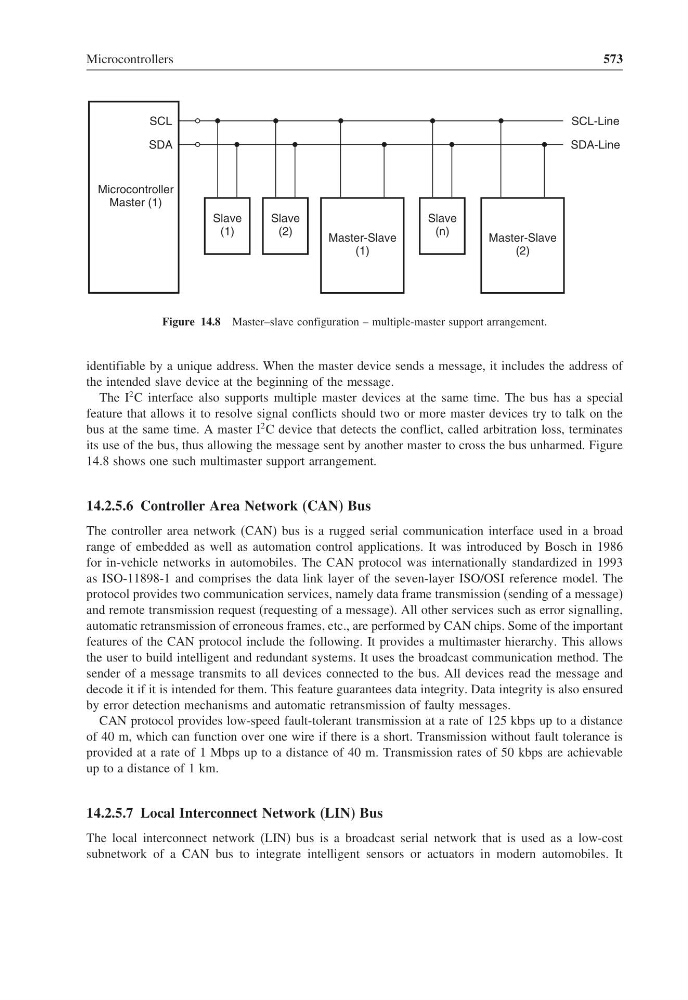
Figure 14.8 Master–slave configuration – multiple-master support arrangement.
identifiable by a unique address. When the master device sends a message, it includes the address of
the intended slave device at the beginning of the message.
The I
2 C interface also supports multiple master devices at the same time. The bus has a special
feature that allows it to resolve signal conflicts should two or more master devices try to talk on the
bus at the same time. A master I
2 C device that detects the conflict, called arbitration loss, terminates
its use of the bus, thus allowing the message sent by another master to cross the bus unharmed. Figure
14.8 shows one such multimaster support arrangement.
14.2.5.6 Controller Area Network (CAN) Bus
The controller area network (CAN) bus is a rugged serial communication interface used in a broad
range of embedded as well as automation control applications. It was introduced by Bosch in 1986
for in-vehicle networks in automobiles. The CAN protocol was internationally standardized in 1993
as ISO-11898-1 and comprises the data link layer of the seven-layer ISO/OSI reference model. The
protocol provides two communication services, namely data frame transmission (sending of a message)
and remote transmission request (requesting of a message). All other services such as error signalling,
automatic retransmission of erroneous frames, etc., are performed by CAN chips. Some of the important
features of the CAN protocol include the following. It provides a multimaster hierarchy. This allows
the user to build intelligent and redundant systems. It uses the broadcast communication method. The
sender of a message transmits to all devices connected to the bus. All devices read the message and
decode it if it is intended for them. This feature guarantees data integrity. Data integrity is also ensured
by error detection mechanisms and automatic retransmission of faulty messages.
CAN protocol provides low-speed fault-tolerant transmission at a rate of 125 kbps up to a distance
of 40 m, which can function over one wire if there is a short. Transmission without fault tolerance is
provided at a rate of 1 Mbps up to a distance of 40 m. Transmission rates of 50 kbps are achievable
up to a distance of 1 km.
14.2.5.7 Local Interconnect Network (LIN) Bus
The local interconnect network (LIN) bus is a broadcast serial network that is used as a low-cost
subnetwork of a CAN bus to integrate intelligent sensors or actuators in modern automobiles. It
573
Microcontroller
Master (1)
SCL
Slave
(1)
SDA
Slave
(2)
Master-Slave
(1)
Slave
(n)
SCL-Line
SDA-Line
Master-Slave
(2)
Figure 14.8 Master–slave configuration – multiple-master support arrangement.
identifiable by a unique address. When the master device sends a message, it includes the address of
the intended slave device at the beginning of the message.
The I
2 C interface also supports multiple master devices at the same time. The bus has a special
feature that allows it to resolve signal conflicts should two or more master devices try to talk on the
bus at the same time. A master I
2 C device that detects the conflict, called arbitration loss, terminates
its use of the bus, thus allowing the message sent by another master to cross the bus unharmed. Figure
14.8 shows one such multimaster support arrangement.
14.2.5.6 Controller Area Network (CAN) Bus
The controller area network (CAN) bus is a rugged serial communication interface used in a broad
range of embedded as well as automation control applications. It was introduced by Bosch in 1986
for in-vehicle networks in automobiles. The CAN protocol was internationally standardized in 1993
as ISO-11898-1 and comprises the data link layer of the seven-layer ISO/OSI reference model. The
protocol provides two communication services, namely data frame transmission (sending of a message)
and remote transmission request (requesting of a message). All other services such as error signalling,
automatic retransmission of erroneous frames, etc., are performed by CAN chips. Some of the important
features of the CAN protocol include the following. It provides a multimaster hierarchy. This allows
the user to build intelligent and redundant systems. It uses the broadcast communication method. The
sender of a message transmits to all devices connected to the bus. All devices read the message and
decode it if it is intended for them. This feature guarantees data integrity. Data integrity is also ensured
by error detection mechanisms and automatic retransmission of faulty messages.
CAN protocol provides low-speed fault-tolerant transmission at a rate of 125 kbps up to a distance
of 40 m, which can function over one wire if there is a short. Transmission without fault tolerance is
provided at a rate of 1 Mbps up to a distance of 40 m. Transmission rates of 50 kbps are achievable
up to a distance of 1 km.
14.2.5.7 Local Interconnect Network (LIN) Bus
The local interconnect network (LIN) bus is a broadcast serial network that is used as a low-cost
subnetwork of a CAN bus to integrate intelligent sensors or actuators in modern automobiles. It