

538
Digital Electronics
13.6.1.2 Power consumption
Power consumption is an important factor for battery-operated systems. The power consumption of a
microprocessor varies with the supply voltage (square of supply voltage), speed (linearly) and with
the software the chip is running. The bus structure of the processor and its interconnection with the
memory ICs should also be looked into.
13.6.1.3 Performance
Processors that are good for one task may not be suitable for another. It is therefore very important
to define the processor requirements for the given application. These include the estimated size and
complexity of the program, speed requirements (time-critical functions), the language to be used, the
arithmetic functions needed, memory requirements (ROM, RAM and mass storage), I/O requirements
and interrupt source and response time required.
After defining the application requirements, they should be matched with those that a processor can
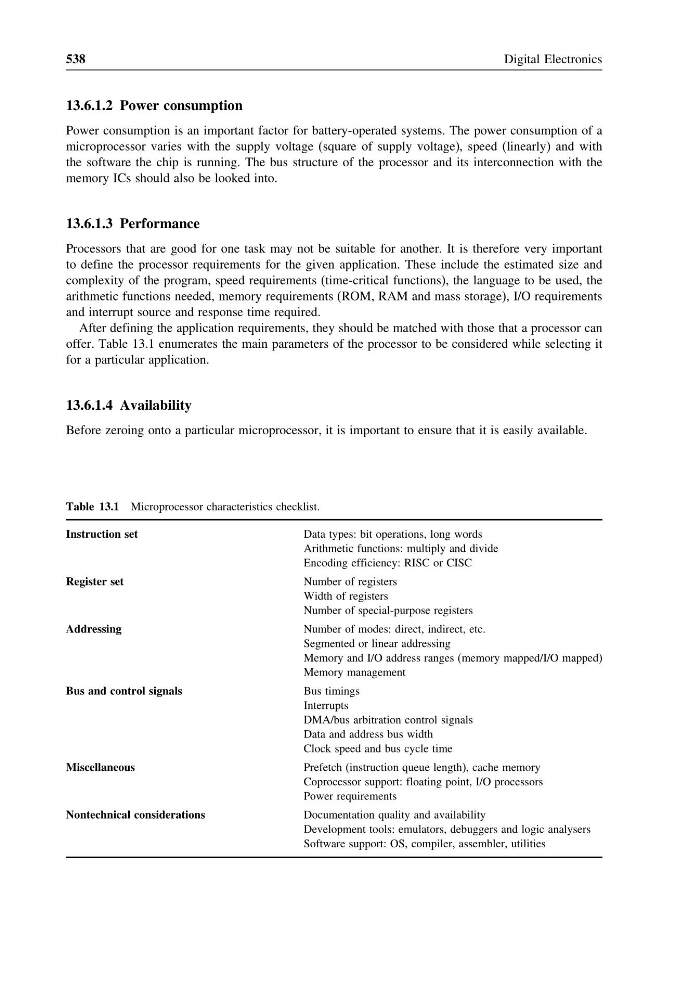
offer. Table 13.1 enumerates the main parameters of the processor to be considered while selecting it
for a particular application.
13.6.1.4 Availability
Before zeroing onto a particular microprocessor, it is important to ensure that it is easily available.
Table 13.1 Microprocessor characteristics checklist.
Instruction set
Data types: bit operations, long words
Arithmetic functions: multiply and divide
Encoding efficiency: RISC or CISC
Register set
Number of registers
Width of registers
Number of special-purpose registers
Addressing
Number of modes: direct, indirect, etc.
Segmented or linear addressing
Memory and I/O address ranges (memory mapped/I/O mapped)
Memory management
Bus and control signals
Bus timings
Interrupts
DMA/bus arbitration control signals
Data and address bus width
Clock speed and bus cycle time
Miscellaneous
Prefetch (instruction queue length), cache memory
Coprocessor support: floating point, I/O processors
Power requirements
Nontechnical considerations
Documentation quality and availability
Development tools: emulators, debuggers and logic analysers
Software support: OS, compiler, assembler, utilities
Digital Electronics
13.6.1.2 Power consumption
Power consumption is an important factor for battery-operated systems. The power consumption of a
microprocessor varies with the supply voltage (square of supply voltage), speed (linearly) and with
the software the chip is running. The bus structure of the processor and its interconnection with the
memory ICs should also be looked into.
13.6.1.3 Performance
Processors that are good for one task may not be suitable for another. It is therefore very important
to define the processor requirements for the given application. These include the estimated size and
complexity of the program, speed requirements (time-critical functions), the language to be used, the
arithmetic functions needed, memory requirements (ROM, RAM and mass storage), I/O requirements
and interrupt source and response time required.
After defining the application requirements, they should be matched with those that a processor can
offer. Table 13.1 enumerates the main parameters of the processor to be considered while selecting it
for a particular application.
13.6.1.4 Availability
Before zeroing onto a particular microprocessor, it is important to ensure that it is easily available.
Table 13.1 Microprocessor characteristics checklist.
Instruction set
Data types: bit operations, long words
Arithmetic functions: multiply and divide
Encoding efficiency: RISC or CISC
Register set
Number of registers
Width of registers
Number of special-purpose registers
Addressing
Number of modes: direct, indirect, etc.
Segmented or linear addressing
Memory and I/O address ranges (memory mapped/I/O mapped)
Memory management
Bus and control signals
Bus timings
Interrupts
DMA/bus arbitration control signals
Data and address bus width
Clock speed and bus cycle time
Miscellaneous
Prefetch (instruction queue length), cache memory
Coprocessor support: floating point, I/O processors
Power requirements
Nontechnical considerations
Documentation quality and availability
Development tools: emulators, debuggers and logic analysers
Software support: OS, compiler, assembler, utilities