

Microprocessors
539
13.6.1.5 Software support
The associated software with the microprocessor, such as the debugger, compiler and operating system,
constitutes one of the factors that needs to be considered.
13.6.1.6 Code density
The code density is the ratio between the size of the source code and the size of the object code.
The smaller the object code, the better is the code density. Processors having high code densities
require less memory to execute the code. RISC processors have poor code density compared with
CISC processors.
Moreover, there is seldom one right microprocessor for a given task. There are several chips that
can be used for a given task. Factors such as past experience, the market reputation of the processor
and availability are considered before making the final decision.
13.6.2 Microprocessor Selection Table for Common Applications
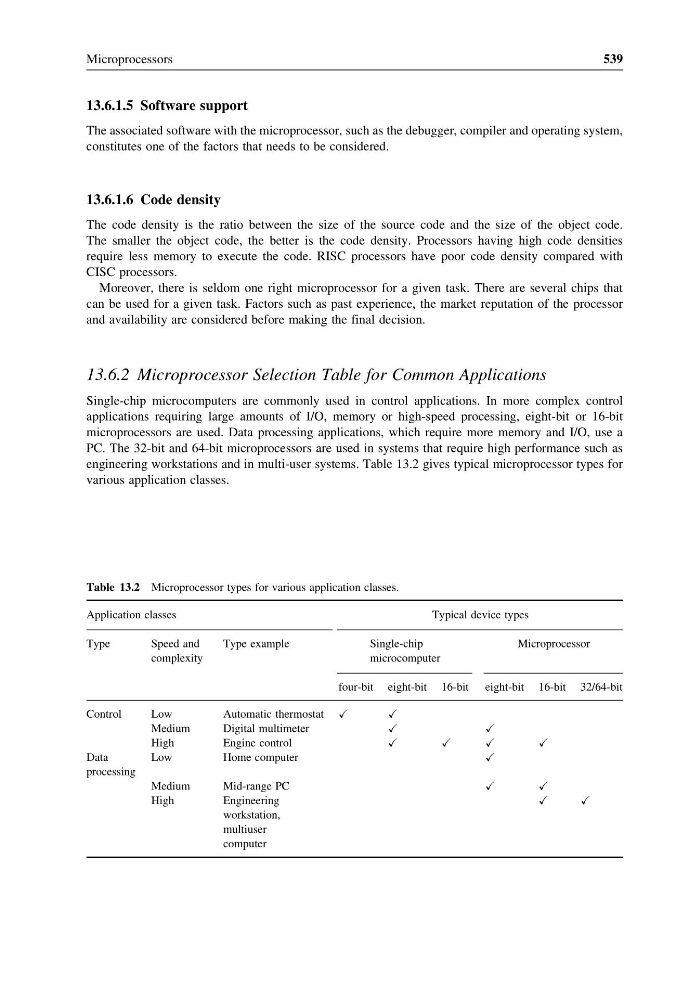
Single-chip microcomputers are commonly used in control applications. In more complex control
applications requiring large amounts of I/O, memory or high-speed processing, eight-bit or 16-bit
microprocessors are used. Data processing applications, which require more memory and I/O, use a
PC. The 32-bit and 64-bit microprocessors are used in systems that require high performance such as
engineering workstations and in multi-user systems. Table 13.2 gives typical microprocessor types for
various application classes.
Table 13.2 Microprocessor types for various application classes.
Application classes
Typical device types
Type
Speed and
complexity
Type example
Single-chip
microcomputer
Microprocessor
four-bit eight-bit 16-bit eight-bit 16-bit 32/64-bit
Control
Low
Automatic thermostat
Medium
Digital multimeter
High
Engine control
Data
processing
Low
Home computer
Medium
Mid-range PC
High
Engineering
workstation,
multiuser
computer
539
13.6.1.5 Software support
The associated software with the microprocessor, such as the debugger, compiler and operating system,
constitutes one of the factors that needs to be considered.
13.6.1.6 Code density
The code density is the ratio between the size of the source code and the size of the object code.
The smaller the object code, the better is the code density. Processors having high code densities
require less memory to execute the code. RISC processors have poor code density compared with
CISC processors.
Moreover, there is seldom one right microprocessor for a given task. There are several chips that
can be used for a given task. Factors such as past experience, the market reputation of the processor
and availability are considered before making the final decision.
13.6.2 Microprocessor Selection Table for Common Applications
Single-chip microcomputers are commonly used in control applications. In more complex control
applications requiring large amounts of I/O, memory or high-speed processing, eight-bit or 16-bit
microprocessors are used. Data processing applications, which require more memory and I/O, use a
PC. The 32-bit and 64-bit microprocessors are used in systems that require high performance such as
engineering workstations and in multi-user systems. Table 13.2 gives typical microprocessor types for
various application classes.
Table 13.2 Microprocessor types for various application classes.
Application classes
Typical device types
Type
Speed and
complexity
Type example
Single-chip
microcomputer
Microprocessor
four-bit eight-bit 16-bit eight-bit 16-bit 32/64-bit
Control
Low
Automatic thermostat
Medium
Digital multimeter
High
Engine control
Data
processing
Low
Home computer
Medium
Mid-range PC
High
Engineering
workstation,
multiuser
computer