

Microprocessors
537
Operation Register Constant
Data
Memory
+
Address
Register
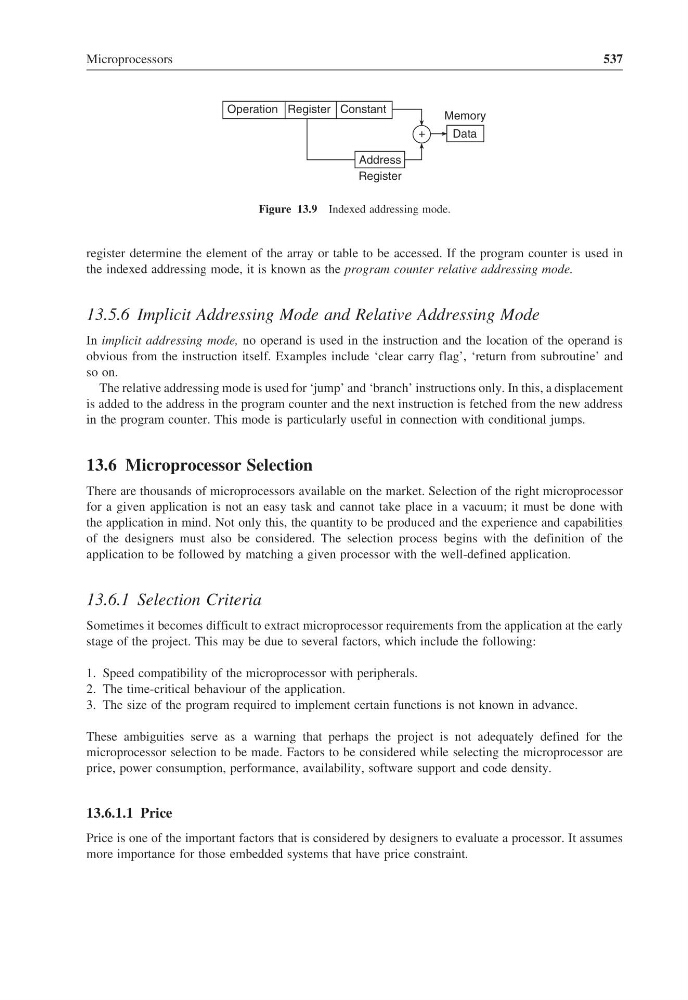
Figure 13.9 Indexed addressing mode.
register determine the element of the array or table to be accessed. If the program counter is used in
the indexed addressing mode, it is known as the program counter relative addressing mode.
13.5.6 Implicit Addressing Mode and Relative Addressing Mode
In implicit addressing mode, no operand is used in the instruction and the location of the operand is
obvious from the instruction itself. Examples include ‘clear carry flag’, ‘return from subroutine’ and
so on.
The relative addressing mode is used for ‘jump’ and ‘branch’ instructions only. In this, a displacement
is added to the address in the program counter and the next instruction is fetched from the new address
in the program counter. This mode is particularly useful in connection with conditional jumps.
13.6 Microprocessor Selection
There are thousands of microprocessors available on the market. Selection of the right microprocessor
for a given application is not an easy task and cannot take place in a vacuum; it must be done with
the application in mind. Not only this, the quantity to be produced and the experience and capabilities
of the designers must also be considered. The selection process begins with the definition of the
application to be followed by matching a given processor with the well-defined application.
13.6.1 Selection Criteria
Sometimes it becomes difficult to extract microprocessor requirements from the application at the early
stage of the project. This may be due to several factors, which include the following:
1. Speed compatibility of the microprocessor with peripherals.
2. The time-critical behaviour of the application.
3. The size of the program required to implement certain functions is not known in advance.
These ambiguities serve as a warning that perhaps the project is not adequately defined for the
microprocessor selection to be made. Factors to be considered while selecting the microprocessor are
price, power consumption, performance, availability, software support and code density.
13.6.1.1 Price
Price is one of the important factors that is considered by designers to evaluate a processor. It assumes
more importance for those embedded systems that have price constraint.
537
Operation Register Constant
Data
Memory
+
Address
Register
Figure 13.9 Indexed addressing mode.
register determine the element of the array or table to be accessed. If the program counter is used in
the indexed addressing mode, it is known as the program counter relative addressing mode.
13.5.6 Implicit Addressing Mode and Relative Addressing Mode
In implicit addressing mode, no operand is used in the instruction and the location of the operand is
obvious from the instruction itself. Examples include ‘clear carry flag’, ‘return from subroutine’ and
so on.
The relative addressing mode is used for ‘jump’ and ‘branch’ instructions only. In this, a displacement
is added to the address in the program counter and the next instruction is fetched from the new address
in the program counter. This mode is particularly useful in connection with conditional jumps.
13.6 Microprocessor Selection
There are thousands of microprocessors available on the market. Selection of the right microprocessor
for a given application is not an easy task and cannot take place in a vacuum; it must be done with
the application in mind. Not only this, the quantity to be produced and the experience and capabilities
of the designers must also be considered. The selection process begins with the definition of the
application to be followed by matching a given processor with the well-defined application.
13.6.1 Selection Criteria
Sometimes it becomes difficult to extract microprocessor requirements from the application at the early
stage of the project. This may be due to several factors, which include the following:
1. Speed compatibility of the microprocessor with peripherals.
2. The time-critical behaviour of the application.
3. The size of the program required to implement certain functions is not known in advance.
These ambiguities serve as a warning that perhaps the project is not adequately defined for the
microprocessor selection to be made. Factors to be considered while selecting the microprocessor are
price, power consumption, performance, availability, software support and code density.
13.6.1.1 Price
Price is one of the important factors that is considered by designers to evaluate a processor. It assumes
more importance for those embedded systems that have price constraint.