

Microprocessors
527
RAM
ROM
Output
Interface
Input
Interface
Input
Device
Output
Device
Address Bus
A 15
A 0
8085
microprocessor
D 7
D 0
Clk
RD
—–
WR
—–
RES
—––
INTR
IO/M
Data Bus
}
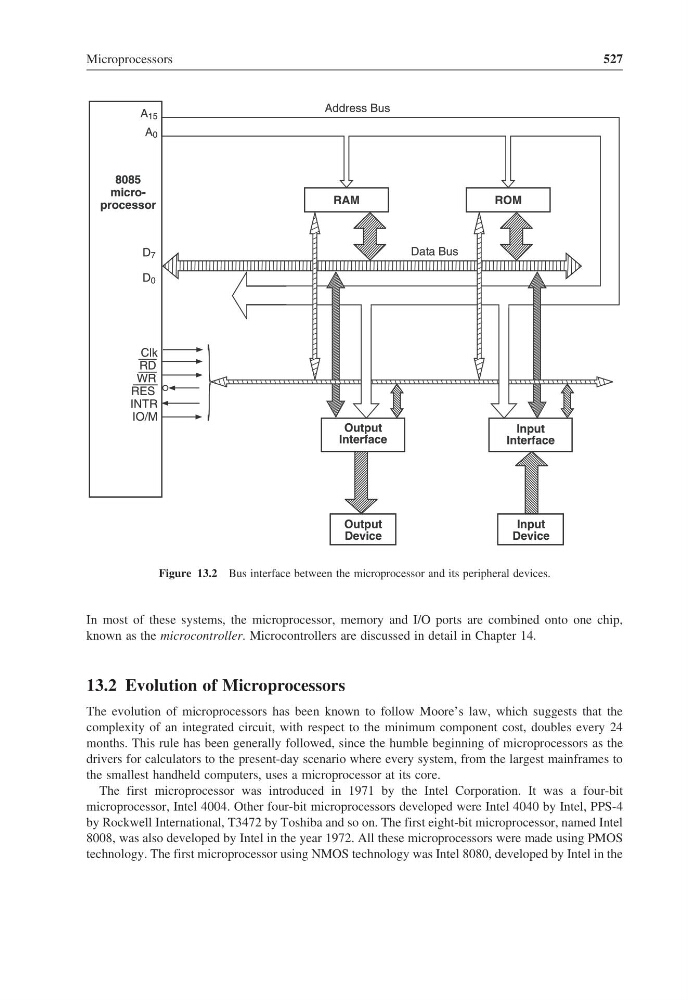
Figure 13.2 Bus interface between the microprocessor and its peripheral devices.
In most of these systems, the microprocessor, memory and I/O ports are combined onto one chip,
known as the microcontroller. Microcontrollers are discussed in detail in Chapter 14.
13.2 Evolution of Microprocessors
The evolution of microprocessors has been known to follow Moore’s law, which suggests that the
complexity of an integrated circuit, with respect to the minimum component cost, doubles every 24
months. This rule has been generally followed, since the humble beginning of microprocessors as the
drivers for calculators to the present-day scenario where every system, from the largest mainframes to
the smallest handheld computers, uses a microprocessor at its core.
The first microprocessor was introduced in 1971 by the Intel Corporation. It was a four-bit
microprocessor, Intel 4004. Other four-bit microprocessors developed were Intel 4040 by Intel, PPS-4
by Rockwell International, T3472 by Toshiba and so on. The first eight-bit microprocessor, named Intel
8008, was also developed by Intel in the year 1972. All these microprocessors were made using PMOS
technology. The first microprocessor using NMOS technology was Intel 8080, developed by Intel in the
527
RAM
ROM
Output
Interface
Input
Interface
Input
Device
Output
Device
Address Bus
A 15
A 0
8085
microprocessor
D 7
D 0
Clk
RD
—–
WR
—–
RES
—––
INTR
IO/M
Data Bus
}
Figure 13.2 Bus interface between the microprocessor and its peripheral devices.
In most of these systems, the microprocessor, memory and I/O ports are combined onto one chip,
known as the microcontroller. Microcontrollers are discussed in detail in Chapter 14.
13.2 Evolution of Microprocessors
The evolution of microprocessors has been known to follow Moore’s law, which suggests that the
complexity of an integrated circuit, with respect to the minimum component cost, doubles every 24
months. This rule has been generally followed, since the humble beginning of microprocessors as the
drivers for calculators to the present-day scenario where every system, from the largest mainframes to
the smallest handheld computers, uses a microprocessor at its core.
The first microprocessor was introduced in 1971 by the Intel Corporation. It was a four-bit
microprocessor, Intel 4004. Other four-bit microprocessors developed were Intel 4040 by Intel, PPS-4
by Rockwell International, T3472 by Toshiba and so on. The first eight-bit microprocessor, named Intel
8008, was also developed by Intel in the year 1972. All these microprocessors were made using PMOS
technology. The first microprocessor using NMOS technology was Intel 8080, developed by Intel in the