

528
Digital Electronics
year 1973. Intel 8080 was followed by Intel 8085 in the year 1975, which became very popular. Other
popular eight-bit microprocessors were Zilog’s Z80 (1976) and Z800, Motorola’s MC6800 (1974) and
MC6809 (1978), National Semiconductor’s NSC 800, RCA’s 1802 (1976) and so on.
The first multichip 16-bit microprocessor was National Semiconductor’s IMP-16, introduced in
1973. The first 16-bit single-chip microprocessor was Texas Instrument’s TMS 9900. Intel’s first 16-bit
microprocessor was Intel 8086 introduced in the year 1978. Other 16-bit microprocessors developed
by Intel were Intel 80186 (1982), Intel 8088, Intel 80188 and Intel 80286 (1982). Other popular 16-bit
microprocessors include Motorola’s 68000 (1979), 68010 and 68012, Zilog’s Z8000, Texas Instruments
TMS 9900 series and so on.
32-bit microprocessors came into existence in the 1980s. The world’s first single-chip 32-bit
microprocessor was introduced by AT&T Bell Labs in the year 1980. It was named BELLMAC32A. The first 32-bit processor introduced by Intel was iapx 432, introduced in 1981. The more
popular 32-bit microprocessor was Intel 80386, introduced by Intel in 1985. It was widely used for
desktop computers. The 32-bit microprocessor family of Intel includes Intel 486, Pentium, Pentium
Pro, Pentium II, Pentium III and Pentium IV. AMD’s K5, K6 and K7, Motorola’s 68020 (1985), 68030
and 68040, National Semiconductor’s 32032 and 32332 and Zilog’s Z80000 are other popular 32-bit
microprocessors. All these microprocessors are based on CISC (Complex Instruction Set Computers)
architecture. The first commercial RISC (Reduced Instruction Set Computers) design was released by
MIPS Technologies, the 32-bit R2000. Some of the popular RISC processors include Intel’s 80860
and 80960, Motorola’s 88100 and Motorola’s, IBM and Apple’s PowerPC series of microprocessors.
While 64-bit microprocessor designs have been in use in several markets since the early 1990s, the
early 2000s have seen the introduction of 64-bit microchips targeted at the PC market. Some of the
popular 64-bit microprocessors are AMD’s AMD64 (2003) and Intel’s x86-64 chips. Popular 64-bit
RISC processors include SUN’s ULTRASPARC, PowerPC 620, Intel’s Itanium, MIPS R4000, R5000,
R10000 and R12000 and so on.
13.3 Inside a Microprocessor
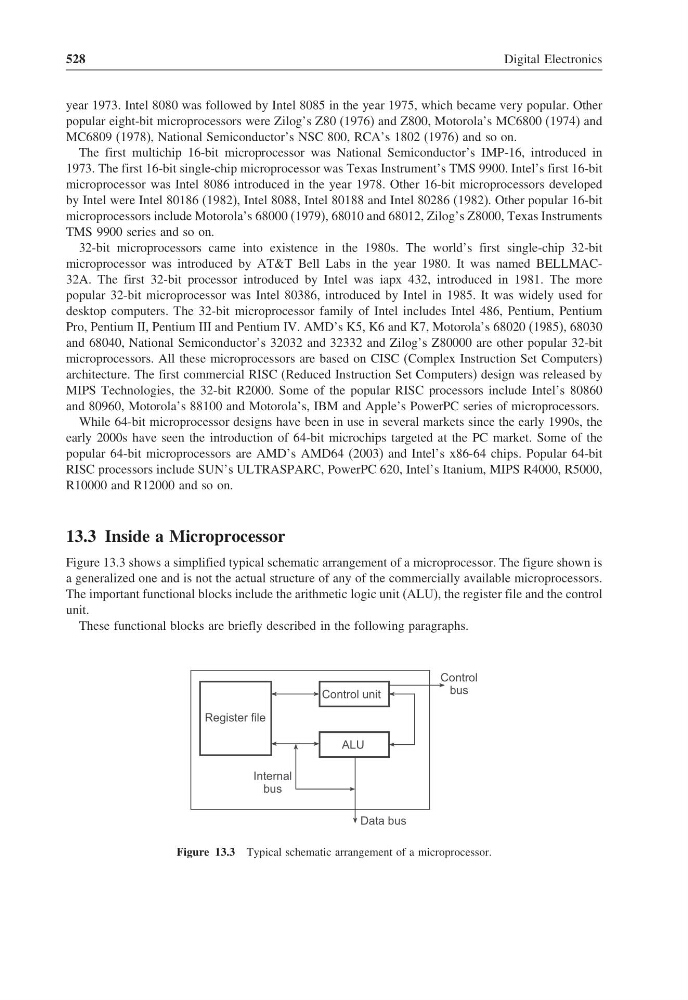
Figure 13.3 shows a simplified typical schematic arrangement of a microprocessor. The figure shown is
a generalized one and is not the actual structure of any of the commercially available microprocessors.
The important functional blocks include the arithmetic logic unit (ALU), the register file and the control
unit.
These functional blocks are briefly described in the following paragraphs.
Control unit
ALU
Register file
Internal
bus
Data bus
Control
bus
Figure 13.3 Typical schematic arrangement of a microprocessor.
Digital Electronics
year 1973. Intel 8080 was followed by Intel 8085 in the year 1975, which became very popular. Other
popular eight-bit microprocessors were Zilog’s Z80 (1976) and Z800, Motorola’s MC6800 (1974) and
MC6809 (1978), National Semiconductor’s NSC 800, RCA’s 1802 (1976) and so on.
The first multichip 16-bit microprocessor was National Semiconductor’s IMP-16, introduced in
1973. The first 16-bit single-chip microprocessor was Texas Instrument’s TMS 9900. Intel’s first 16-bit
microprocessor was Intel 8086 introduced in the year 1978. Other 16-bit microprocessors developed
by Intel were Intel 80186 (1982), Intel 8088, Intel 80188 and Intel 80286 (1982). Other popular 16-bit
microprocessors include Motorola’s 68000 (1979), 68010 and 68012, Zilog’s Z8000, Texas Instruments
TMS 9900 series and so on.
32-bit microprocessors came into existence in the 1980s. The world’s first single-chip 32-bit
microprocessor was introduced by AT&T Bell Labs in the year 1980. It was named BELLMAC32A. The first 32-bit processor introduced by Intel was iapx 432, introduced in 1981. The more
popular 32-bit microprocessor was Intel 80386, introduced by Intel in 1985. It was widely used for
desktop computers. The 32-bit microprocessor family of Intel includes Intel 486, Pentium, Pentium
Pro, Pentium II, Pentium III and Pentium IV. AMD’s K5, K6 and K7, Motorola’s 68020 (1985), 68030
and 68040, National Semiconductor’s 32032 and 32332 and Zilog’s Z80000 are other popular 32-bit
microprocessors. All these microprocessors are based on CISC (Complex Instruction Set Computers)
architecture. The first commercial RISC (Reduced Instruction Set Computers) design was released by
MIPS Technologies, the 32-bit R2000. Some of the popular RISC processors include Intel’s 80860
and 80960, Motorola’s 88100 and Motorola’s, IBM and Apple’s PowerPC series of microprocessors.
While 64-bit microprocessor designs have been in use in several markets since the early 1990s, the
early 2000s have seen the introduction of 64-bit microchips targeted at the PC market. Some of the
popular 64-bit microprocessors are AMD’s AMD64 (2003) and Intel’s x86-64 chips. Popular 64-bit
RISC processors include SUN’s ULTRASPARC, PowerPC 620, Intel’s Itanium, MIPS R4000, R5000,
R10000 and R12000 and so on.
13.3 Inside a Microprocessor
Figure 13.3 shows a simplified typical schematic arrangement of a microprocessor. The figure shown is
a generalized one and is not the actual structure of any of the commercially available microprocessors.
The important functional blocks include the arithmetic logic unit (ALU), the register file and the control
unit.
These functional blocks are briefly described in the following paragraphs.
Control unit
ALU
Register file
Internal
bus
Data bus
Control
bus
Figure 13.3 Typical schematic arrangement of a microprocessor.