

480
Digital Electronics
Some D/A converters even provide four-quadrant operation by allowing the use of both positive and
negative reference. Multiplying D/A converters are particularly useful when we are looking for digitally
programmable attenuation of an analogue input signal.
12.3.2 Bipolar-Output D/A Converters
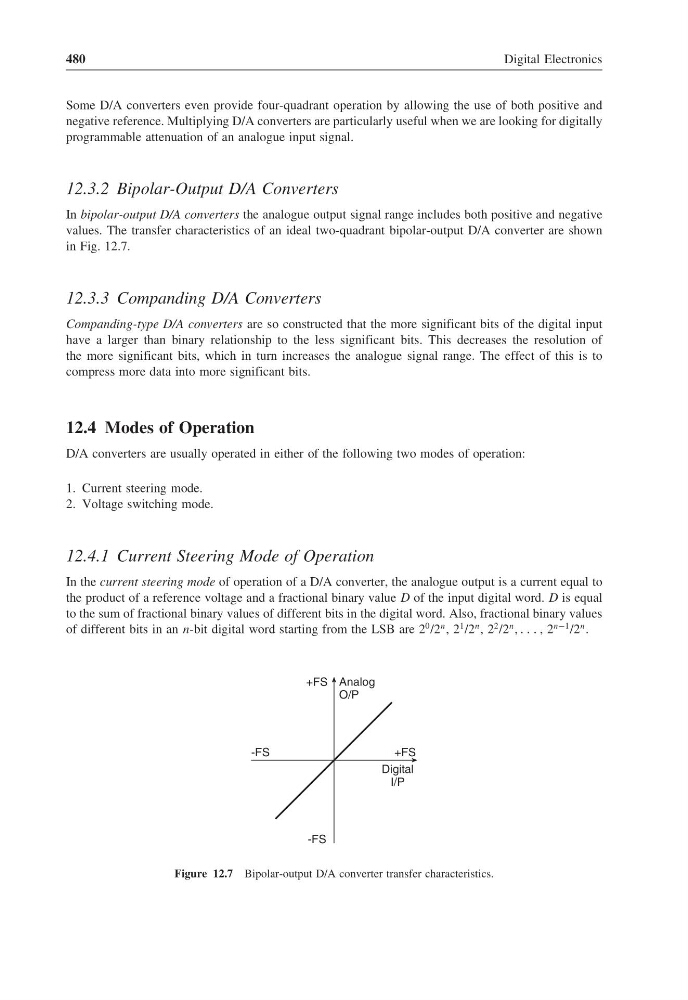
In bipolar-output D/A converters the analogue output signal range includes both positive and negative
values. The transfer characteristics of an ideal two-quadrant bipolar-output D/A converter are shown
in Fig. 12.7.
12.3.3 Companding D/A Converters
Companding-type D/A converters are so constructed that the more significant bits of the digital input
have a larger than binary relationship to the less significant bits. This decreases the resolution of
the more significant bits, which in turn increases the analogue signal range. The effect of this is to
compress more data into more significant bits.
12.4 Modes of Operation
D/A converters are usually operated in either of the following two modes of operation:
1. Current steering mode.
2. Voltage switching mode.
12.4.1 Current Steering Mode of Operation
In the current steering mode of operation of a D/A converter, the analogue output is a current equal to
the product of a reference voltage and a fractional binary value D of the input digital word. D is equal
to the sum of fractional binary values of different bits in the digital word. Also, fractional binary values
of different bits in an n-bit digital word starting from the LSB are 2
0 /2
n , 2
1 /2
n , 2
2 /2
n , , 2
n−1 /2
n .
Analog
O/P
+FS
-FS
-FS
+FS
Digital
I/P
Figure 12.7 Bipolar-output D/A converter transfer characteristics.
Digital Electronics
Some D/A converters even provide four-quadrant operation by allowing the use of both positive and
negative reference. Multiplying D/A converters are particularly useful when we are looking for digitally
programmable attenuation of an analogue input signal.
12.3.2 Bipolar-Output D/A Converters
In bipolar-output D/A converters the analogue output signal range includes both positive and negative
values. The transfer characteristics of an ideal two-quadrant bipolar-output D/A converter are shown
in Fig. 12.7.
12.3.3 Companding D/A Converters
Companding-type D/A converters are so constructed that the more significant bits of the digital input
have a larger than binary relationship to the less significant bits. This decreases the resolution of
the more significant bits, which in turn increases the analogue signal range. The effect of this is to
compress more data into more significant bits.
12.4 Modes of Operation
D/A converters are usually operated in either of the following two modes of operation:
1. Current steering mode.
2. Voltage switching mode.
12.4.1 Current Steering Mode of Operation
In the current steering mode of operation of a D/A converter, the analogue output is a current equal to
the product of a reference voltage and a fractional binary value D of the input digital word. D is equal
to the sum of fractional binary values of different bits in the digital word. Also, fractional binary values
of different bits in an n-bit digital word starting from the LSB are 2
0 /2
n , 2
1 /2
n , 2
2 /2
n , , 2
n−1 /2
n .
Analog
O/P
+FS
-FS
-FS
+FS
Digital
I/P
Figure 12.7 Bipolar-output D/A converter transfer characteristics.