

478
Digital Electronics
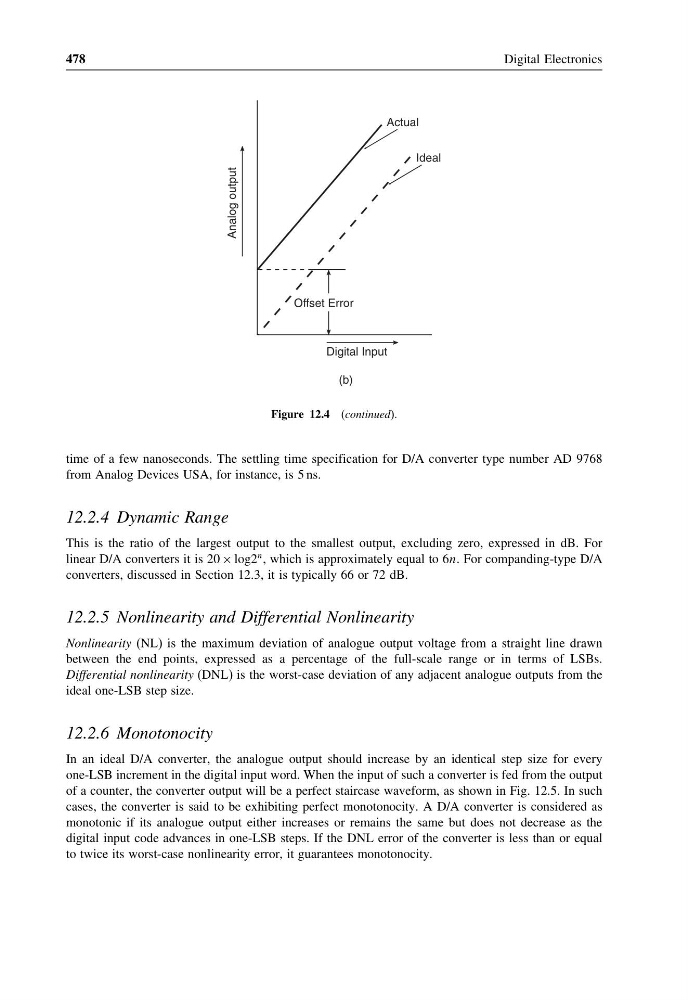
Offset Error
Digital Input
Actual
Ideal
Analog output
(b)
Figure 12.4 (continued).
time of a few nanoseconds. The settling time specification for D/A converter type number AD 9768
from Analog Devices USA, for instance, is 5 ns.
12.2.4 Dynamic Range
This is the ratio of the largest output to the smallest output, excluding zero, expressed in dB. For
linear D/A converters it is 20 × log2
n , which is approximately equal to 6nn For companding-type D/A
converters, discussed in Section 12.3, it is typically 66 or 72 dB.
12.2.5 Nonlinearity and Differential Nonlinearity
Nonlinearity (NL) is the maximum deviation of analogue output voltage from a straight line drawn
between the end points, expressed as a percentage of the full-scale range or in terms of LSBs.
Differential nonlinearity (DNL) is the worst-case deviation of any adjacent analogue outputs from the
ideal one-LSB step size.
12.2.6 Monotonocity
In an ideal D/A converter, the analogue output should increase by an identical step size for every
one-LSB increment in the digital input word. When the input of such a converter is fed from the output
of a counter, the converter output will be a perfect staircase waveform, as shown in Fig. 12.5. In such
cases, the converter is said to be exhibiting perfect monotonocity. A D/A converter is considered as
monotonic if its analogue output either increases or remains the same but does not decrease as the
digital input code advances in one-LSB steps. If the DNL error of the converter is less than or equal
to twice its worst-case nonlinearity error, it guarantees monotonocity.
Digital Electronics
Offset Error
Digital Input
Actual
Ideal
Analog output
(b)
Figure 12.4 (continued).
time of a few nanoseconds. The settling time specification for D/A converter type number AD 9768
from Analog Devices USA, for instance, is 5 ns.
12.2.4 Dynamic Range
This is the ratio of the largest output to the smallest output, excluding zero, expressed in dB. For
linear D/A converters it is 20 × log2
n , which is approximately equal to 6nn For companding-type D/A
converters, discussed in Section 12.3, it is typically 66 or 72 dB.
12.2.5 Nonlinearity and Differential Nonlinearity
Nonlinearity (NL) is the maximum deviation of analogue output voltage from a straight line drawn
between the end points, expressed as a percentage of the full-scale range or in terms of LSBs.
Differential nonlinearity (DNL) is the worst-case deviation of any adjacent analogue outputs from the
ideal one-LSB step size.
12.2.6 Monotonocity
In an ideal D/A converter, the analogue output should increase by an identical step size for every
one-LSB increment in the digital input word. When the input of such a converter is fed from the output
of a counter, the converter output will be a perfect staircase waveform, as shown in Fig. 12.5. In such
cases, the converter is said to be exhibiting perfect monotonocity. A D/A converter is considered as
monotonic if its analogue output either increases or remains the same but does not decrease as the
digital input code advances in one-LSB steps. If the DNL error of the converter is less than or equal
to twice its worst-case nonlinearity error, it guarantees monotonocity.