

462
Digital Electronics
7491
A
B
CP
9
11
12
5
V CC
GND
13 Serial
Out
+V CC
10
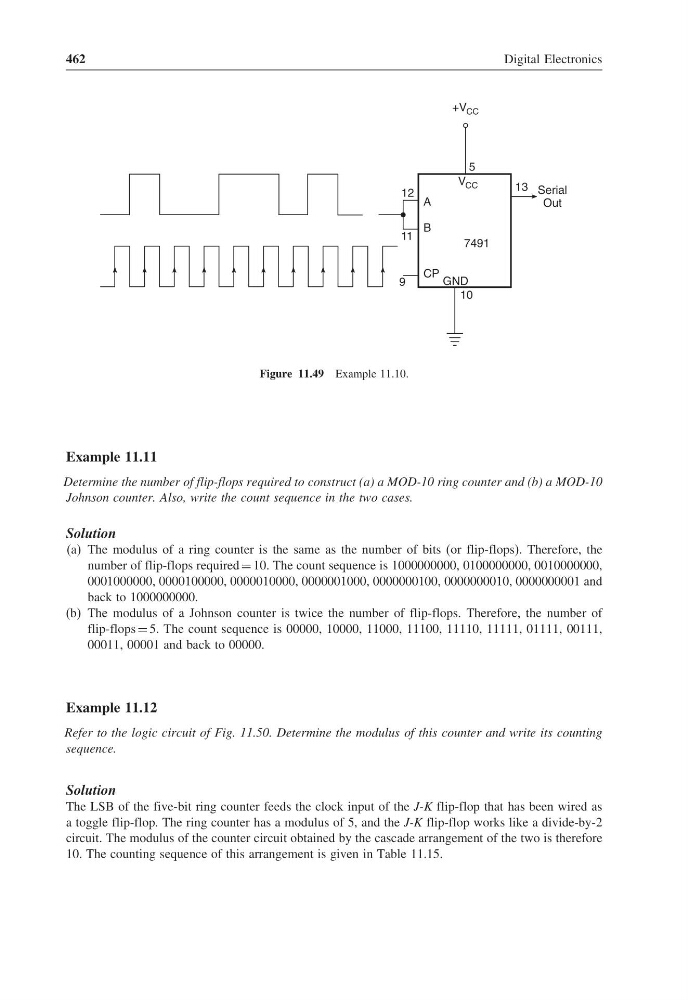
Figure 11.49 Example 11.10.
Example 11.11
Determine the number of flip-flops required to construct (a) a MOD-10 ring counter and (b) a MOD-10
Johnson counter. Also, write the count sequence in the two cases.
Solution
(a) The modulus of a ring counter is the same as the number of bits (or flip-flops). Therefore, the
number of flip-flops required = 10. The count sequence is 1000000000, 0100000000, 0010000000,
0001000000, 0000100000, 0000010000, 0000001000, 0000000100, 0000000010, 0000000001 and
back to 1000000000.
(b) The modulus of a Johnson counter is twice the number of flip-flops. Therefore, the number of
flip-flops = 5. The count sequence is 00000, 10000, 11000, 11100, 11110, 11111, 01111, 00111,
00011, 00001 and back to 00000.
Example 11.12
Refer to the logic circuit of Fig. 11.50. Determine the modulus of this counter and write its counting
sequence.
Solution
The LSB of the five-bit ring counter feeds the clock input of the J-K flip-flop that has been wired as
a toggle flip-flop. The ring counter has a modulus of 5, and the J-K flip-flop works like a divide-by-2
circuit. The modulus of the counter circuit obtained by the cascade arrangement of the two is therefore
10. The counting sequence of this arrangement is given in Table 11.15.
Digital Electronics
7491
A
B
CP
9
11
12
5
V CC
GND
13 Serial
Out
+V CC
10
Figure 11.49 Example 11.10.
Example 11.11
Determine the number of flip-flops required to construct (a) a MOD-10 ring counter and (b) a MOD-10
Johnson counter. Also, write the count sequence in the two cases.
Solution
(a) The modulus of a ring counter is the same as the number of bits (or flip-flops). Therefore, the
number of flip-flops required = 10. The count sequence is 1000000000, 0100000000, 0010000000,
0001000000, 0000100000, 0000010000, 0000001000, 0000000100, 0000000010, 0000000001 and
back to 1000000000.
(b) The modulus of a Johnson counter is twice the number of flip-flops. Therefore, the number of
flip-flops = 5. The count sequence is 00000, 10000, 11000, 11100, 11110, 11111, 01111, 00111,
00011, 00001 and back to 00000.
Example 11.12
Refer to the logic circuit of Fig. 11.50. Determine the modulus of this counter and write its counting
sequence.
Solution
The LSB of the five-bit ring counter feeds the clock input of the J-K flip-flop that has been wired as
a toggle flip-flop. The ring counter has a modulus of 5, and the J-K flip-flop works like a divide-by-2
circuit. The modulus of the counter circuit obtained by the cascade arrangement of the two is therefore
10. The counting sequence of this arrangement is given in Table 11.15.