

Flip-Flops and Related Devices
361
Q 2
C
R
R c1
–V
R 2
Q 1
R C2
R 1
+V CC
C 1
Vo
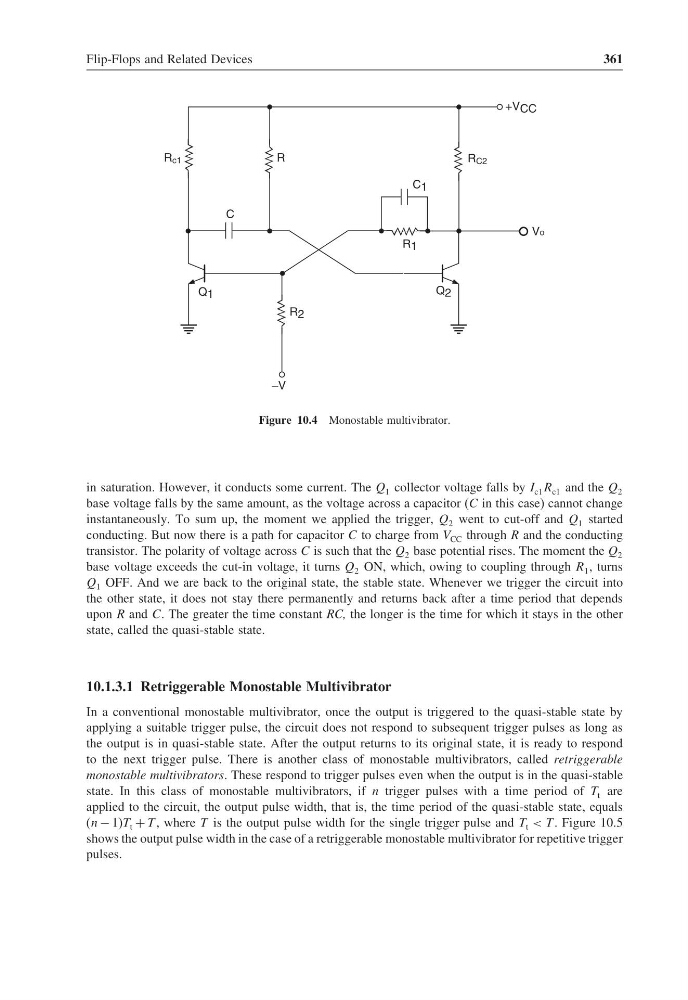
Figure 10.4 Monostable multivibrator.
in saturation. However, it conducts some current. The Q 1 collector voltage falls by I c1 R c1 and the Q 2
base voltage falls by the same amount, as the voltage across a capacitor (C in this case) cannot change
instantaneously. To sum up, the moment we applied the trigger, Q 2 went to cut-off and Q 1 started
conducting. But now there is a path for capacitor C to charge from V CC through R and the conducting
transistor. The polarity of voltage across C is such that the Q 2 base potential rises. The moment the Q 2
base voltage exceeds the cut-in voltage, it turns Q 2 ON, which, owing to coupling through R 1 , turns
Q 1 OFF. And we are back to the original state, the stable state. Whenever we trigger the circuit into
the other state, it does not stay there permanently and returns back after a time period that depends
upon R and C. The greater the time constant RC, the longer is the time for which it stays in the other
state, called the quasi-stable state.
10.1.3.1 Retriggerable Monostable Multivibrator
In a conventional monostable multivibrator, once the output is triggered to the quasi-stable state by
applying a suitable trigger pulse, the circuit does not respond to subsequent trigger pulses as long as
the output is in quasi-stable state. After the output returns to its original state, it is ready to respond
to the next trigger pulse. There is another class of monostable multivibrators, called retriggerable
monostable multivibrators. These respond to trigger pulses even when the output is in the quasi-stable
state. In this class of monostable multivibrators, if n trigger pulses with a time period of T t are
applied to the circuit, the output pulse width, that is, the time period of the quasi-stable state, equals
(n − 1)T t + T , where T is the output pulse width for the single trigger pulse and T t < T. Figure 10.5
shows the output pulse width in the case of a retriggerable monostable multivibrator for repetitive trigger
pulses.
361
Q 2
C
R
R c1
–V
R 2
Q 1
R C2
R 1
+V CC
C 1
Vo
Figure 10.4 Monostable multivibrator.
in saturation. However, it conducts some current. The Q 1 collector voltage falls by I c1 R c1 and the Q 2
base voltage falls by the same amount, as the voltage across a capacitor (C in this case) cannot change
instantaneously. To sum up, the moment we applied the trigger, Q 2 went to cut-off and Q 1 started
conducting. But now there is a path for capacitor C to charge from V CC through R and the conducting
transistor. The polarity of voltage across C is such that the Q 2 base potential rises. The moment the Q 2
base voltage exceeds the cut-in voltage, it turns Q 2 ON, which, owing to coupling through R 1 , turns
Q 1 OFF. And we are back to the original state, the stable state. Whenever we trigger the circuit into
the other state, it does not stay there permanently and returns back after a time period that depends
upon R and C. The greater the time constant RC, the longer is the time for which it stays in the other
state, called the quasi-stable state.
10.1.3.1 Retriggerable Monostable Multivibrator
In a conventional monostable multivibrator, once the output is triggered to the quasi-stable state by
applying a suitable trigger pulse, the circuit does not respond to subsequent trigger pulses as long as
the output is in quasi-stable state. After the output returns to its original state, it is ready to respond
to the next trigger pulse. There is another class of monostable multivibrators, called retriggerable
monostable multivibrators. These respond to trigger pulses even when the output is in the quasi-stable
state. In this class of monostable multivibrators, if n trigger pulses with a time period of T t are
applied to the circuit, the output pulse width, that is, the time period of the quasi-stable state, equals
(n − 1)T t + T , where T is the output pulse width for the single trigger pulse and T t < T. Figure 10.5
shows the output pulse width in the case of a retriggerable monostable multivibrator for repetitive trigger
pulses.