

Programmable Logic Devices
349
Programmable
Interconnect
Matrix (PIM)
Macrocells
and I/O
pins
I/Os
Macrocells
and I/O
pins
I/Os
Macrocells
and I/O
pins
I/Os
Macrocells
and I/O
pins
I/Os
Macrocells
and I/O
pins
I/Os
Macrocells
and I/O
pins
I/Os
Macrocells
and I/O
pins
I/Os
Macrocells
and I/O
pins
I/Os
Clock
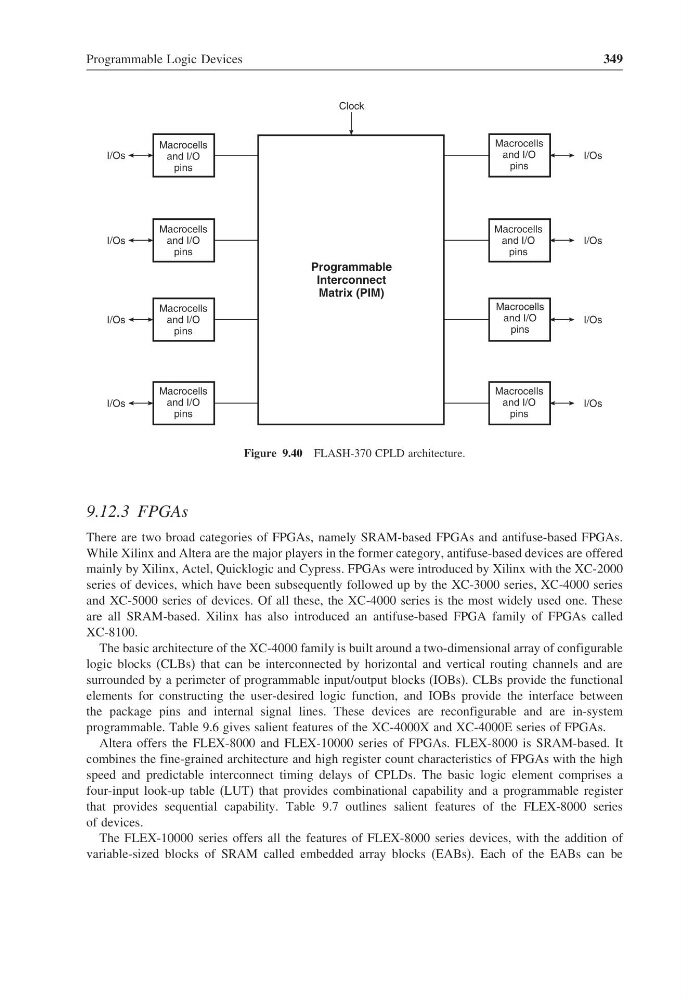
Figure 9.40 FLASH-370 CPLD architecture.
9.12.3 FPGAs
There are two broad categories of FPGAs, namely SRAM-based FPGAs and antifuse-based FPGAs.
While Xilinx and Altera are the major players in the former category, antifuse-based devices are offered
mainly by Xilinx, Actel, Quicklogic and Cypress. FPGAs were introduced by Xilinx with the XC-2000
series of devices, which have been subsequently followed up by the XC-3000 series, XC-4000 series
and XC-5000 series of devices. Of all these, the XC-4000 series is the most widely used one. These
are all SRAM-based. Xilinx has also introduced an antifuse-based FPGA family of FPGAs called
XC-8100.
The basic architecture of the XC-4000 family is built around a two-dimensional array of configurable
logic blocks (CLBs) that can be interconnected by horizontal and vertical routing channels and are
surrounded by a perimeter of programmable input/output blocks (IOBs). CLBs provide the functional
elements for constructing the user-desired logic function, and IOBs provide the interface between
the package pins and internal signal lines. These devices are reconfigurable and are in-system
programmable. Table 9.6 gives salient features of the XC-4000X and XC-4000E series of FPGAs.
Altera offers the FLEX-8000 and FLEX-10000 series of FPGAs. FLEX-8000 is SRAM-based. It
combines the fine-grained architecture and high register count characteristics of FPGAs with the high
speed and predictable interconnect timing delays of CPLDs. The basic logic element comprises a
four-input look-up table (LUT) that provides combinational capability and a programmable register
that provides sequential capability. Table 9.7 outlines salient features of the FLEX-8000 series
of devices.
The FLEX-10000 series offers all the features of FLEX-8000 series devices, with the addition of
variable-sized blocks of SRAM called embedded array blocks (EABs). Each of the EABs can be
349
Programmable
Interconnect
Matrix (PIM)
Macrocells
and I/O
pins
I/Os
Macrocells
and I/O
pins
I/Os
Macrocells
and I/O
pins
I/Os
Macrocells
and I/O
pins
I/Os
Macrocells
and I/O
pins
I/Os
Macrocells
and I/O
pins
I/Os
Macrocells
and I/O
pins
I/Os
Macrocells
and I/O
pins
I/Os
Clock
Figure 9.40 FLASH-370 CPLD architecture.
9.12.3 FPGAs
There are two broad categories of FPGAs, namely SRAM-based FPGAs and antifuse-based FPGAs.
While Xilinx and Altera are the major players in the former category, antifuse-based devices are offered
mainly by Xilinx, Actel, Quicklogic and Cypress. FPGAs were introduced by Xilinx with the XC-2000
series of devices, which have been subsequently followed up by the XC-3000 series, XC-4000 series
and XC-5000 series of devices. Of all these, the XC-4000 series is the most widely used one. These
are all SRAM-based. Xilinx has also introduced an antifuse-based FPGA family of FPGAs called
XC-8100.
The basic architecture of the XC-4000 family is built around a two-dimensional array of configurable
logic blocks (CLBs) that can be interconnected by horizontal and vertical routing channels and are
surrounded by a perimeter of programmable input/output blocks (IOBs). CLBs provide the functional
elements for constructing the user-desired logic function, and IOBs provide the interface between
the package pins and internal signal lines. These devices are reconfigurable and are in-system
programmable. Table 9.6 gives salient features of the XC-4000X and XC-4000E series of FPGAs.
Altera offers the FLEX-8000 and FLEX-10000 series of FPGAs. FLEX-8000 is SRAM-based. It
combines the fine-grained architecture and high register count characteristics of FPGAs with the high
speed and predictable interconnect timing delays of CPLDs. The basic logic element comprises a
four-input look-up table (LUT) that provides combinational capability and a programmable register
that provides sequential capability. Table 9.7 outlines salient features of the FLEX-8000 series
of devices.
The FLEX-10000 series offers all the features of FLEX-8000 series devices, with the addition of
variable-sized blocks of SRAM called embedded array blocks (EABs). Each of the EABs can be