

Logic Families
167
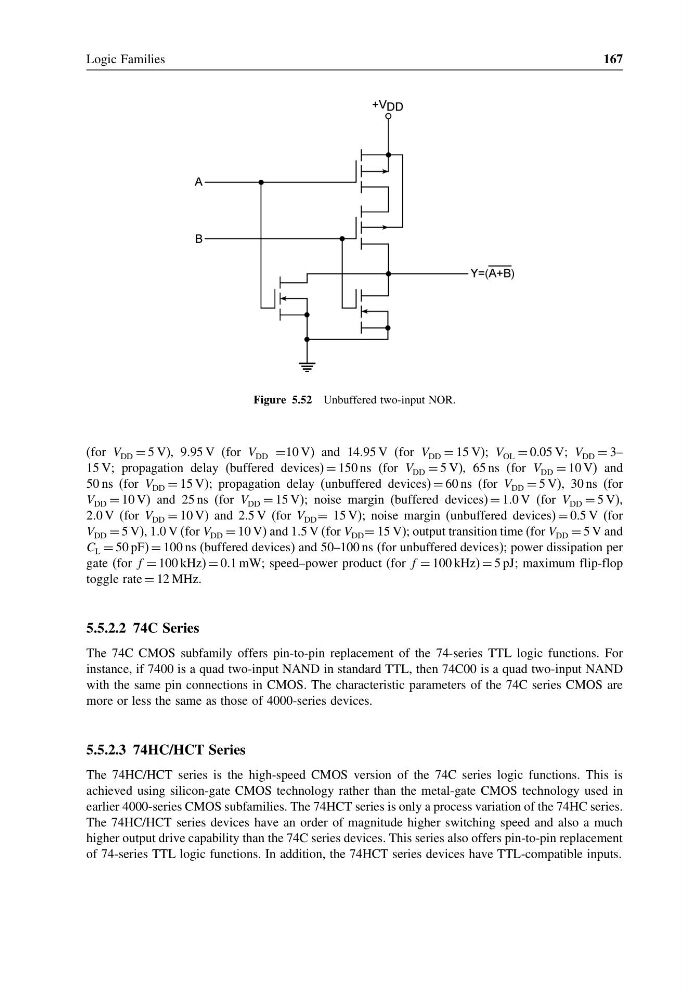
Figure 5.52 Unbuffered two-input NOR.
(for V DD = 5 V), 9.95 V (for V DD =10 V) and 14.95 V (for V DD = 15 V); V OL = 0.05 V; V DD = 3–
15 V; propagation delay (buffered devices) = 150 ns (for V DD = 5 V), 65 ns (for V DD = 10 V) and
50 ns (for V DD = 15 V); propagation delay (unbuffered devices) = 60 ns (for V DD = 5 V), 30 ns (for
V DD = 10 V) and 25 ns (for V DD = 15 V); noise margin (buffered devices) = 1.0 V (for V DD = 5 V),
2.0 V (for V DD = 10 V) and 2.5 V (for V DD = 15 V); noise margin (unbuffered devices) = 0.5 V (for
V DD = 5 V), 1.0 V (for V DD = 10 V) and 1.5 V (for V DD = 15 V); output transition time (for V DD = 5 V and
C L = 50 pF) = 100 ns (buffered devices) and 50–100 ns (for unbuffered devices); power dissipation per
gate (for f = 100 kHz) = 0.1 mW; speed–power product (for f = 100 kHz) = 5 pJ; maximum flip-flop
toggle rate = 12 MHz.
5.5.2.2 74C Series
The 74C CMOS subfamily offers pin-to-pin replacement of the 74-series TTL logic functions. For
instance, if 7400 is a quad two-input NAND in standard TTL, then 74C00 is a quad two-input NAND
with the same pin connections in CMOS. The characteristic parameters of the 74C series CMOS are
more or less the same as those of 4000-series devices.
5.5.2.3 74HC/HCT Series
The 74HC/HCT series is the high-speed CMOS version of the 74C series logic functions. This is
achieved using silicon-gate CMOS technology rather than the metal-gate CMOS technology used in
earlier 4000-series CMOS subfamilies. The 74HCT series is only a process variation of the 74HC series.
The 74HC/HCT series devices have an order of magnitude higher switching speed and also a much
higher output drive capability than the 74C series devices. This series also offers pin-to-pin replacement
of 74-series TTL logic functions. In addition, the 74HCT series devices have TTL-compatible inputs.
167
Figure 5.52 Unbuffered two-input NOR.
(for V DD = 5 V), 9.95 V (for V DD =10 V) and 14.95 V (for V DD = 15 V); V OL = 0.05 V; V DD = 3–
15 V; propagation delay (buffered devices) = 150 ns (for V DD = 5 V), 65 ns (for V DD = 10 V) and
50 ns (for V DD = 15 V); propagation delay (unbuffered devices) = 60 ns (for V DD = 5 V), 30 ns (for
V DD = 10 V) and 25 ns (for V DD = 15 V); noise margin (buffered devices) = 1.0 V (for V DD = 5 V),
2.0 V (for V DD = 10 V) and 2.5 V (for V DD = 15 V); noise margin (unbuffered devices) = 0.5 V (for
V DD = 5 V), 1.0 V (for V DD = 10 V) and 1.5 V (for V DD = 15 V); output transition time (for V DD = 5 V and
C L = 50 pF) = 100 ns (buffered devices) and 50–100 ns (for unbuffered devices); power dissipation per
gate (for f = 100 kHz) = 0.1 mW; speed–power product (for f = 100 kHz) = 5 pJ; maximum flip-flop
toggle rate = 12 MHz.
5.5.2.2 74C Series
The 74C CMOS subfamily offers pin-to-pin replacement of the 74-series TTL logic functions. For
instance, if 7400 is a quad two-input NAND in standard TTL, then 74C00 is a quad two-input NAND
with the same pin connections in CMOS. The characteristic parameters of the 74C series CMOS are
more or less the same as those of 4000-series devices.
5.5.2.3 74HC/HCT Series
The 74HC/HCT series is the high-speed CMOS version of the 74C series logic functions. This is
achieved using silicon-gate CMOS technology rather than the metal-gate CMOS technology used in
earlier 4000-series CMOS subfamilies. The 74HCT series is only a process variation of the 74HC series.
The 74HC/HCT series devices have an order of magnitude higher switching speed and also a much
higher output drive capability than the 74C series devices. This series also offers pin-to-pin replacement
of 74-series TTL logic functions. In addition, the 74HCT series devices have TTL-compatible inputs.