

22
3 Theories of Conflict and Cooperation Over …
basins may influence riparian behaviour significantly and, as such, may turn out to
be critical drivers of conflict or cooperation irrespective of the foregoing theoretical
premises. The relevant literature clusters these factors as follows:
3.2.4.1 Geography and the Availability of Water
The starting point of the politics of transboundary water cooperation is that the geography of river systems hardly coincides with political boundaries. Such discrepancy
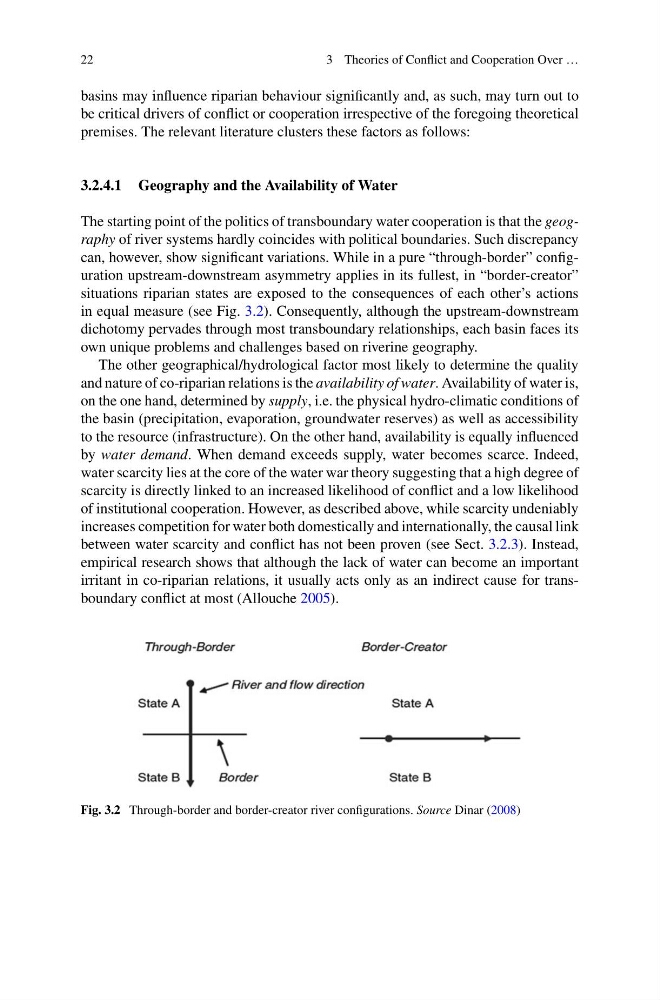
can, however, show significant variations. While in a pure “through-border” configuration upstream-downstream asymmetry applies in its fullest, in “border-creator”
situations riparian states are exposed to the consequences of each other’s actions
in equal measure (see Fig. 3.2). Consequently, although the upstream-downstream
dichotomy pervades through most transboundary relationships, each basin faces its
own unique problems and challenges based on riverine geography.
The other geographical/hydrological factor most likely to determine the quality
and nature of co-riparian relations is the availability of water. Availability of water is,
on the one hand, determined by supply, i.e. the physical hydro-climatic conditions of
the basin (precipitation, evaporation, groundwater reserves) as well as accessibility
to the resource (infrastructure). On the other hand, availability is equally influenced
by water demand. When demand exceeds supply, water becomes scarce. Indeed,
water scarcity lies at the core of the water war theory suggesting that a high degree of
scarcity is directly linked to an increased likelihood of conflict and a low likelihood
of institutional cooperation. However, as described above, while scarcity undeniably
increases competition for water both domestically and internationally, the causal link
between water scarcity and conflict has not been proven (see Sect. 3.2.3). Instead,
empirical research shows that although the lack of water can become an important
irritant in co-riparian relations, it usually acts only as an indirect cause for transboundary conflict at most (Allouche 2005).
Fig. 3.2 Through-border and border-creator river configurations. Source Dinar (2008)
3 Theories of Conflict and Cooperation Over …
basins may influence riparian behaviour significantly and, as such, may turn out to
be critical drivers of conflict or cooperation irrespective of the foregoing theoretical
premises. The relevant literature clusters these factors as follows:
3.2.4.1 Geography and the Availability of Water
The starting point of the politics of transboundary water cooperation is that the geography of river systems hardly coincides with political boundaries. Such discrepancy
can, however, show significant variations. While in a pure “through-border” configuration upstream-downstream asymmetry applies in its fullest, in “border-creator”
situations riparian states are exposed to the consequences of each other’s actions
in equal measure (see Fig. 3.2). Consequently, although the upstream-downstream
dichotomy pervades through most transboundary relationships, each basin faces its
own unique problems and challenges based on riverine geography.
The other geographical/hydrological factor most likely to determine the quality
and nature of co-riparian relations is the availability of water. Availability of water is,
on the one hand, determined by supply, i.e. the physical hydro-climatic conditions of
the basin (precipitation, evaporation, groundwater reserves) as well as accessibility
to the resource (infrastructure). On the other hand, availability is equally influenced
by water demand. When demand exceeds supply, water becomes scarce. Indeed,
water scarcity lies at the core of the water war theory suggesting that a high degree of
scarcity is directly linked to an increased likelihood of conflict and a low likelihood
of institutional cooperation. However, as described above, while scarcity undeniably
increases competition for water both domestically and internationally, the causal link
between water scarcity and conflict has not been proven (see Sect. 3.2.3). Instead,
empirical research shows that although the lack of water can become an important
irritant in co-riparian relations, it usually acts only as an indirect cause for transboundary conflict at most (Allouche 2005).
Fig. 3.2 Through-border and border-creator river configurations. Source Dinar (2008)