

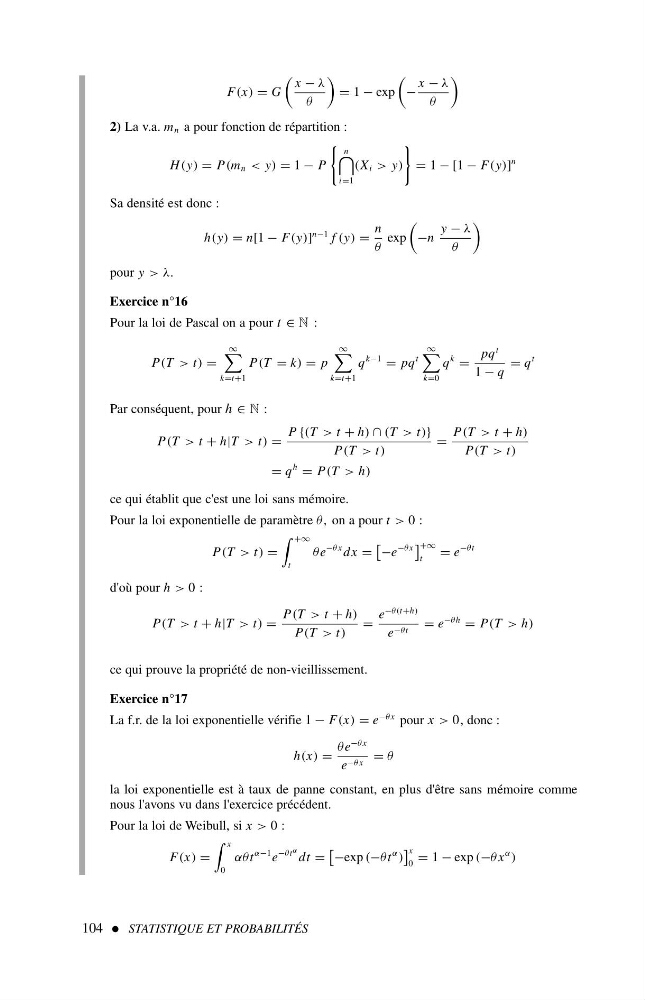
F(x) = G
x − λ
θ
= 1 − exp
−
x − λ
θ
2) La v.a. m n a pour fonction de répartition :
H (y) = P(m n < y) = 1 − P
n
i=1
(X i > y)
= 1 − [1 − F(y)]
n
Sa densité est donc :
h(y) = n[1 − F(y)]
n−1 f (y) =
n
θ
exp
−n
y − λ
θ
pour y >λ.
Exercice n°16
Pour la loi de Pascal on a pour t ∈ N :
P(T > t) =
∞
k=t+1
P(T = k) = p
∞
k=t+1
q
k−1 = pq
t
∞
k=0
q
k =
pq
t
1 − q
= q
t
Par conséquent, pour h ∈ N :
P(T > t + h|T > t) =
P {(T > t + h) ∩ (T > t)}
P(T > t)
=
P(T > t + h)
P(T > t)
= q
h = P(T > h)
ce qui établit que c'est une loi sans mémoire.
Pour la loi exponentielle de paramètre θ, on a pour t > 0 :
P(T > t) =
+∞
t
θe
−θ x dx =
−e
−θ x
+∞
t
= e
−θt
d'où pour h > 0 :
P(T > t + h|T > t) =
P(T > t + h)
P(T > t)
=
e
−θ(t+h)
e −θt = e
−θ h = P(T > h)
ce qui prouve la propriété de non-vieillissement.
Exercice n°17
La f.r. de la loi exponentielle vérifie 1 − F(x) = e
−θ x pour x > 0, donc :
h(x) =
θe
−θ x
e −θ x = θ
la loi exponentielle est à taux de panne constant, en plus d'être sans mémoire comme
nous l'avons vu dans l'exercice précédent.
Pour la loi de Weibull, si x > 0 :
F(x) =
x
0
αθt
α−1 e
−θt α dt =
−exp (−θt
α )
x
0
= 1 − exp (−θ x
α )
104 STATISTIQUE ET PROBABILITÉS
x − λ
θ
= 1 − exp
−
x − λ
θ
2) La v.a. m n a pour fonction de répartition :
H (y) = P(m n < y) = 1 − P
n
i=1
(X i > y)
= 1 − [1 − F(y)]
n
Sa densité est donc :
h(y) = n[1 − F(y)]
n−1 f (y) =
n
θ
exp
−n
y − λ
θ
pour y >λ.
Exercice n°16
Pour la loi de Pascal on a pour t ∈ N :
P(T > t) =
∞
k=t+1
P(T = k) = p
∞
k=t+1
q
k−1 = pq
t
∞
k=0
q
k =
pq
t
1 − q
= q
t
Par conséquent, pour h ∈ N :
P(T > t + h|T > t) =
P {(T > t + h) ∩ (T > t)}
P(T > t)
=
P(T > t + h)
P(T > t)
= q
h = P(T > h)
ce qui établit que c'est une loi sans mémoire.
Pour la loi exponentielle de paramètre θ, on a pour t > 0 :
P(T > t) =
+∞
t
θe
−θ x dx =
−e
−θ x
+∞
t
= e
−θt
d'où pour h > 0 :
P(T > t + h|T > t) =
P(T > t + h)
P(T > t)
=
e
−θ(t+h)
e −θt = e
−θ h = P(T > h)
ce qui prouve la propriété de non-vieillissement.
Exercice n°17
La f.r. de la loi exponentielle vérifie 1 − F(x) = e
−θ x pour x > 0, donc :
h(x) =
θe
−θ x
e −θ x = θ
la loi exponentielle est à taux de panne constant, en plus d'être sans mémoire comme
nous l'avons vu dans l'exercice précédent.
Pour la loi de Weibull, si x > 0 :
F(x) =
x
0
αθt
α−1 e
−θt α dt =
−exp (−θt
α )
x
0
= 1 − exp (−θ x
α )
104 STATISTIQUE ET PROBABILITÉS