

70 Maˆ ıtriser l’al´ eatoire
3.19
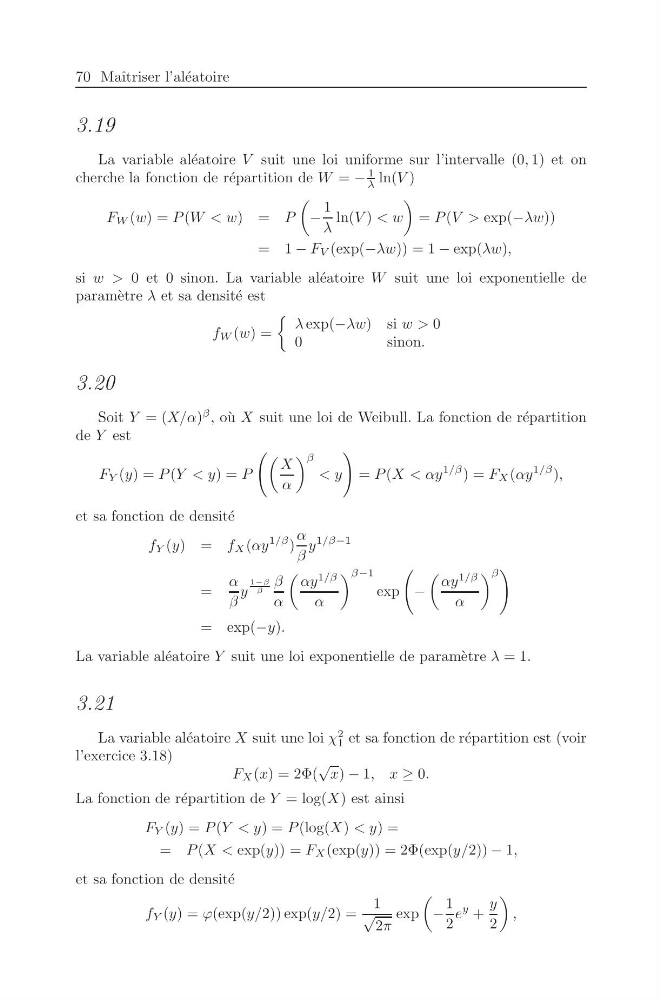
La variable al´ eatoire V suit une loi uniforme sur l’intervalle (0, 1) et on
cherche la fonction de r´ epartition de W = −
1
λ ln(V )
F W (w) = P (W < w) = P
−
1
λ
ln(V ) < w
= P (V > exp(−λw))
= 1 − F V (exp(−λw)) = 1 − exp(λw),
si w > 0 et 0 sinon. La variable al´ eatoire W suit une loi exponentielle de
param` etre λ et sa densit´ e est
f W (w) =
λ exp(−λw) si w > 0
0
s i n o n .
3.20
Soit Y = (X/α)
β , o` u X suit une loi de Weibull. La fonction de r´ epartition
de Y est
F Y (y) = P (Y < y) = P
X
α
β
< y
= P (X < αy
1/β ) = F X (αy
1/β ),
et sa fonction de densit´ e
f Y (y) = f X (αy
1/β )
α
β
y
1/β−1
=
α
β
y
1−β
β
β
α
αy
1/β
α
β−1
exp
−
αy
1/β
α
β
= exp(−y).
La variable al´ eatoire Y suit une loi exponentielle de param` etre λ = 1.
3.21
La variable al´ eatoire X suit une loi χ
2
1 et sa fonction de r´ epartition est (voir
l’exercice 3.18)
F X (x) = 2Φ(
√
x) − 1, x ≥ 0.
La fonction de r´ epartition de Y = log(X) est ainsi
F Y (y) = P (Y < y) = P (log(X) < y) =
= P (X < exp(y)) = F X (exp(y)) = 2Φ(exp(y/2)) − 1,
et sa fonction de densit´ e
f Y (y) = ϕ(exp(y/2)) exp(y/2) =
1
√
2π
exp
−
1
2
e
y +
y
2
,
3.19
La variable al´ eatoire V suit une loi uniforme sur l’intervalle (0, 1) et on
cherche la fonction de r´ epartition de W = −
1
λ ln(V )
F W (w) = P (W < w) = P
−
1
λ
ln(V ) < w
= P (V > exp(−λw))
= 1 − F V (exp(−λw)) = 1 − exp(λw),
si w > 0 et 0 sinon. La variable al´ eatoire W suit une loi exponentielle de
param` etre λ et sa densit´ e est
f W (w) =
λ exp(−λw) si w > 0
0
s i n o n .
3.20
Soit Y = (X/α)
β , o` u X suit une loi de Weibull. La fonction de r´ epartition
de Y est
F Y (y) = P (Y < y) = P
X
α
β
< y
= P (X < αy
1/β ) = F X (αy
1/β ),
et sa fonction de densit´ e
f Y (y) = f X (αy
1/β )
α
β
y
1/β−1
=
α
β
y
1−β
β
β
α
αy
1/β
α
β−1
exp
−
αy
1/β
α
β
= exp(−y).
La variable al´ eatoire Y suit une loi exponentielle de param` etre λ = 1.
3.21
La variable al´ eatoire X suit une loi χ
2
1 et sa fonction de r´ epartition est (voir
l’exercice 3.18)
F X (x) = 2Φ(
√
x) − 1, x ≥ 0.
La fonction de r´ epartition de Y = log(X) est ainsi
F Y (y) = P (Y < y) = P (log(X) < y) =
= P (X < exp(y)) = F X (exp(y)) = 2Φ(exp(y/2)) − 1,
et sa fonction de densit´ e
f Y (y) = ϕ(exp(y/2)) exp(y/2) =
1
√
2π
exp
−
1
2
e
y +
y
2
,