

8. Inf´ erence 235
8.47
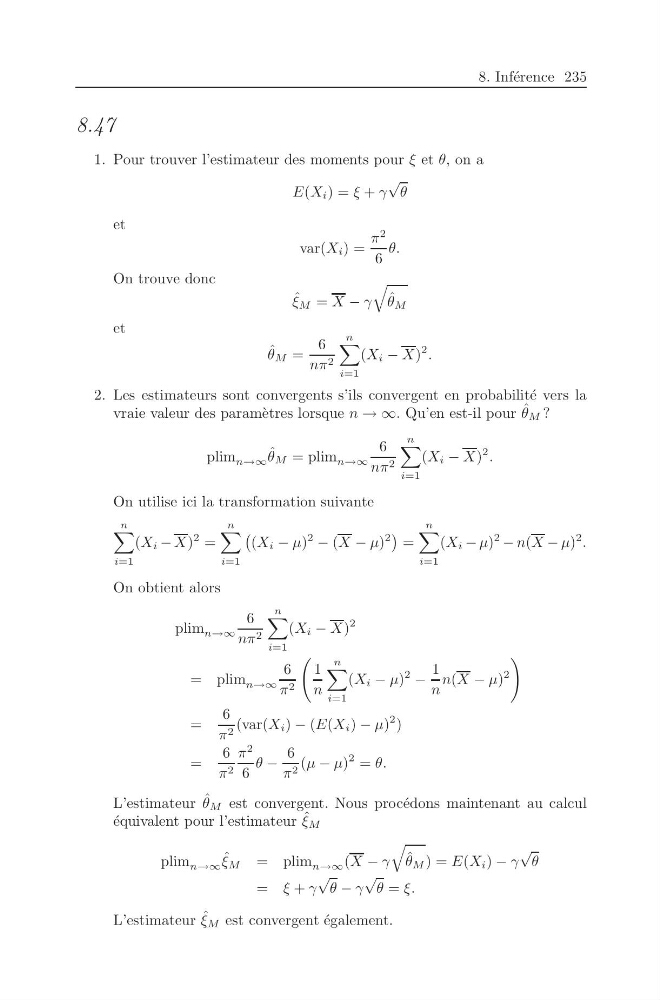
1. Pour trouver l’estimateur des moments pour ξ et θ, on a
E(X i ) = ξ + γ
√
θ
et
var(X i ) =
π
2
6
θ.
On trouve donc
ˆ
ξ M = X − γ
ˆ
θ M
et
ˆ
θ M =
6
nπ 2
n
i=1
(X i − X)
2 .
2. Les estimateurs sont convergents s’ils convergent en probabilit´ e vers la
vraie valeur des param` etres lorsque n → ∞. Qu’en est-il pour ˆ
θ M ?
plim n→∞
ˆ
θ M = plim n→∞
6
nπ 2
n
i=1
(X i − X)
2 .
On utilise ici la transformation suivante
n
i=1
(X i − X)
2 =
n
i=1
(X i − µ)
2
− (X − µ)
2
=
n
i=1
(X i − µ)
2
− n(X − µ)
2 .
On obtient alors
plim n→∞
6
nπ 2
n
i=1
(X i − X)
2
= plim n→∞
6
π 2
1
n
n
i=1
(X i − µ)
2
−
1
n
n(X − µ)
2
=
6
π 2 (var(X i ) − (E(X i ) − µ)
2 )
=
6
π 2
π
2
6
θ −
6
π 2 (µ − µ)
2 = θ.
L’estimateur ˆ
θ M est convergent. Nous proc´ edons maintenant au calcul
´ equivalent pour l’estimateur ˆ
ξ M
plim n→∞
ˆ
ξ M = plim n→∞ (X − γ
ˆ
θ M ) = E(X i ) − γ
√
θ
= ξ + γ
√
θ − γ
√
θ = ξ.
L’estimateur ˆ
ξ M est convergent ´ egalement.
8.47
1. Pour trouver l’estimateur des moments pour ξ et θ, on a
E(X i ) = ξ + γ
√
θ
et
var(X i ) =
π
2
6
θ.
On trouve donc
ˆ
ξ M = X − γ
ˆ
θ M
et
ˆ
θ M =
6
nπ 2
n
i=1
(X i − X)
2 .
2. Les estimateurs sont convergents s’ils convergent en probabilit´ e vers la
vraie valeur des param` etres lorsque n → ∞. Qu’en est-il pour ˆ
θ M ?
plim n→∞
ˆ
θ M = plim n→∞
6
nπ 2
n
i=1
(X i − X)
2 .
On utilise ici la transformation suivante
n
i=1
(X i − X)
2 =
n
i=1
(X i − µ)
2
− (X − µ)
2
=
n
i=1
(X i − µ)
2
− n(X − µ)
2 .
On obtient alors
plim n→∞
6
nπ 2
n
i=1
(X i − X)
2
= plim n→∞
6
π 2
1
n
n
i=1
(X i − µ)
2
−
1
n
n(X − µ)
2
=
6
π 2 (var(X i ) − (E(X i ) − µ)
2 )
=
6
π 2
π
2
6
θ −
6
π 2 (µ − µ)
2 = θ.
L’estimateur ˆ
θ M est convergent. Nous proc´ edons maintenant au calcul
´ equivalent pour l’estimateur ˆ
ξ M
plim n→∞
ˆ
ξ M = plim n→∞ (X − γ
ˆ
θ M ) = E(X i ) − γ
√
θ
= ξ + γ
√
θ − γ
√
θ = ξ.
L’estimateur ˆ
ξ M est convergent ´ egalement.