

8. Inf´ erence 231
et on trouve ˆ
θ MC en ´ egalant cette derni` ere ` a z´ ero
n
i=1
Y i x
2
i − ˆ
θ MC
n
i=1
x
4
i = 0
⇔ ˆ
θ MC =
n
i=1 Y i x
2
i
n
i=1 x 4
i
.
L’estimateur est sans biais car
E( ˆ
θ MC ) =
1
n
i=1 x 4
i
n
i=1
x
2
i E(Y i ) =
1
n
i=1 x 4
i
θ
n
i=1
x
4
i = θ
et sa variance vaut
var( ˆ
θ MC ) =
1
(
n
i=1 x 4
i )
2
n
i=1
x
4
i var(Y i ) =
σ
2
n
i=1 x 4
i
.
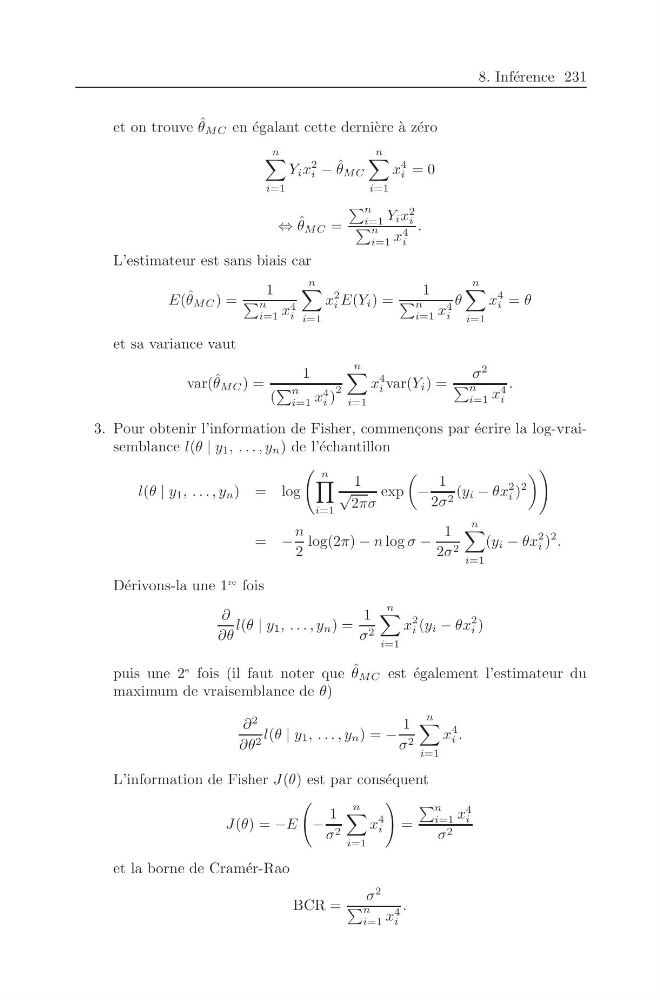
3. Pour obtenir l’information de Fisher, commen¸ cons par ´ ecrire la log-vraisemblance l(θ | y 1 , . . . , y n ) de l’´ echantillon
l(θ | y 1 , . . . , y n ) = log
n
i=1
1
√
2πσ
exp
−
1
2σ 2 (y i − θx
2
i )
2
= −
n
2
log(2π) − n log σ −
1
2σ 2
n
i=1
(y i − θx
2
i )
2 .
D´ erivons-la une 1
re fois
∂
∂θ
l(θ | y 1 , . . . , y n ) =
1
σ 2
n
i=1
x
2
i (y i − θx
2
i )
puis une 2
e fois (il faut noter que ˆ
θ MC est ´ egalement l’estimateur du
maximum de vraisemblance de θ)
∂
2
∂θ 2 l(θ | y 1 , . . . , y n ) = −
1
σ 2
n
i=1
x
4
i .
L’information de Fisher J(θ) est par cons´ equent
J(θ) = −E
−
1
σ 2
n
i=1
x
4
i
=
n
i=1 x
4
i
σ 2
et la borne de Cram´ er-Rao
BCR =
σ
2
n
i=1 x 4
i
.
et on trouve ˆ
θ MC en ´ egalant cette derni` ere ` a z´ ero
n
i=1
Y i x
2
i − ˆ
θ MC
n
i=1
x
4
i = 0
⇔ ˆ
θ MC =
n
i=1 Y i x
2
i
n
i=1 x 4
i
.
L’estimateur est sans biais car
E( ˆ
θ MC ) =
1
n
i=1 x 4
i
n
i=1
x
2
i E(Y i ) =
1
n
i=1 x 4
i
θ
n
i=1
x
4
i = θ
et sa variance vaut
var( ˆ
θ MC ) =
1
(
n
i=1 x 4
i )
2
n
i=1
x
4
i var(Y i ) =
σ
2
n
i=1 x 4
i
.
3. Pour obtenir l’information de Fisher, commen¸ cons par ´ ecrire la log-vraisemblance l(θ | y 1 , . . . , y n ) de l’´ echantillon
l(θ | y 1 , . . . , y n ) = log
n
i=1
1
√
2πσ
exp
−
1
2σ 2 (y i − θx
2
i )
2
= −
n
2
log(2π) − n log σ −
1
2σ 2
n
i=1
(y i − θx
2
i )
2 .
D´ erivons-la une 1
re fois
∂
∂θ
l(θ | y 1 , . . . , y n ) =
1
σ 2
n
i=1
x
2
i (y i − θx
2
i )
puis une 2
e fois (il faut noter que ˆ
θ MC est ´ egalement l’estimateur du
maximum de vraisemblance de θ)
∂
2
∂θ 2 l(θ | y 1 , . . . , y n ) = −
1
σ 2
n
i=1
x
4
i .
L’information de Fisher J(θ) est par cons´ equent
J(θ) = −E
−
1
σ 2
n
i=1
x
4
i
=
n
i=1 x
4
i
σ 2
et la borne de Cram´ er-Rao
BCR =
σ
2
n
i=1 x 4
i
.