

160 Maˆ ıtriser l’al´ eatoire
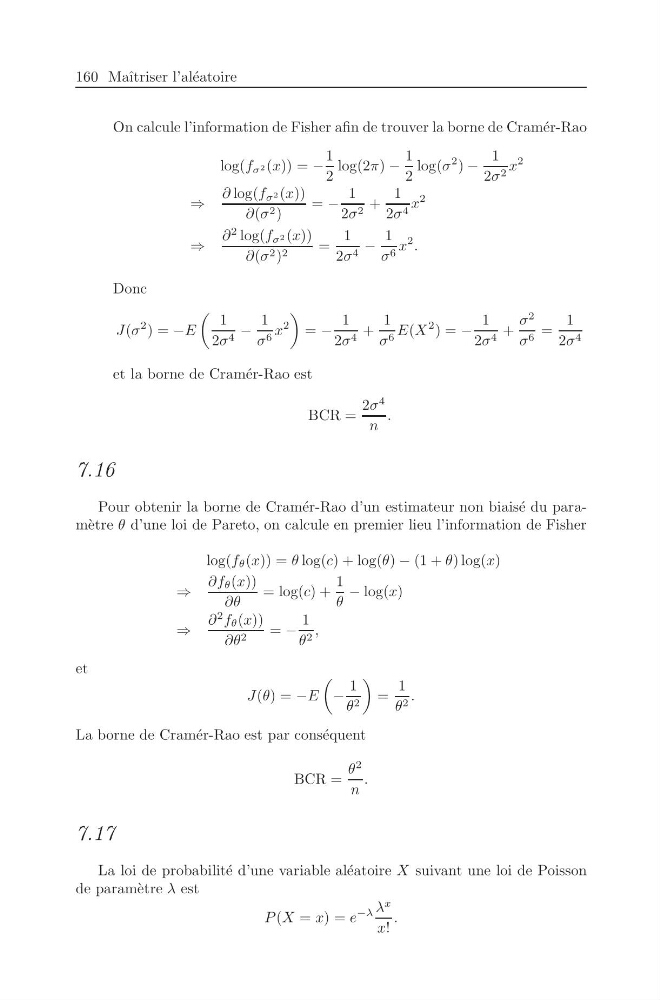
On calcule l’information de Fisher afin de trouver la borne de Cram´ er-Rao
log(f σ 2 (x)) = −
1
2
log(2π) −
1
2
log(σ
2 ) −
1
2σ 2 x
2
⇒
∂ log(f σ 2 (x))
∂(σ 2 )
= −
1
2σ 2 +
1
2σ 4 x
2
⇒
∂
2 log(f σ 2 (x))
∂(σ 2 ) 2
=
1
2σ 4 −
1
σ 6 x
2 .
Donc
J(σ
2 ) = −E
1
2σ 4 −
1
σ 6 x
2
= −
1
2σ 4 +
1
σ 6 E(X
2 ) = −
1
2σ 4 +
σ
2
σ 6 =
1
2σ 4
et la borne de Cram´ er-Rao est
BCR =
2σ
4
n
.
7.16
Pour obtenir la borne de Cram´ er-Rao d’un estimateur non biais´ e du param` etre θ d’une loi de Pareto, on calcule en premier lieu l’information de Fisher
log(f θ (x)) = θ log(c) + log(θ) − (1 + θ) log(x)
⇒
∂f θ (x))
∂θ
= log(c) +
1
θ
− log(x)
⇒
∂
2 f θ (x))
∂θ 2
= −
1
θ 2 ,
et
J(θ) = −E
−
1
θ 2
=
1
θ 2 .
La borne de Cram´ er-Rao est par cons´ equent
BCR =
θ
2
n
.
7.17
La loi de probabilit´ e d’une variable al´ eatoire X suivant une loi de Poisson
de param` etre λ est
P (X = x) = e
−λ λ
x
x!
.
On calcule l’information de Fisher afin de trouver la borne de Cram´ er-Rao
log(f σ 2 (x)) = −
1
2
log(2π) −
1
2
log(σ
2 ) −
1
2σ 2 x
2
⇒
∂ log(f σ 2 (x))
∂(σ 2 )
= −
1
2σ 2 +
1
2σ 4 x
2
⇒
∂
2 log(f σ 2 (x))
∂(σ 2 ) 2
=
1
2σ 4 −
1
σ 6 x
2 .
Donc
J(σ
2 ) = −E
1
2σ 4 −
1
σ 6 x
2
= −
1
2σ 4 +
1
σ 6 E(X
2 ) = −
1
2σ 4 +
σ
2
σ 6 =
1
2σ 4
et la borne de Cram´ er-Rao est
BCR =
2σ
4
n
.
7.16
Pour obtenir la borne de Cram´ er-Rao d’un estimateur non biais´ e du param` etre θ d’une loi de Pareto, on calcule en premier lieu l’information de Fisher
log(f θ (x)) = θ log(c) + log(θ) − (1 + θ) log(x)
⇒
∂f θ (x))
∂θ
= log(c) +
1
θ
− log(x)
⇒
∂
2 f θ (x))
∂θ 2
= −
1
θ 2 ,
et
J(θ) = −E
−
1
θ 2
=
1
θ 2 .
La borne de Cram´ er-Rao est par cons´ equent
BCR =
θ
2
n
.
7.17
La loi de probabilit´ e d’une variable al´ eatoire X suivant une loi de Poisson
de param` etre λ est
P (X = x) = e
−λ λ
x
x!
.