

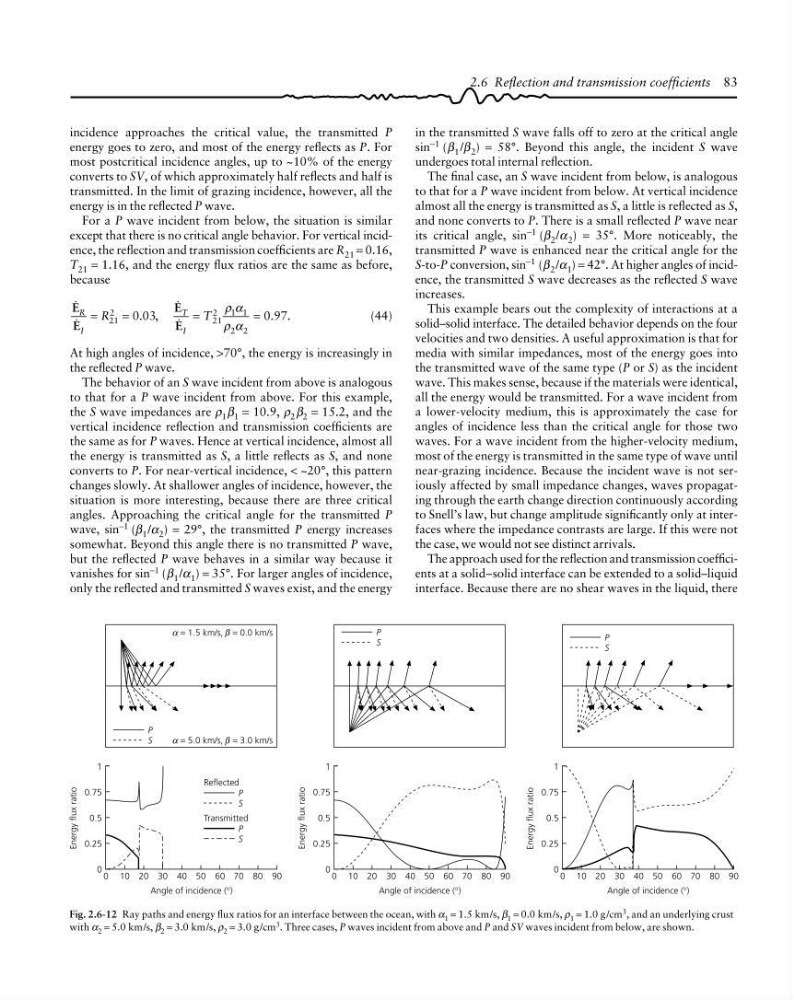
incidence approaches the critical value, the transmitted P
energy goes to zero, and most of the energy reflects as P. For
most postcritical incidence angles, up to ~10% of the energy
converts to SV, of which approximately half reflects and half is
transmitted. In the limit of grazing incidence, however, all the
energy is in the reflected P wave.
For a P wave incident from below, the situation is similar
except that there is no critical angle behavior. For vertical incidence, the reflection and transmission coefficients are R 21 = 0.16,
T 21 = 1.16, and the energy flux ratios are the same as before,
because
0
0
0
0
R
I
T
I
R
T
. ,
. .
=
=
=
=
21
2
21
2
1 1
2 2
0 03
0 97
ρ α
ρ α
(44)
At high angles of incidence, >70°, the energy is increasingly in
the reflected P wave.
The behavior of an S wave incident from above is analogous
to that for a P wave incident from above. For this example,
the S wave impedances are ρ 1 β 1 = 10.9, ρ 2 β 2 = 15.2, and the
vertical incidence reflection and transmission coefficients are
the same as for P waves. Hence at vertical incidence, almost all
the energy is transmitted as S, a little reflects as S, and none
converts to P. For near-vertical incidence, < ~20°, this pattern
changes slowly. At shallower angles of incidence, however, the
situation is more interesting, because there are three critical
angles. Approaching the critical angle for the transmitted P
wave, sin −1 (β 1 /α 2 ) = 29°, the transmitted P energy increases
somewhat. Beyond this angle there is no transmitted P wave,
but the reflected P wave behaves in a similar way because it
vanishes for sin
−1 (β 1 /α 1 ) = 35°. For larger angles of incidence,
only the reflected and transmitted S waves exist, and the energy
in the transmitted S wave falls off to zero at the critical angle
sin
−1 (β 1 /β 2 ) = 58°. Beyond this angle, the incident S wave
undergoes total internal reflection.
The final case, an S wave incident from below, is analogous
to that for a P wave incident from below. At vertical incidence
almost all the energy is transmitted as S, a little is reflected as S,
and none converts to P. There is a small reflected P wave near
its critical angle, sin −1 (β 2 /α 2 ) = 35°. More noticeably, the
transmitted P wave is enhanced near the critical angle for the
S-to-P conversion, sin −1 (β 2 /α 1 ) = 42°. At higher angles of incidence, the transmitted S wave decreases as the reflected S wave
increases.
This example bears out the complexity of interactions at a
solid–solid interface. The detailed behavior depends on the four
velocities and two densities. A useful approximation is that for
media with similar impedances, most of the energy goes into
the transmitted wave of the same type (P or S) as the incident
wave. This makes sense, because if the materials were identical,
all the energy would be transmitted. For a wave incident from
a lower-velocity medium, this is approximately the case for
angles of incidence less than the critical angle for those two
waves. For a wave incident from the higher-velocity medium,
most of the energy is transmitted in the same type of wave until
near-grazing incidence. Because the incident wave is not seriously affected by small impedance changes, waves propagating through the earth change direction continuously according
to Snell’s law, but change amplitude significantly only at interfaces where the impedance contrasts are large. If this were not
the case, we would not see distinct arrivals.
The approach used for the reflection and transmission coefficients at a solid–solid interface can be extended to a solid–liquid
interface. Because there are no shear waves in the liquid, there
2.6 Reflection and transmission coefficients 83
Fig. 2.6-12 Ray paths and energy flux ratios for an interface between the ocean, with α 1 = 1.5 km/s, β 1 = 0.0 km/s, ρ 1 = 1.0 g/cm 3 , and an underlying crust
with α 2 = 5.0 km/s, β 2 = 3.0 km/s, ρ 2 = 3.0 g/cm
3 . Three cases, P waves incident from above and P and SV waves incident from below, are shown.
Energy flux ratio
1
0.75
0.5
0.25
0
90
P
S
Reflected
P
S
Transmitted
80
70
60
50
40
30
20
10
0
Angle of incidence (°)
Energy flux ratio
1
0.75
0.5
0.25
0
90
80
70
60
50
40
30
20
10
0
Angle of incidence (°)
Energy flux ratio
1
0.75
0.5
0.25
0
90
80
70
60
50
40
30
20
10
0
Angle of incidence (°)
= 1.5 km/s, = 0.0 km/s
α
β
= 5.0 km/s, = 3.0 km/s
α
β
P
S
P
S
P
S
energy goes to zero, and most of the energy reflects as P. For
most postcritical incidence angles, up to ~10% of the energy
converts to SV, of which approximately half reflects and half is
transmitted. In the limit of grazing incidence, however, all the
energy is in the reflected P wave.
For a P wave incident from below, the situation is similar
except that there is no critical angle behavior. For vertical incidence, the reflection and transmission coefficients are R 21 = 0.16,
T 21 = 1.16, and the energy flux ratios are the same as before,
because
0
0
0
0
R
I
T
I
R
T
. ,
. .
=
=
=
=
21
2
21
2
1 1
2 2
0 03
0 97
ρ α
ρ α
(44)
At high angles of incidence, >70°, the energy is increasingly in
the reflected P wave.
The behavior of an S wave incident from above is analogous
to that for a P wave incident from above. For this example,
the S wave impedances are ρ 1 β 1 = 10.9, ρ 2 β 2 = 15.2, and the
vertical incidence reflection and transmission coefficients are
the same as for P waves. Hence at vertical incidence, almost all
the energy is transmitted as S, a little reflects as S, and none
converts to P. For near-vertical incidence, < ~20°, this pattern
changes slowly. At shallower angles of incidence, however, the
situation is more interesting, because there are three critical
angles. Approaching the critical angle for the transmitted P
wave, sin −1 (β 1 /α 2 ) = 29°, the transmitted P energy increases
somewhat. Beyond this angle there is no transmitted P wave,
but the reflected P wave behaves in a similar way because it
vanishes for sin
−1 (β 1 /α 1 ) = 35°. For larger angles of incidence,
only the reflected and transmitted S waves exist, and the energy
in the transmitted S wave falls off to zero at the critical angle
sin
−1 (β 1 /β 2 ) = 58°. Beyond this angle, the incident S wave
undergoes total internal reflection.
The final case, an S wave incident from below, is analogous
to that for a P wave incident from below. At vertical incidence
almost all the energy is transmitted as S, a little is reflected as S,
and none converts to P. There is a small reflected P wave near
its critical angle, sin −1 (β 2 /α 2 ) = 35°. More noticeably, the
transmitted P wave is enhanced near the critical angle for the
S-to-P conversion, sin −1 (β 2 /α 1 ) = 42°. At higher angles of incidence, the transmitted S wave decreases as the reflected S wave
increases.
This example bears out the complexity of interactions at a
solid–solid interface. The detailed behavior depends on the four
velocities and two densities. A useful approximation is that for
media with similar impedances, most of the energy goes into
the transmitted wave of the same type (P or S) as the incident
wave. This makes sense, because if the materials were identical,
all the energy would be transmitted. For a wave incident from
a lower-velocity medium, this is approximately the case for
angles of incidence less than the critical angle for those two
waves. For a wave incident from the higher-velocity medium,
most of the energy is transmitted in the same type of wave until
near-grazing incidence. Because the incident wave is not seriously affected by small impedance changes, waves propagating through the earth change direction continuously according
to Snell’s law, but change amplitude significantly only at interfaces where the impedance contrasts are large. If this were not
the case, we would not see distinct arrivals.
The approach used for the reflection and transmission coefficients at a solid–solid interface can be extended to a solid–liquid
interface. Because there are no shear waves in the liquid, there
2.6 Reflection and transmission coefficients 83
Fig. 2.6-12 Ray paths and energy flux ratios for an interface between the ocean, with α 1 = 1.5 km/s, β 1 = 0.0 km/s, ρ 1 = 1.0 g/cm 3 , and an underlying crust
with α 2 = 5.0 km/s, β 2 = 3.0 km/s, ρ 2 = 3.0 g/cm
3 . Three cases, P waves incident from above and P and SV waves incident from below, are shown.
Energy flux ratio
1
0.75
0.5
0.25
0
90
P
S
Reflected
P
S
Transmitted
80
70
60
50
40
30
20
10
0
Angle of incidence (°)
Energy flux ratio
1
0.75
0.5
0.25
0
90
80
70
60
50
40
30
20
10
0
Angle of incidence (°)
Energy flux ratio
1
0.75
0.5
0.25
0
90
80
70
60
50
40
30
20
10
0
Angle of incidence (°)
= 1.5 km/s, = 0.0 km/s
α
β
= 5.0 km/s, = 3.0 km/s
α
β
P
S
P
S
P
S