

Halfspace
A 1
B 2
A 2
z
i
j
i
x
P
S
Fig. 2.6-5 The effect of phase shifts on a seismic waveform shown in the
upper trace. (Choy and Richards, 1975. © Seismological Society of
America. All rights reserved.)
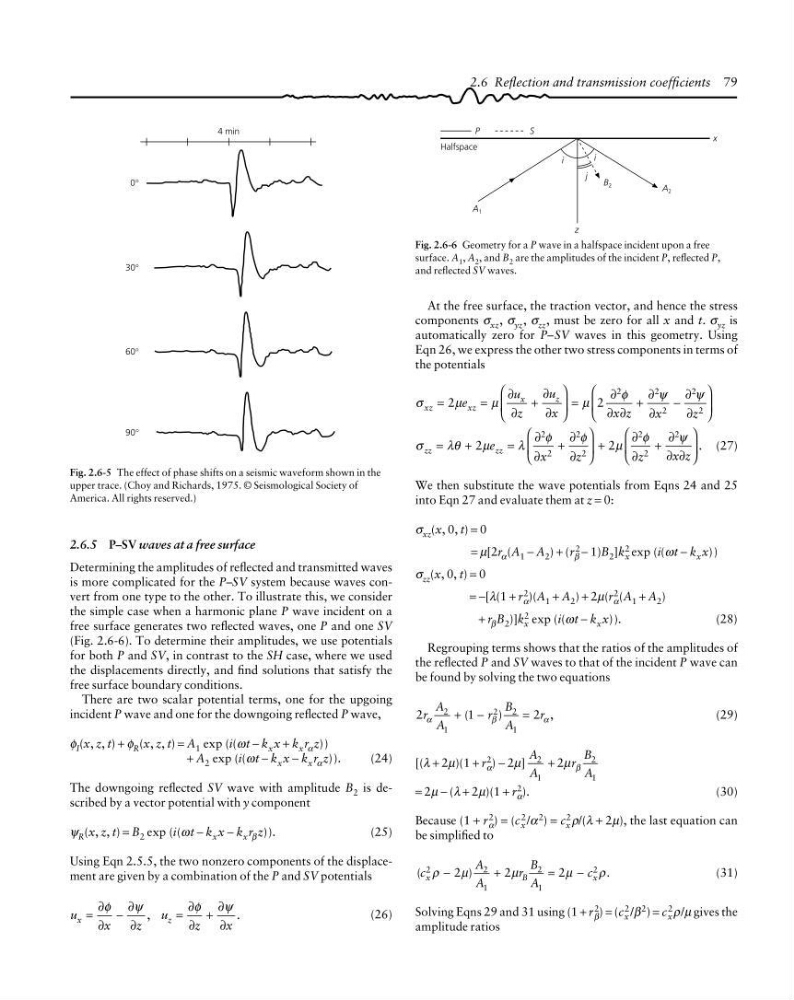
Fig. 2.6-6 Geometry for a P wave in a halfspace incident upon a free
surface. A 1 , A 2 , and B 2 are the amplitudes of the incident P, reflected P,
and reflected SV waves.
At the free surface, the traction vector, and hence the stress
components σ xz , σ yz , σ zz , must be zero for all x and t. σ yz is
automatically zero for P–SV waves in this geometry. Using
Eqn 26, we express the other two stress components in terms of
the potentials
σ
µ
µ
µ
φ
ψ
ψ
xz
xz
x
z
e
u
z
u
x
xz
x
z
=
=
+
⎛
⎝
⎜
⎞
⎠
⎟ =
+
−
⎛
⎝
⎜
⎞
⎠
⎟
2
2
2
2
∂
∂
∂
∂
∂
∂ ∂
∂
∂
∂
∂
2
2
2
σ
λθ
µ
λ
φ
φ
µ
φ
ψ
zz
zz
e
x
z
z
x z
=
+
=
+
⎛
⎝
⎜
⎞
⎠
⎟ +
+
⎛
⎝
⎜
⎞
⎠
⎟ .
2
2
2
2
2
∂
∂
∂
∂
∂
∂
∂
∂ ∂
2
2
2
2
(27)
We then substitute the wave potentials from Eqns 24 and 25
into Eqn 27 and evaluate them at z = 0:
σ xz (x, 0, t) = 0
= µ[2r α (A 1 − A 2 ) + (r 2
β − 1)B 2 ]k 2
x exp (i(ωt − k x x))
σ zz (x, 0, t) = 0
= −[λ(1 + r
2
α )(A 1 + A 2 ) + 2µ(r
2
α (A 1 + A 2 )
+ r β B 2 )]k 2
x exp (i(ωt − k x x)).
(28)
Regrouping terms shows that the ratios of the amplitudes of
the reflected P and SV waves to that of the incident P wave can
be found by solving the two equations
2
1
2
2
1
2
2
1
r
A
A
r
B
A
r
α
β
α
(
)
,
+ −
=
(29)
[(λ + 2µ)(1 + r
2
α ) − 2µ]
A
A
2
1
+ 2µr β
B
A
2
1
= 2µ − (λ + 2µ)(1 + r 2
α ).
(30)
Because (1 + r 2
α ) = (c 2
x /α 2 ) = c 2
x ρ/(λ + 2µ), the last equation can
be simplified to
(
)
.
c
A
A
r
B
A
c
x
B
x
2
2
1
2
1
2
2
2
2
ρ
µ
µ
µ
ρ
−
+
=
−
(31)
Solving Eqns 29 and 31 using (1 + r 2
β ) = (c 2
x /β 2 ) = c 2
x ρ/µ gives the
amplitude ratios
0°
30°
60°
90°
4 min
2.6 Reflection and transmission coefficients 79
2.6.5 P–SV waves at a free surface
Determining the amplitudes of reflected and transmitted waves
is more complicated for the P–SV system because waves convert from one type to the other. To illustrate this, we consider
the simple case when a harmonic plane P wave incident on a
free surface generates two reflected waves, one P and one SV
(Fig. 2.6-6). To determine their amplitudes, we use potentials
for both P and SV, in contrast to the SH case, where we used
the displacements directly, and find solutions that satisfy the
free surface boundary conditions.
There are two scalar potential terms, one for the upgoing
incident P wave and one for the downgoing reflected P wave,
φ I (x, z, t) + φ R (x, z, t) = A 1 exp (i(ωt − k x x + k x r α z))
+ A 2 exp (i(ωt − k x x − k x r α z)).
(24)
The downgoing reflected SV wave with amplitude B 2 is described by a vector potential with y component
ψ R (x, z, t) = B 2 exp (i(ωt − k x x − k x r β z)).
(25)
Using Eqn 2.5.5, the two nonzero components of the displacement are given by a combination of the P and SV potentials
u
x
z
u
z
x
x
z
=
−
=
+
,
.
∂
∂
∂
∂
∂
∂
∂
∂
φ
ψ
φ
ψ
(26)
A 1
B 2
A 2
z
i
j
i
x
P
S
Fig. 2.6-5 The effect of phase shifts on a seismic waveform shown in the
upper trace. (Choy and Richards, 1975. © Seismological Society of
America. All rights reserved.)
Fig. 2.6-6 Geometry for a P wave in a halfspace incident upon a free
surface. A 1 , A 2 , and B 2 are the amplitudes of the incident P, reflected P,
and reflected SV waves.
At the free surface, the traction vector, and hence the stress
components σ xz , σ yz , σ zz , must be zero for all x and t. σ yz is
automatically zero for P–SV waves in this geometry. Using
Eqn 26, we express the other two stress components in terms of
the potentials
σ
µ
µ
µ
φ
ψ
ψ
xz
xz
x
z
e
u
z
u
x
xz
x
z
=
=
+
⎛
⎝
⎜
⎞
⎠
⎟ =
+
−
⎛
⎝
⎜
⎞
⎠
⎟
2
2
2
2
∂
∂
∂
∂
∂
∂ ∂
∂
∂
∂
∂
2
2
2
σ
λθ
µ
λ
φ
φ
µ
φ
ψ
zz
zz
e
x
z
z
x z
=
+
=
+
⎛
⎝
⎜
⎞
⎠
⎟ +
+
⎛
⎝
⎜
⎞
⎠
⎟ .
2
2
2
2
2
∂
∂
∂
∂
∂
∂
∂
∂ ∂
2
2
2
2
(27)
We then substitute the wave potentials from Eqns 24 and 25
into Eqn 27 and evaluate them at z = 0:
σ xz (x, 0, t) = 0
= µ[2r α (A 1 − A 2 ) + (r 2
β − 1)B 2 ]k 2
x exp (i(ωt − k x x))
σ zz (x, 0, t) = 0
= −[λ(1 + r
2
α )(A 1 + A 2 ) + 2µ(r
2
α (A 1 + A 2 )
+ r β B 2 )]k 2
x exp (i(ωt − k x x)).
(28)
Regrouping terms shows that the ratios of the amplitudes of
the reflected P and SV waves to that of the incident P wave can
be found by solving the two equations
2
1
2
2
1
2
2
1
r
A
A
r
B
A
r
α
β
α
(
)
,
+ −
=
(29)
[(λ + 2µ)(1 + r
2
α ) − 2µ]
A
A
2
1
+ 2µr β
B
A
2
1
= 2µ − (λ + 2µ)(1 + r 2
α ).
(30)
Because (1 + r 2
α ) = (c 2
x /α 2 ) = c 2
x ρ/(λ + 2µ), the last equation can
be simplified to
(
)
.
c
A
A
r
B
A
c
x
B
x
2
2
1
2
1
2
2
2
2
ρ
µ
µ
µ
ρ
−
+
=
−
(31)
Solving Eqns 29 and 31 using (1 + r 2
β ) = (c 2
x /β 2 ) = c 2
x ρ/µ gives the
amplitude ratios
0°
30°
60°
90°
4 min
2.6 Reflection and transmission coefficients 79
2.6.5 P–SV waves at a free surface
Determining the amplitudes of reflected and transmitted waves
is more complicated for the P–SV system because waves convert from one type to the other. To illustrate this, we consider
the simple case when a harmonic plane P wave incident on a
free surface generates two reflected waves, one P and one SV
(Fig. 2.6-6). To determine their amplitudes, we use potentials
for both P and SV, in contrast to the SH case, where we used
the displacements directly, and find solutions that satisfy the
free surface boundary conditions.
There are two scalar potential terms, one for the upgoing
incident P wave and one for the downgoing reflected P wave,
φ I (x, z, t) + φ R (x, z, t) = A 1 exp (i(ωt − k x x + k x r α z))
+ A 2 exp (i(ωt − k x x − k x r α z)).
(24)
The downgoing reflected SV wave with amplitude B 2 is described by a vector potential with y component
ψ R (x, z, t) = B 2 exp (i(ωt − k x x − k x r β z)).
(25)
Using Eqn 2.5.5, the two nonzero components of the displacement are given by a combination of the P and SV potentials
u
x
z
u
z
x
x
z
=
−
=
+
,
.
∂
∂
∂
∂
∂
∂
∂
∂
φ
ψ
φ
ψ
(26)