

a. Spherical obstacle
b. Spherical slow anomaly
c. Spherical fast anomaly
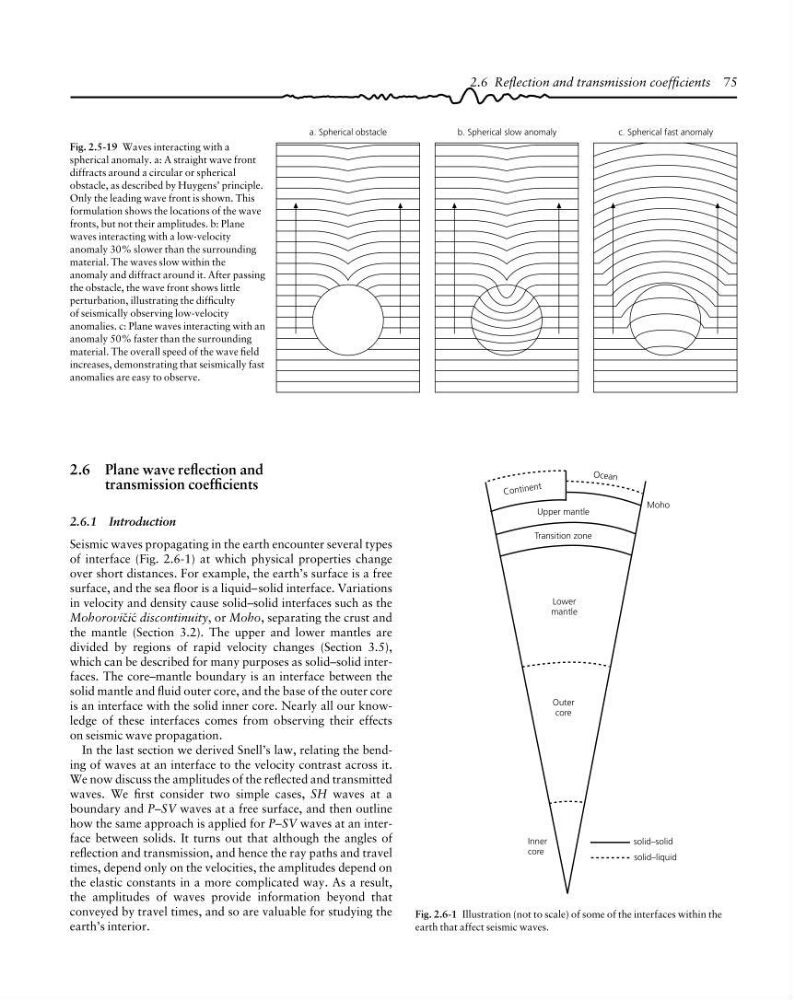
Fig. 2.5-19 Waves interacting with a
spherical anomaly. a: A straight wave front
diffracts around a circular or spherical
obstacle, as described by Huygens’ principle.
Only the leading wave front is shown. This
formulation shows the locations of the wave
fronts, but not their amplitudes. b: Plane
waves interacting with a low-velocity
anomaly 30% slower than the surrounding
material. The waves slow within the
anomaly and diffract around it. After passing
the obstacle, the wave front shows little
perturbation, illustrating the difficulty
of seismically observing low-velocity
anomalies. c: Plane waves interacting with an
anomaly 50% faster than the surrounding
material. The overall speed of the wave field
increases, demonstrating that seismically fast
anomalies are easy to observe.
2.6 Reflection and transmission coefficients 75
2.6 Plane wave reflection and
transmission coefficients
2.6.1 Introduction
Seismic waves propagating in the earth encounter several types
of interface (Fig. 2.6-1) at which physical properties change
over short distances. For example, the earth’s surface is a free
surface, and the sea floor is a liquid–solid interface. Variations
in velocity and density cause solid–solid interfaces such as the
Mohorovibia discontinuity, or Moho, separating the crust and
the mantle (Section 3.2). The upper and lower mantles are
divided by regions of rapid velocity changes (Section 3.5),
which can be described for many purposes as solid–solid interfaces. The core–mantle boundary is an interface between the
solid mantle and fluid outer core, and the base of the outer core
is an interface with the solid inner core. Nearly all our knowledge of these interfaces comes from observing their effects
on seismic wave propagation.
In the last section we derived Snell’s law, relating the bending of waves at an interface to the velocity contrast across it.
We now discuss the amplitudes of the reflected and transmitted
waves. We first consider two simple cases, SH waves at a
boundary and P–SV waves at a free surface, and then outline
how the same approach is applied for P–SV waves at an interface between solids. It turns out that although the angles of
reflection and transmission, and hence the ray paths and travel
times, depend only on the velocities, the amplitudes depend on
the elastic constants in a more complicated way. As a result,
the amplitudes of waves provide information beyond that
conveyed by travel times, and so are valuable for studying the
earth’s interior.
Fig. 2.6-1 Illustration (not to scale) of some of the interfaces within the
earth that affect seismic waves.
Lower
mantle
Upper mantle
Co nti ne nt
Oce an
Transition zone
Moho
Outer
core
Inner
core
solid–solid
solid–liquid
b. Spherical slow anomaly
c. Spherical fast anomaly
Fig. 2.5-19 Waves interacting with a
spherical anomaly. a: A straight wave front
diffracts around a circular or spherical
obstacle, as described by Huygens’ principle.
Only the leading wave front is shown. This
formulation shows the locations of the wave
fronts, but not their amplitudes. b: Plane
waves interacting with a low-velocity
anomaly 30% slower than the surrounding
material. The waves slow within the
anomaly and diffract around it. After passing
the obstacle, the wave front shows little
perturbation, illustrating the difficulty
of seismically observing low-velocity
anomalies. c: Plane waves interacting with an
anomaly 50% faster than the surrounding
material. The overall speed of the wave field
increases, demonstrating that seismically fast
anomalies are easy to observe.
2.6 Reflection and transmission coefficients 75
2.6 Plane wave reflection and
transmission coefficients
2.6.1 Introduction
Seismic waves propagating in the earth encounter several types
of interface (Fig. 2.6-1) at which physical properties change
over short distances. For example, the earth’s surface is a free
surface, and the sea floor is a liquid–solid interface. Variations
in velocity and density cause solid–solid interfaces such as the
Mohorovibia discontinuity, or Moho, separating the crust and
the mantle (Section 3.2). The upper and lower mantles are
divided by regions of rapid velocity changes (Section 3.5),
which can be described for many purposes as solid–solid interfaces. The core–mantle boundary is an interface between the
solid mantle and fluid outer core, and the base of the outer core
is an interface with the solid inner core. Nearly all our knowledge of these interfaces comes from observing their effects
on seismic wave propagation.
In the last section we derived Snell’s law, relating the bending of waves at an interface to the velocity contrast across it.
We now discuss the amplitudes of the reflected and transmitted
waves. We first consider two simple cases, SH waves at a
boundary and P–SV waves at a free surface, and then outline
how the same approach is applied for P–SV waves at an interface between solids. It turns out that although the angles of
reflection and transmission, and hence the ray paths and travel
times, depend only on the velocities, the amplitudes depend on
the elastic constants in a more complicated way. As a result,
the amplitudes of waves provide information beyond that
conveyed by travel times, and so are valuable for studying the
earth’s interior.
Fig. 2.6-1 Illustration (not to scale) of some of the interfaces within the
earth that affect seismic waves.
Lower
mantle
Upper mantle
Co nti ne nt
Oce an
Transition zone
Moho
Outer
core
Inner
core
solid–solid
solid–liquid