

κ α
Wave
front
Half-space
x
z
i
k x
kα
k z α
i
s = α
k ˆ
sin i
p = α
η α = α
cos i
Transmitted
(refracted)
x
z
β1
β
Incident
SH
Reflected
j 1
j 1
j 2
β2
β
Fig. 2.5-8 An SH wave propagating in the x–z plane creates only
transmitted and reflected SH waves when incident on a solid–solid
interface in the x–y plane. The incident and reflected waves have the
same incidence angle, j 1 . For β 2 > β 1 , j 2 > j 1 .
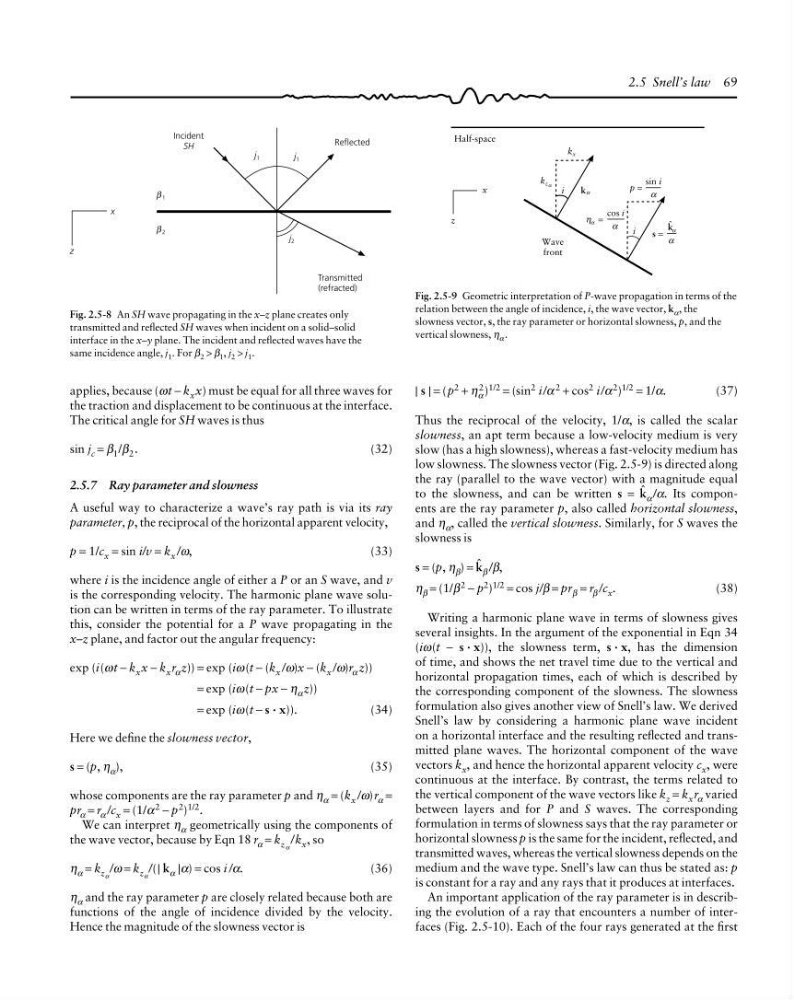
Fig. 2.5-9 Geometric interpretation of P-wave propagation in terms of the
relation between the angle of incidence, i, the wave vector, k α , the
slowness vector, s, the ray parameter or horizontal slowness, p, and the
vertical slowness, η α .
2.5 Snell’s law 69
applies, because (ωt − k x x) must be equal for all three waves for
the traction and displacement to be continuous at the interface.
The critical angle for SH waves is thus
sin j c = β 1 /β 2 .
(32)
2.5.7 Ray parameter and slowness
A useful way to characterize a wave’s ray path is via its ray
parameter, p, the reciprocal of the horizontal apparent velocity,
p = 1/c x = sin i/v = k x /ω,
(33)
where i is the incidence angle of either a P or an S wave, and v
is the corresponding velocity. The harmonic plane wave solution can be written in terms of the ray parameter. To illustrate
this, consider the potential for a P wave propagating in the
x–z plane, and factor out the angular frequency:
exp (i(ωt − k x x − k x r α z)) = exp (iω (t − (k x /ω)x − (k x /ω)r α z))
= exp (iω (t − px − η α z))
= exp (iω (t − s · x)).
(34)
Here we define the slowness vector,
s = (p, η α ),
(35)
whose components are the ray parameter p and η α = (k x /ω)r α =
pr α = r α /c x = (1/α 2 − p 2 ) 1/2 .
We can interpret η α geometrically using the components of
the wave vector, because by Eqn 18 r α = k z α /k x , so
η α = k z α /ω = k z α /(| k α |α) = cos i /α.
(36)
η α and the ray parameter p are closely related because both are
functions of the angle of incidence divided by the velocity.
Hence the magnitude of the slowness vector is
| s | = (p 2 + η α
2 ) 1/2 = (sin 2 i/α 2 + cos 2 i/α 2 ) 1/2 = 1/α.
(37)
Thus the reciprocal of the velocity, 1/α, is called the scalar
slowness, an apt term because a low-velocity medium is very
slow (has a high slowness), whereas a fast-velocity medium has
low slowness. The slowness vector (Fig. 2.5-9) is directed along
the ray (parallel to the wave vector) with a magnitude equal
to the slowness, and can be written s = 3 α /α. Its components are the ray parameter p, also called horizontal slowness,
and η α , called the vertical slowness. Similarly, for S waves the
slowness is
s = (p, η β ) = 3 β /β,
η β = (1/β 2 − p 2 ) 1/2 = cos j/β = pr β = r β /c x .
(38)
Writing a harmonic plane wave in terms of slowness gives
several insights. In the argument of the exponential in Eqn 34
(iω(t − s · x)), the slowness term, s · x, has the dimension
of time, and shows the net travel time due to the vertical and
horizontal propagation times, each of which is described by
the corresponding component of the slowness. The slowness
formulation also gives another view of Snell’s law. We derived
Snell’s law by considering a harmonic plane wave incident
on a horizontal interface and the resulting reflected and transmitted plane waves. The horizontal component of the wave
vectors k x , and hence the horizontal apparent velocity c x , were
continuous at the interface. By contrast, the terms related to
the vertical component of the wave vectors like k z = k x r α varied
between layers and for P and S waves. The corresponding
formulation in terms of slowness says that the ray parameter or
horizontal slowness p is the same for the incident, reflected, and
transmitted waves, whereas the vertical slowness depends on the
medium and the wave type. Snell’s law can thus be stated as: p
is constant for a ray and any rays that it produces at interfaces.
An important application of the ray parameter is in describing the evolution of a ray that encounters a number of interfaces (Fig. 2.5-10). Each of the four rays generated at the first
Wave
front
Half-space
x
z
i
k x
kα
k z α
i
s = α
k ˆ
sin i
p = α
η α = α
cos i
Transmitted
(refracted)
x
z
β1
β
Incident
SH
Reflected
j 1
j 1
j 2
β2
β
Fig. 2.5-8 An SH wave propagating in the x–z plane creates only
transmitted and reflected SH waves when incident on a solid–solid
interface in the x–y plane. The incident and reflected waves have the
same incidence angle, j 1 . For β 2 > β 1 , j 2 > j 1 .
Fig. 2.5-9 Geometric interpretation of P-wave propagation in terms of the
relation between the angle of incidence, i, the wave vector, k α , the
slowness vector, s, the ray parameter or horizontal slowness, p, and the
vertical slowness, η α .
2.5 Snell’s law 69
applies, because (ωt − k x x) must be equal for all three waves for
the traction and displacement to be continuous at the interface.
The critical angle for SH waves is thus
sin j c = β 1 /β 2 .
(32)
2.5.7 Ray parameter and slowness
A useful way to characterize a wave’s ray path is via its ray
parameter, p, the reciprocal of the horizontal apparent velocity,
p = 1/c x = sin i/v = k x /ω,
(33)
where i is the incidence angle of either a P or an S wave, and v
is the corresponding velocity. The harmonic plane wave solution can be written in terms of the ray parameter. To illustrate
this, consider the potential for a P wave propagating in the
x–z plane, and factor out the angular frequency:
exp (i(ωt − k x x − k x r α z)) = exp (iω (t − (k x /ω)x − (k x /ω)r α z))
= exp (iω (t − px − η α z))
= exp (iω (t − s · x)).
(34)
Here we define the slowness vector,
s = (p, η α ),
(35)
whose components are the ray parameter p and η α = (k x /ω)r α =
pr α = r α /c x = (1/α 2 − p 2 ) 1/2 .
We can interpret η α geometrically using the components of
the wave vector, because by Eqn 18 r α = k z α /k x , so
η α = k z α /ω = k z α /(| k α |α) = cos i /α.
(36)
η α and the ray parameter p are closely related because both are
functions of the angle of incidence divided by the velocity.
Hence the magnitude of the slowness vector is
| s | = (p 2 + η α
2 ) 1/2 = (sin 2 i/α 2 + cos 2 i/α 2 ) 1/2 = 1/α.
(37)
Thus the reciprocal of the velocity, 1/α, is called the scalar
slowness, an apt term because a low-velocity medium is very
slow (has a high slowness), whereas a fast-velocity medium has
low slowness. The slowness vector (Fig. 2.5-9) is directed along
the ray (parallel to the wave vector) with a magnitude equal
to the slowness, and can be written s = 3 α /α. Its components are the ray parameter p, also called horizontal slowness,
and η α , called the vertical slowness. Similarly, for S waves the
slowness is
s = (p, η β ) = 3 β /β,
η β = (1/β 2 − p 2 ) 1/2 = cos j/β = pr β = r β /c x .
(38)
Writing a harmonic plane wave in terms of slowness gives
several insights. In the argument of the exponential in Eqn 34
(iω(t − s · x)), the slowness term, s · x, has the dimension
of time, and shows the net travel time due to the vertical and
horizontal propagation times, each of which is described by
the corresponding component of the slowness. The slowness
formulation also gives another view of Snell’s law. We derived
Snell’s law by considering a harmonic plane wave incident
on a horizontal interface and the resulting reflected and transmitted plane waves. The horizontal component of the wave
vectors k x , and hence the horizontal apparent velocity c x , were
continuous at the interface. By contrast, the terms related to
the vertical component of the wave vectors like k z = k x r α varied
between layers and for P and S waves. The corresponding
formulation in terms of slowness says that the ray parameter or
horizontal slowness p is the same for the incident, reflected, and
transmitted waves, whereas the vertical slowness depends on the
medium and the wave type. Snell’s law can thus be stated as: p
is constant for a ray and any rays that it produces at interfaces.
An important application of the ray parameter is in describing the evolution of a ray that encounters a number of interfaces (Fig. 2.5-10). Each of the four rays generated at the first