

56 Basic Seismological Theory
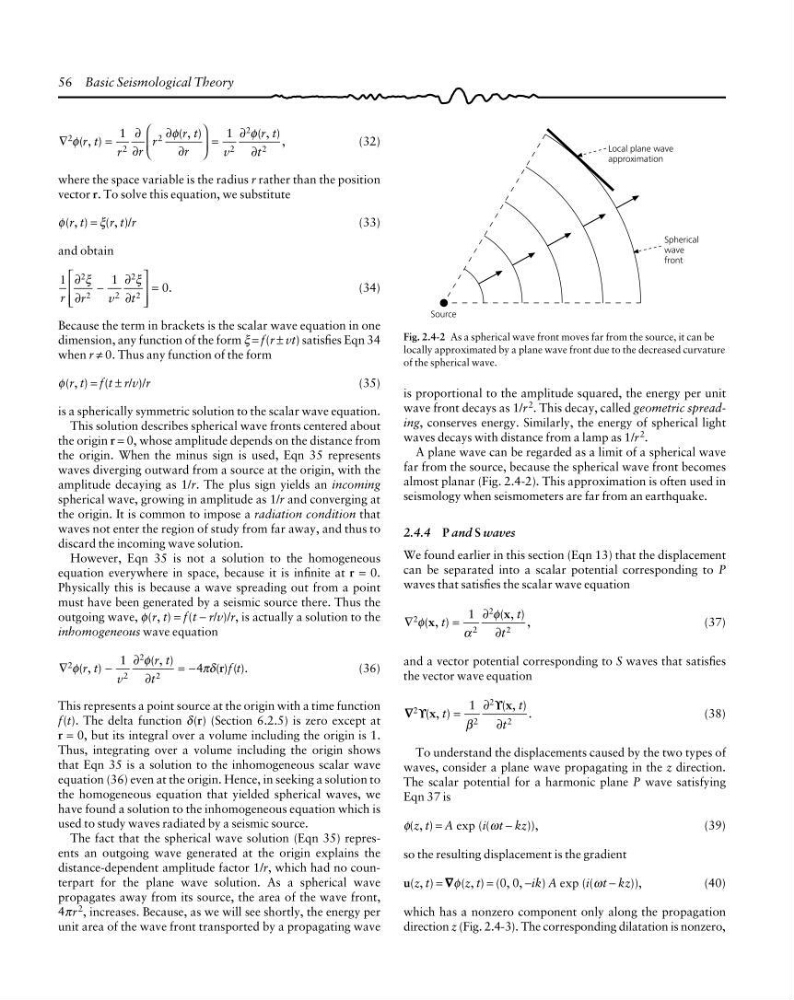
Source
Spherical
wave
front
Local plane wave
approximation
Fig. 2.4-2 As a spherical wave front moves far from the source, it can be
locally approximated by a plane wave front due to the decreased curvature
of the spherical wave.
∇
=
⎛
⎝
⎜
⎞
⎠
⎟ =
2
2
2
2
1
1
φ
φ
φ
( , )
( , )
( , ) ,
r t
r r
r
r t
r
v
r t
t
∂
∂
∂
∂
∂
∂
2
2
(32)
where the space variable is the radius r rather than the position
vector r. To solve this equation, we substitute
φ(r, t) = ξ(r, t)/r
(33)
and obtain
1 ∂
∂
∂
∂
2
2
2
2
r r
v t
ξ
ξ
.
−
⎡
⎣
⎢
⎢
⎤
⎦
⎥
⎥
=
1
0
2
(34)
Because the term in brackets is the scalar wave equation in one
dimension, any function of the form ξ = f(r ± vt) satisfies Eqn 34
when r ≠ 0. Thus any function of the form
φ(r, t) = f(t ± r/v)/r
(35)
is a spherically symmetric solution to the scalar wave equation.
This solution describes spherical wave fronts centered about
the origin r = 0, whose amplitude depends on the distance from
the origin. When the minus sign is used, Eqn 35 represents
waves diverging outward from a source at the origin, with the
amplitude decaying as 1/r. The plus sign yields an incoming
spherical wave, growing in amplitude as 1/r and converging at
the origin. It is common to impose a radiation condition that
waves not enter the region of study from far away, and thus to
discard the incoming wave solution.
However, Eqn 35 is not a solution to the homogeneous
equation everywhere in space, because it is infinite at r = 0.
Physically this is because a wave spreading out from a point
must have been generated by a seismic source there. Thus the
outgoing wave, φ(r, t) = f(t − r/v)/r, is actually a solution to the
inhomogeneous wave equation
∇
−
=−
2
2
2
∂
∂
φ
φ
πδ
( , )
( , )
( ) ( ).
r t
v
r t
t
f t
1
4
2
r
(36)
This represents a point source at the origin with a time function
f(t). The delta function δ(r) (Section 6.2.5) is zero except at
r = 0, but its integral over a volume including the origin is 1.
Thus, integrating over a volume including the origin shows
that Eqn 35 is a solution to the inhomogeneous scalar wave
equation (36) even at the origin. Hence, in seeking a solution to
the homogeneous equation that yielded spherical waves, we
have found a solution to the inhomogeneous equation which is
used to study waves radiated by a seismic source.
The fact that the spherical wave solution (Eqn 35) represents an outgoing wave generated at the origin explains the
distance-dependent amplitude factor 1/r, which had no counterpart for the plane wave solution. As a spherical wave
propagates away from its source, the area of the wave front,
4πr 2 , increases. Because, as we will see shortly, the energy per
unit area of the wave front transported by a propagating wave
is proportional to the amplitude squared, the energy per unit
wave front decays as 1/r 2 . This decay, called geometric spreading, conserves energy. Similarly, the energy of spherical light
waves decays with distance from a lamp as 1/r 2 .
A plane wave can be regarded as a limit of a spherical wave
far from the source, because the spherical wave front becomes
almost planar (Fig. 2.4-2). This approximation is often used in
seismology when seismometers are far from an earthquake.
2.4.4 P and S waves
We found earlier in this section (Eqn 13) that the displacement
can be separated into a scalar potential corresponding to P
waves that satisfies the scalar wave equation
∇
=
2
2
2
∂
∂
φ
α
φ
( , )
( , ) ,
x
x
t
t
t
1
2
(37)
and a vector potential corresponding to S waves that satisfies
the vector wave equation
∇ ∇ ϒ ϒ
ϒ ϒ
2
2
2
∂
∂
( , )
( , ) .
x
x
t
t
t
=
1
2
β
(38)
To understand the displacements caused by the two types of
waves, consider a plane wave propagating in the z direction.
The scalar potential for a harmonic plane P wave satisfying
Eqn 37 is
φ(z, t) = A exp (i(ωt − kz)),
(39)
so the resulting displacement is the gradient
u(z, t) = ∇
∇ ∇
∇ ∇φ(z, t) = (0, 0, −ik) A exp (i(ωt − kz)),
(40)
which has a nonzero component only along the propagation
direction z (Fig. 2.4-3). The corresponding dilatation is nonzero,
Source
Spherical
wave
front
Local plane wave
approximation
Fig. 2.4-2 As a spherical wave front moves far from the source, it can be
locally approximated by a plane wave front due to the decreased curvature
of the spherical wave.
∇
=
⎛
⎝
⎜
⎞
⎠
⎟ =
2
2
2
2
1
1
φ
φ
φ
( , )
( , )
( , ) ,
r t
r r
r
r t
r
v
r t
t
∂
∂
∂
∂
∂
∂
2
2
(32)
where the space variable is the radius r rather than the position
vector r. To solve this equation, we substitute
φ(r, t) = ξ(r, t)/r
(33)
and obtain
1 ∂
∂
∂
∂
2
2
2
2
r r
v t
ξ
ξ
.
−
⎡
⎣
⎢
⎢
⎤
⎦
⎥
⎥
=
1
0
2
(34)
Because the term in brackets is the scalar wave equation in one
dimension, any function of the form ξ = f(r ± vt) satisfies Eqn 34
when r ≠ 0. Thus any function of the form
φ(r, t) = f(t ± r/v)/r
(35)
is a spherically symmetric solution to the scalar wave equation.
This solution describes spherical wave fronts centered about
the origin r = 0, whose amplitude depends on the distance from
the origin. When the minus sign is used, Eqn 35 represents
waves diverging outward from a source at the origin, with the
amplitude decaying as 1/r. The plus sign yields an incoming
spherical wave, growing in amplitude as 1/r and converging at
the origin. It is common to impose a radiation condition that
waves not enter the region of study from far away, and thus to
discard the incoming wave solution.
However, Eqn 35 is not a solution to the homogeneous
equation everywhere in space, because it is infinite at r = 0.
Physically this is because a wave spreading out from a point
must have been generated by a seismic source there. Thus the
outgoing wave, φ(r, t) = f(t − r/v)/r, is actually a solution to the
inhomogeneous wave equation
∇
−
=−
2
2
2
∂
∂
φ
φ
πδ
( , )
( , )
( ) ( ).
r t
v
r t
t
f t
1
4
2
r
(36)
This represents a point source at the origin with a time function
f(t). The delta function δ(r) (Section 6.2.5) is zero except at
r = 0, but its integral over a volume including the origin is 1.
Thus, integrating over a volume including the origin shows
that Eqn 35 is a solution to the inhomogeneous scalar wave
equation (36) even at the origin. Hence, in seeking a solution to
the homogeneous equation that yielded spherical waves, we
have found a solution to the inhomogeneous equation which is
used to study waves radiated by a seismic source.
The fact that the spherical wave solution (Eqn 35) represents an outgoing wave generated at the origin explains the
distance-dependent amplitude factor 1/r, which had no counterpart for the plane wave solution. As a spherical wave
propagates away from its source, the area of the wave front,
4πr 2 , increases. Because, as we will see shortly, the energy per
unit area of the wave front transported by a propagating wave
is proportional to the amplitude squared, the energy per unit
wave front decays as 1/r 2 . This decay, called geometric spreading, conserves energy. Similarly, the energy of spherical light
waves decays with distance from a lamp as 1/r 2 .
A plane wave can be regarded as a limit of a spherical wave
far from the source, because the spherical wave front becomes
almost planar (Fig. 2.4-2). This approximation is often used in
seismology when seismometers are far from an earthquake.
2.4.4 P and S waves
We found earlier in this section (Eqn 13) that the displacement
can be separated into a scalar potential corresponding to P
waves that satisfies the scalar wave equation
∇
=
2
2
2
∂
∂
φ
α
φ
( , )
( , ) ,
x
x
t
t
t
1
2
(37)
and a vector potential corresponding to S waves that satisfies
the vector wave equation
∇ ∇ ϒ ϒ
ϒ ϒ
2
2
2
∂
∂
( , )
( , ) .
x
x
t
t
t
=
1
2
β
(38)
To understand the displacements caused by the two types of
waves, consider a plane wave propagating in the z direction.
The scalar potential for a harmonic plane P wave satisfying
Eqn 37 is
φ(z, t) = A exp (i(ωt − kz)),
(39)
so the resulting displacement is the gradient
u(z, t) = ∇
∇ ∇
∇ ∇φ(z, t) = (0, 0, −ik) A exp (i(ωt − kz)),
(40)
which has a nonzero component only along the propagation
direction z (Fig. 2.4-3). The corresponding dilatation is nonzero,