

z
y
x
k
4 When the arguments of exponentials become lengthy, we sometimes use the notation exp (x) = e x for clarity.
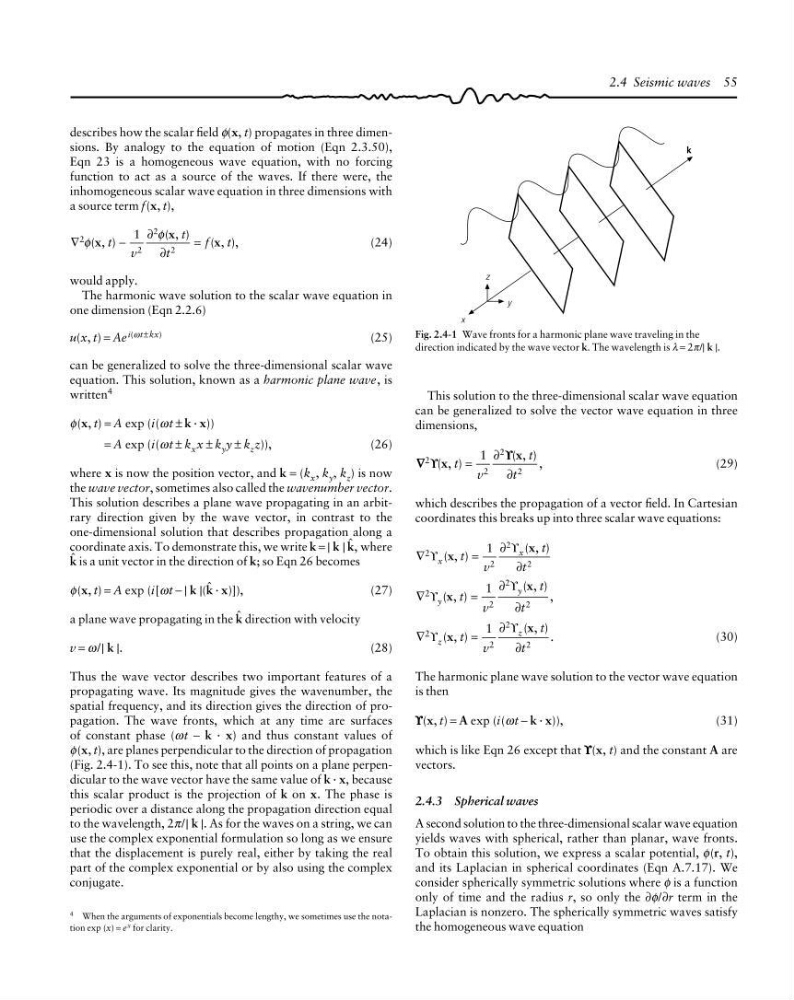
Fig. 2.4-1 Wave fronts for a harmonic plane wave traveling in the
direction indicated by the wave vector k. The wavelength is λ = 2π/| k |.
2.4 Seismic waves 55
describes how the scalar field φ(x, t) propagates in three dimensions. By analogy to the equation of motion (Eqn 2.3.50),
Eqn 23 is a homogeneous wave equation, with no forcing
function to act as a source of the waves. If there were, the
inhomogeneous scalar wave equation in three dimensions with
a source term f(x, t),
∇
−
=
2
2
1
φ
φ
( , )
( , )
( , ),
x
x
x
t
v
t
t
f t
∂
∂
2
2
(24)
would apply.
The harmonic wave solution to the scalar wave equation in
one dimension (Eqn 2.2.6)
u(x, t) = Ae i(ωt± kx)
(25)
can be generalized to solve the three-dimensional scalar wave
equation. This solution, known as a harmonic plane wave, is
written 4
φ(x, t) = A exp (i(ωt ± k · x))
= A exp (i(ωt ± k x x ± k y y ± k z z)),
(26)
where x is now the position vector, and k = (k x , k y , k z ) is now
the wave vector, sometimes also called the wavenumber vector.
This solution describes a plane wave propagating in an arbitrary direction given by the wave vector, in contrast to the
one-dimensional solution that describes propagation along a
coordinate axis. To demonstrate this, we write k = | k | 3, where
3 is a unit vector in the direction of k; so Eqn 26 becomes
φ(x, t) = A exp (i[ωt − | k |(3 · x)]),
(27)
a plane wave propagating in the 3 direction with velocity
v = ω /| k |.
(28)
Thus the wave vector describes two important features of a
propagating wave. Its magnitude gives the wavenumber, the
spatial frequency, and its direction gives the direction of propagation. The wave fronts, which at any time are surfaces
of constant phase (ωt − k · x) and thus constant values of
φ(x, t), are planes perpendicular to the direction of propagation
(Fig. 2.4-1). To see this, note that all points on a plane perpendicular to the wave vector have the same value of k · x, because
this scalar product is the projection of k on x. The phase is
periodic over a distance along the propagation direction equal
to the wavelength, 2π/| k |. As for the waves on a string, we can
use the complex exponential formulation so long as we ensure
that the displacement is purely real, either by taking the real
part of the complex exponential or by also using the complex
conjugate.
This solution to the three-dimensional scalar wave equation
can be generalized to solve the vector wave equation in three
dimensions,
∇ ∇ ϒ ϒ
ϒ ϒ
2
2
1
( , )
( , ) ,
x
x
t
v
t
t
=
∂
∂
2
2
(29)
which describes the propagation of a vector field. In Cartesian
coordinates this breaks up into three scalar wave equations:
∇
=
2
2
1
ϒ
∂ ϒ
∂
2
2
x
x
t
v
t
t
( , )
( , )
x
x
∇
=
2
2
1
ϒ
∂ ϒ
∂
2
2
y
y
t
v
t
t
( , )
( , )
,
x
x
∇
=
2
2
1
ϒ
∂ ϒ
∂
2
2
z
z
t
v
t
t
( , )
( , ) .
x
x
(30)
The harmonic plane wave solution to the vector wave equation
is then
ϒ
ϒ ϒ
ϒ ϒ(x, t) = A exp (i(ωt − k · x)),
(31)
which is like Eqn 26 except that ϒ
ϒ ϒ
ϒ ϒ(x, t) and the constant A are
vectors.
2.4.3 Spherical waves
A second solution to the three-dimensional scalar wave equation
yields waves with spherical, rather than planar, wave fronts.
To obtain this solution, we express a scalar potential, φ(r, t),
and its Laplacian in spherical coordinates (Eqn A.7.17). We
consider spherically symmetric solutions where φ is a function
only of time and the radius r, so only the ∂φ/∂r term in the
Laplacian is nonzero. The spherically symmetric waves satisfy
the homogeneous wave equation
y
x
k
4 When the arguments of exponentials become lengthy, we sometimes use the notation exp (x) = e x for clarity.
Fig. 2.4-1 Wave fronts for a harmonic plane wave traveling in the
direction indicated by the wave vector k. The wavelength is λ = 2π/| k |.
2.4 Seismic waves 55
describes how the scalar field φ(x, t) propagates in three dimensions. By analogy to the equation of motion (Eqn 2.3.50),
Eqn 23 is a homogeneous wave equation, with no forcing
function to act as a source of the waves. If there were, the
inhomogeneous scalar wave equation in three dimensions with
a source term f(x, t),
∇
−
=
2
2
1
φ
φ
( , )
( , )
( , ),
x
x
x
t
v
t
t
f t
∂
∂
2
2
(24)
would apply.
The harmonic wave solution to the scalar wave equation in
one dimension (Eqn 2.2.6)
u(x, t) = Ae i(ωt± kx)
(25)
can be generalized to solve the three-dimensional scalar wave
equation. This solution, known as a harmonic plane wave, is
written 4
φ(x, t) = A exp (i(ωt ± k · x))
= A exp (i(ωt ± k x x ± k y y ± k z z)),
(26)
where x is now the position vector, and k = (k x , k y , k z ) is now
the wave vector, sometimes also called the wavenumber vector.
This solution describes a plane wave propagating in an arbitrary direction given by the wave vector, in contrast to the
one-dimensional solution that describes propagation along a
coordinate axis. To demonstrate this, we write k = | k | 3, where
3 is a unit vector in the direction of k; so Eqn 26 becomes
φ(x, t) = A exp (i[ωt − | k |(3 · x)]),
(27)
a plane wave propagating in the 3 direction with velocity
v = ω /| k |.
(28)
Thus the wave vector describes two important features of a
propagating wave. Its magnitude gives the wavenumber, the
spatial frequency, and its direction gives the direction of propagation. The wave fronts, which at any time are surfaces
of constant phase (ωt − k · x) and thus constant values of
φ(x, t), are planes perpendicular to the direction of propagation
(Fig. 2.4-1). To see this, note that all points on a plane perpendicular to the wave vector have the same value of k · x, because
this scalar product is the projection of k on x. The phase is
periodic over a distance along the propagation direction equal
to the wavelength, 2π/| k |. As for the waves on a string, we can
use the complex exponential formulation so long as we ensure
that the displacement is purely real, either by taking the real
part of the complex exponential or by also using the complex
conjugate.
This solution to the three-dimensional scalar wave equation
can be generalized to solve the vector wave equation in three
dimensions,
∇ ∇ ϒ ϒ
ϒ ϒ
2
2
1
( , )
( , ) ,
x
x
t
v
t
t
=
∂
∂
2
2
(29)
which describes the propagation of a vector field. In Cartesian
coordinates this breaks up into three scalar wave equations:
∇
=
2
2
1
ϒ
∂ ϒ
∂
2
2
x
x
t
v
t
t
( , )
( , )
x
x
∇
=
2
2
1
ϒ
∂ ϒ
∂
2
2
y
y
t
v
t
t
( , )
( , )
,
x
x
∇
=
2
2
1
ϒ
∂ ϒ
∂
2
2
z
z
t
v
t
t
( , )
( , ) .
x
x
(30)
The harmonic plane wave solution to the vector wave equation
is then
ϒ
ϒ ϒ
ϒ ϒ(x, t) = A exp (i(ωt − k · x)),
(31)
which is like Eqn 26 except that ϒ
ϒ ϒ
ϒ ϒ(x, t) and the constant A are
vectors.
2.4.3 Spherical waves
A second solution to the three-dimensional scalar wave equation
yields waves with spherical, rather than planar, wave fronts.
To obtain this solution, we express a scalar potential, φ(r, t),
and its Laplacian in spherical coordinates (Eqn A.7.17). We
consider spherically symmetric solutions where φ is a function
only of time and the radius r, so only the ∂φ/∂r term in the
Laplacian is nonzero. The spherically symmetric waves satisfy
the homogeneous wave equation